
Why executive development needs a new map, and why the leader who has run out of techniques has not run out of road.

01 – Executive Summary
For more than half a century, executive development has followed the same basic path: identify the competencies associated with successful leadership, assess executives against them, and invest in closing whatever gaps the assessment reveals. The approach has produced real value. Communication improves, strategic thinking sharpens, decision making becomes more disciplined, and organizations benefit from all of it.
Yet one question continues to puzzle executives, boards, and leadership practitioners alike. Why do some leaders keep growing throughout their careers while others plateau, despite decades of experience, advanced education, executive coaching, and every development program their organizations could buy?
The answer rarely lies in intelligence, and it rarely lies in ambition, opportunity, or technical expertise either, since most senior executives possess all of these in abundance.
The difference is developmental.
Traditional leadership development expands what leaders know and what they can do. The assumption underneath it, usually unstated, is that greater effectiveness comes from adding competencies, refining skills, and acquiring better techniques. Those investments remain important, and nothing in this paper argues against them. But they leave a more fundamental question largely unexplored. What if leadership development is less about improving competencies than about developing the person who expresses them?
Experience adds knowledge. Development changes the knower.
One expands capability. The other reorganizes perception, which is a slower and far less visible kind of change, and the one this paper is about.
This paper introduces a developmental map called the Leadership Arc. Its proposition is that leadership matures through seven recognizable levels, that somewhere along the way a threshold separates leadership organized around doing from leadership grounded in being, and that the most consequential fact about any executive is rarely the competency they lack. It is the developmental level from which they lead.
The organizations that get the most from their executives over the coming decade will not necessarily be the ones that teach the most techniques. They will be the ones that understand how leaders actually mature.
This paper is the first in a series introducing the Leadership Arc.
02 – The Executive Development Paradox
I have spent twenty-five years assessing and coaching executives across industries, cultures, and continents, and one observation has followed me the entire way: two leaders can hold nearly identical credentials and produce profoundly different organizations.
Picture two executives, both intelligent, both holding advanced degrees, both carrying decades of experience and impressive track records. Each has graduated from serious leadership programs, worked with capable coaches, and can hold his own in any conversation about strategy. On paper there is nothing to choose between them.
In practice, one inspired initiative while the other produced compliance. One left behind a bench of leaders; the other left behind followers, and an organization that could not function without his continued intervention.
The difference was obvious to everyone who worked for them. The explanation was harder to find.
Traditional theory offers useful lenses here. Personality accounts for some of the variation, emotional intelligence for another portion, competencies for more still, and culture, incentives, and market conditions all play their part. Yet a further variable operates beneath all of them, and because it is nearly invisible, it is almost never deliberately developed.
The Competency Trap
Modern leadership development has been a genuine success story. We can now describe strategic thinking, collaboration, coaching, innovation, resilience, and execution with more precision than at any point in the field’s history. But competency models quietly encourage an assumption that rarely gets questioned: if leadership improves by adding competencies, then more competencies should produce better leaders.
Sometimes that holds. Often it does not.
Consider two executives who both score highly on strategic thinking. One uses strategy to simplify complexity and give the organization confidence about where it is going. The other uses it to demonstrate that he is the smartest person in the room. The competency is identical; the experience of being led by it could not be more different.
Competencies describe behavior. They say very little about the consciousness behind it, which is why they carry a leader a long way and then quietly stop helping. Early in a career, each new competency tends to produce dramatic gains. Twenty years in, the returns diminish, and the reason is rarely that competencies stopped mattering. Something deeper has taken over the question of how they get expressed.
The challenge is no longer learning a better technique. It is becoming a different kind of leader.
Developmental Blindness
Organizations measure almost everything: financial performance, engagement, innovation, quality, execution, competencies, personality, derailers, potential, learning agility. Surprisingly few ever ask a more fundamental question, which is what level of development their leaders are actually leading from.
Most executives can tell you their personality profile, and many know their derailers or their emotional intelligence scores. Almost none know their developmental coordinates. Without that orientation, development turns additive: another course, another certification, another coaching model, another competency. Each has value, but none of it is necessarily transformative, because none of it is aimed at the person underneath.
Genuine development rarely feels like accumulation; it feels like reorganization. The leader does not simply know more. He sees differently, so that problems he once treated as technical reveal themselves as relational, challenges he once met with control become occasions for stewardship, and conflict starts arriving as information rather than threat. Leadership itself begins to change, and no new competency deserves the credit. Perception expanded, and everything downstream of it moved.
Experience Is Not Development
One of the most persistent myths in executive life is that experience naturally produces maturity. It often does, but not reliably, because experience accumulates automatically and development does not.
Two executives can spend twenty years in similar roles and emerge entirely different: one with twenty years of increasingly integrated leadership, the other with one year of experience repeated twenty times. The difference is not what happened to them. It is what each was able to make of what happened.
This is why some leaders keep expanding long after others plateau. The plateau rarely reflects a lack of intelligence; it reflects the limits of the lens through which reality is being interpreted. Leaders get stuck when the way they make meaning stops growing, and when complexity finally exceeds that meaning-making capacity, the instinctive response is always the same: work harder, communicate more clearly, analyze more deeply, tighten control, move faster. The result is more motion, not more development.
03 – A New Map
For centuries, explorers carried maps that could not calm a storm, shorten a voyage, or guarantee an arrival. They carried them anyway, because a map answers the one question nothing else can. Where am I?
Organizations spend considerable effort locating the business: where the market is moving, where competitors are headed, how customers are changing. They spend almost none locating their leaders developmentally. Without that orientation, advice turns generic. Communicate more clearly. Delegate more. Become more strategic. Improve executive presence. Any of it may be valuable, but none of it starts by asking whether this particular leader is ready for that particular crossing.
Maps become useful only after you know where you are.
The Leadership Arc
The Leadership Arc is neither a personality model nor another competency framework. It is a developmental map, and its purpose is to explain how leaders mature rather than how they differ from one another. It proposes that leadership develops through increasingly integrated ways of perceiving reality, and that as leaders grow they gradually reorganize how they understand themselves, relate to others, exercise authority, and respond to uncertainty.
The journey unfolds through seven levels. Each expands rather than replaces the one before it, and each crossing carries a price. In my experience, development stalls not because leaders cannot see the next level but because they are unwilling, sometimes for years, to pay for it.
Motion
Leadership begins with action. Energy goes into execution, achievement, and proving competence, and success comes from initiative and the sheer ability to produce results.
Direction
As experience grows, leadership becomes intentional. Goals sharpen, ownership deepens, and leaders begin shaping outcomes instead of responding to circumstance.
Vision
Eventually leaders discover that execution alone is insufficient. They begin questioning assumptions, imagining possibilities, and building futures that do not yet exist. Innovation becomes essential.
Resonance
A quieter shift begins here. Leadership becomes less about performance and more about alignment, and decisions start reflecting purpose rather than image. Authenticity gradually replaces achievement as the organizing principle.
Presence
Influence starts coming less from what the leader knows than from the quality of attention, steadiness, and judgment he brings into difficult rooms. Leadership becomes a way of being.
Generativity
Attention moves beyond personal success toward developing others, building institutions, and creating conditions that will outlast the individual. Stewardship replaces ambition.
Wisdom
The earlier capacities settle into a coherent whole. Action, thought, relationship, and presence operate together, and leadership stops being a role the person performs. It becomes an expression of who they are.
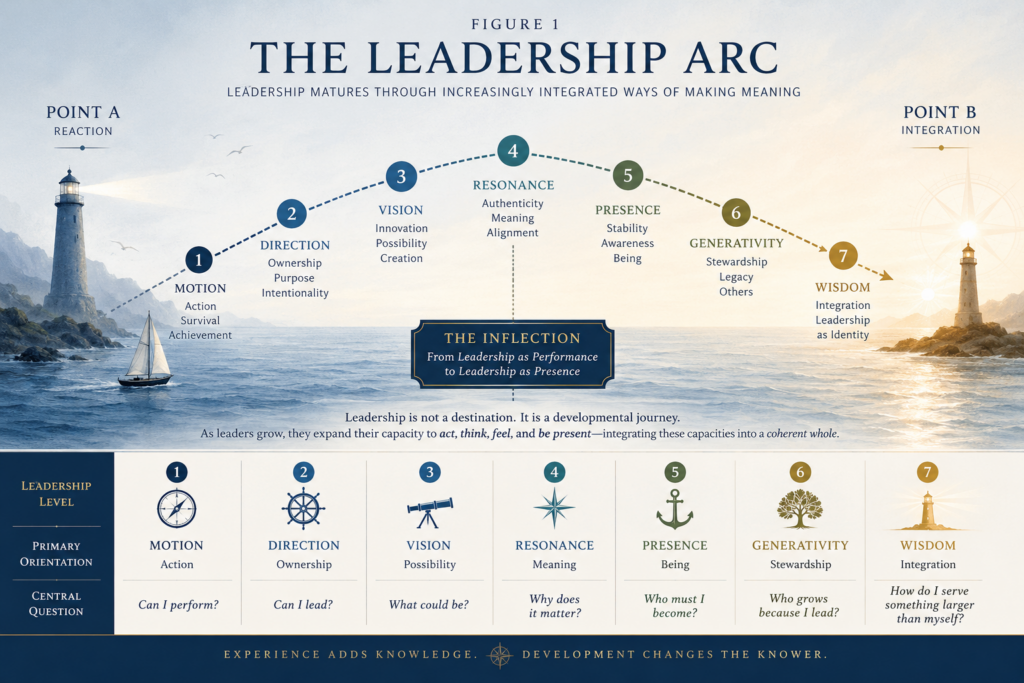
FIGURE 1 Leadership development progresses through increasingly integrated ways of engaging reality. Each level expands rather than replaces the one before it.
04 – The Four Human Capacities
One observation emerged repeatedly across the assessments: every leader arrives with the same four fundamental human capacities, the capacity to act, to think, to feel, and to be present. The question is never whether these capacities exist but how fully they have been developed and integrated. The Leadership Arc names them Initiative, Innovation, Intrinsic, and Immersive, the capacities to will, to think, to feel, and to be, and treats them as capacities because each represents a distinct current through which leadership matures.
Initiative is the energy that turns intention into movement. Innovation lets executives step past inherited assumptions and imagine possibilities that did not previously exist. Intrinsic gives leadership its center of gravity, aligning decisions with deeply held purpose rather than external approval. And Immersive is what allows an executive to stay grounded in uncertainty, holding action, thought, and relationship together in one coherent way of being.
These capacities are not sequential, and they are not independent; they interact continually. Mature leadership comes from gradually integrating all four, and the leaders who struggle most are usually the ones who long ago maximized one and quietly abandoned another.
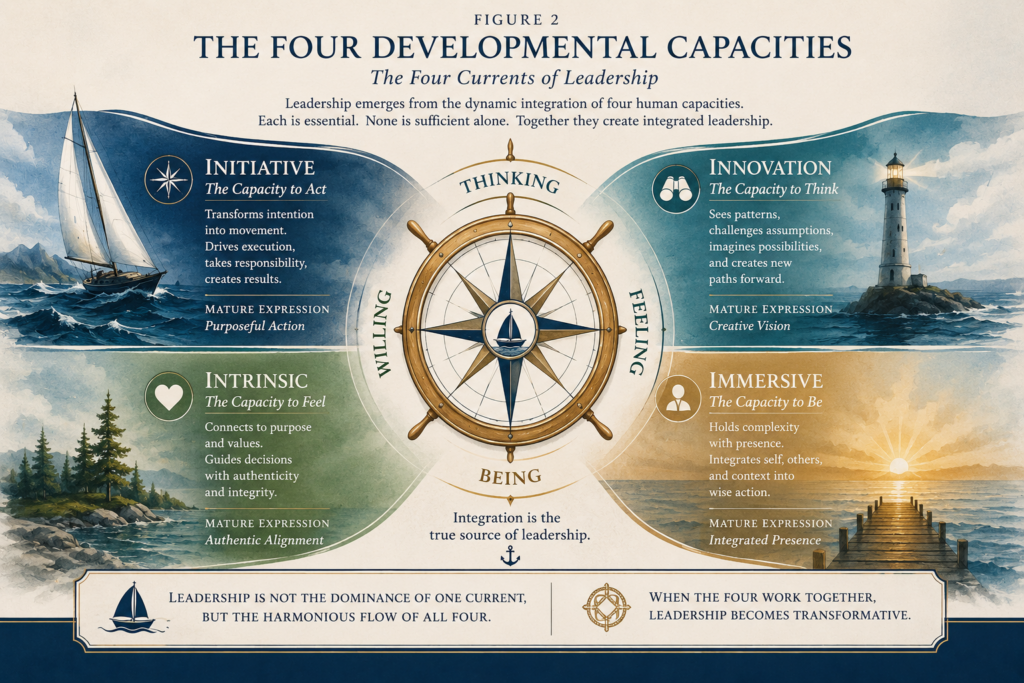
FIGURE 2 Leadership develops through the progressive integration of willing, thinking, feeling, and presence. The strongest leaders are not those who excel in one capacity alone, but those who learn to balance all four.
ON SCREEN Apollo 13
Gene Kranz never raises his rank. His authority in the crisis flows entirely from competence and composure, and the room organizes itself around him. Initiative, innovation, and presence operate at once, and no one in that room is confused about who is leading.
Executive reflection. Which of the four capacities has carried me this far, and which one have I been quietly avoiding?
05 – The Inflection Fence
Every developmental journey contains a threshold, and for executives it usually appears after years of success, when the strategies that once produced extraordinary results begin producing diminishing ones. Achievement stops satisfying the way it used to. Control stops generating confidence, and expertise alone no longer inspires the trust it once commanded. I have come to call this threshold the Inflection Fence, because it behaves less like a wall than like a boundary a leader could step over at almost any time and mostly chooses not to. The territory inside it is known, rewarded, and safe. Everything the leader has built sits on that side of the line.
Most executives respond by working harder. The Leadership Arc suggests that the situation is asking for something else entirely: integration rather than effort.
There comes a point where leadership shifts from accomplishing through performance to influencing through presence.
This crossing is not another competency to acquire. It is a different way of leading altogether, and it is the one crossing most executive development programs are least equipped to support. We devote nearly all of our attention to making leaders more effective below the threshold and very little to preparing them to cross it.
THE PRICE OF THE CROSSING Crossing the Inflection Fence means accepting that the very behaviors that built your reputation are now the ones limiting it. There is a period, sometimes a long one, in which the old strategies have lost their power and the new ones have not yet been earned. Most executives turn back there, and call it pragmatism.
ON SCREEN The Godfather
Michael Corleone crosses no threshold at all. He becomes extraordinarily effective within a single level, and every capacity he develops is placed in service of control. The film is a study in what happens when consciousness does not expand alongside power: the organization grows, the leader shrinks, and everyone around him becomes an instrument.
Executive reflection. Am I working harder at a level I have outgrown, or genuinely preparing for the crossing that comes next?
06 – Implications for the Organization
If leadership is developmental rather than merely competency-based, the implications reach well past executive education, into how leaders are selected, how potential is identified, how coaching is conducted, how succession is decided, and ultimately into how the organization defines leadership itself.
The question stops being whether an executive possesses the competencies a role requires and becomes whether the person possesses the developmental capacity the role’s complexity demands. Competence remains essential. What development determines is how that competence will be expressed.
Assessment becomes a map, not a report card
Most executive assessments describe the leader: personality, behavioral tendencies, style, strengths, derailers. All of that is valuable, and it predicts how a leader is likely to behave, but it says far less about how that leader currently makes meaning. A developmental assessment asks a different set of questions. Where does this executive stand on the journey? Which assumptions organize their leadership? Which capacities remain underdeveloped, and above all, what is the next crossing actually going to require of them?
Coaching begins one question earlier
Traditional coaching begins with goals: improve delegation, increase executive presence, manage conflict more effectively. Worthwhile objectives, all of them. Developmental coaching simply asks one question before any goal is set: who is this person becoming while pursuing them? Two executives can work on identical behaviors and end up in very different places, one more skillful, the other fundamentally changed, and from the outside the behavior looks nearly the same.
Succession selects for capacity, not only performance
Organizations usually identify successors by asking who performs best today, and performance does matter. But the executive who runs a business unit brilliantly may not yet possess the developmental capacity an enterprise demands, while a less polished peer may be showing far more room to grow. Current performance is a fact about the present. Developmental capacity is the best available evidence about the future.
Culture reflects the level it is led from
Leaders shape cultures, and cultures shape leaders, so every organization gradually comes to reflect the developmental maturity of the people it has entrusted with authority. Where leaders prize control, organizations grow cautious. Where they prize expertise, organizations grow dependent on specialists. And where leaders begin operating from purpose, authenticity, and stewardship, trust deepens, innovation expands, and people become willing to take on responsibility no one asked them to carry.
Perhaps the most enduring contribution any leader makes is not the strategy they implement, but the level of consciousness they normalize within the organization.
07 – The Leader the Future Requires
Throughout the twentieth century, leadership development concentrated on expanding managerial competence, and for that century it was the right focus. This one presents a different challenge. Complexity no longer increases incrementally; it accelerates. Artificial intelligence will commoditize much of what we currently call expertise, markets will keep rewarding speed, and complexity will punish the leader whose only move has ever been to push harder.
In that environment, technique depreciates. What appreciates is judgment that holds under uncertainty, character that does not negotiate with convenience, and presence that steadies a room when no one knows the answer. None of that is soft, and none of it can be installed. It can only be developed, slowly, in the person.
For decades, executive development has been organized around a genuinely powerful question: what should this leader learn next? It has served organizations well, and it is not going anywhere. But a second question now deserves equal attention.
Who must this leader become next?
That question moves the work from technique toward transformation, from behavior toward being. This paper has introduced the Leadership Arc as one map for that journey. Leaders do not all follow the same path, but every meaningful journey begins with orientation.
Maps do not eliminate uncertainty; they help us navigate it. And organizations rarely grow beyond the developmental maturity of the people who lead them.
The future of leadership, therefore, may not depend upon teaching executives more. It may depend upon helping them become more.
Five Questions
Development accelerates when leaders stop asking what skill to learn next and begin asking who they must become next. Before turning the page, sit with the following for a few minutes.
— What assumptions about leadership have brought me this far?
— Which of those assumptions may now be limiting my growth?
— When faced with increasing complexity, do I respond by doing more, or by seeing differently?
— Which level described in this paper irritates me the most when I see it in others?
— Who must I become next in order to lead the future rather than manage the present?
The answers may reveal more about your developmental journey than any competency model ever will.
CONTINUE THE CONVERSATION
Where are you on the Arc?
Every executive occupies a particular position along the Leadership Arc. Some lead primarily through achievement and action, others through expertise and judgment, others through relationship and trust. A smaller number have begun integrating willing, thinking, feeling, and presence into a way of leading that inspires confidence almost on contact.
The challenge is that very few leaders accurately recognize their own developmental center of gravity.
My work focuses on helping executives answer that question. The Leadership Arc Assessment identifies a leader’s developmental coordinates, surfaces the assumptions that may be limiting further growth, and lays out a practical roadmap for the next crossing.
The objective is not simply to become more competent. It is to become more complete.
Because every meaningful journey begins by knowing where you are.
The next paper in this series takes up what it costs to travel this Arc without a map. Experience teaches every leader the same lessons regardless, and the only real variables are when the understanding arrives and who ends up paying for the delay. That paper examines why the invoice so often goes to the team rather than to the leader, and what changes when understanding arrives before the collision rather than after it.
NOTE: Source bibliography and/or client references available upon request. The integrated ideas, arguments, frameworks, and conceptual architecture presented in this paper are the original work of the author. Artificial intelligence was used as a collaborative writing and editorial tool to assist in drafting and refining the prose. All substantive judgments, interpretations, and conclusions are the author’s, who retains full responsibility for the final content.
© 2026 CaMiNa Consulting. All rights reserved.