
The nine patterns that keep capable executives circling, and why intelligence is no protection against any of them.

01 – Executive Summary
The question is not whether we have Loops. The question is whether our Loops have us.
Several years ago I was coaching the chief executive of a highly successful company. Revenue had doubled during that tenure, the board admired the discipline, and the team used the word brilliant. This was a leader who had assembled an exceptional leadership team and was attending nearly every important meeting anyway. The organization had grown steadily more dependent on the one person trying hardest to make it independent.
One question came up in a session that I have never forgotten. Not how do I delegate, which was already understood. Not how should I structure my team, which had been done repeatedly. Not what should I read, since everything had been read.
Why do I keep returning to the very behavior I know is limiting both me and my organization?
Over the next twenty years I heard versions of that question from hundreds of accomplished executives: a chief financial officer who could never stop checking everyone else’s work, a founder who launched new initiatives before finishing existing ones, a hospital executive who solved everyone’s problems except her own. What interested me was not that they struggled. It was that they struggled in the same way, consistently enough to be almost predictable.
The first two papers in this series argued that executive development has reached the limits of the competency model, and that experience will teach every leader the same lessons regardless, so the only real variables are what the tuition costs and who pays it. The third argued that none of it can be used until a leader knows where they are standing.
That paper also named the mechanism that keeps them from knowing: Adaptive Loops, self-reinforcing patterns in which each behavior creates the conditions that justify its own continuation. The fourth took the resulting ceiling apart and found it built from a leader’s own successes, and the fifth mapped it capacity by capacity.
This paper goes underneath all of it and asks what has been handing the leader the hammer. Competency models explain what leaders know. They do not explain what leaders actually do when uncertainty arrives, and that gap may be the single greatest blind spot in leadership development, because knowing and becoming are not the same thing.
We practice emotional responses as repeatedly as musicians practice scales, until repetition builds a pathway that runs faster than conscious thought. What began as adaptation becomes identity, and by the time we reach the executive suite we mistake our most practiced survival strategy for our leadership style.
The greatest obstacle to executive maturity is often yesterday’s greatest strength, and this is why exceptionally intelligent leaders get stuck. They have not stopped learning; they are solving new challenges with old adaptations. Every promotion hands them larger problems, and almost none requires them to examine the system solving those problems. Leaders grow increasingly sophisticated while remaining organized by remarkably familiar emotional patterns.
So this paper replaces the usual question. Instead of asking what competency should I develop next, it asks what invisible pattern quietly organizes my leadership whenever uncertainty appears. That question led me to nine consistent patterns appearing again and again across thousands of executive conversations. I came to call them the Nine Loops. They are neither personality types nor diagnoses, but survival strategies that became so successful they eventually began leading the leader.
Readers of the third paper will recognize the machinery: what that paper called Adaptive Loops, organized around Security, Worth, and Belonging, described here in its nine recognizable forms. Recognizing them may be the most important step an executive ever takes, not because it changes what they know, but because it changes who is making the next decision.
This paper is the sixth in a series introducing the Leadership Arc.
02 – The Illusion of Progress
Review the résumé of a successful executive and you will find a story of continuous advancement: larger roles, greater responsibility, more complex challenges. From the outside the trajectory looks unmistakably upward, and often it is. But a résumé records what happened around a leader and almost nothing about what happened within one. Movement is visible. Transformation is not.
Imagine standing on the shore watching a sailboat head for the horizon, sails full, wake stretching confidently behind it. Now imagine the same boat from directly above: instead of crossing the bay it is sailing in a nearly perfect circle. The movement is real and so is the effort. Only the destination never changes. Leadership careers often unfold this way, the scenery changing while the emotional center holds still.
This is the difference between motion and transformation. Motion accumulates experience and improves capability. Transformation changes the person having the experience. Motion asks how can I become better. Transformation asks who keeps showing up whenever leadership becomes difficult, and that second question is the one that opens the door to the Nine Loops.
ON SCREEN Groundhog Day
Phil Connors wakes to the same morning for what the film implies is years, and for most of them he is not stuck for lack of intelligence or effort. Every strategy he tries is a variation on the one he arrived with. Charm, manipulation, mastery, even despair are attempts to win the day rather than to become someone for whom the day is different. The loop breaks only when he stops working the situation and starts noticing himself inside it.
Executive reflection. If my leadership were viewed from directly above, would it be crossing the bay or circling it?
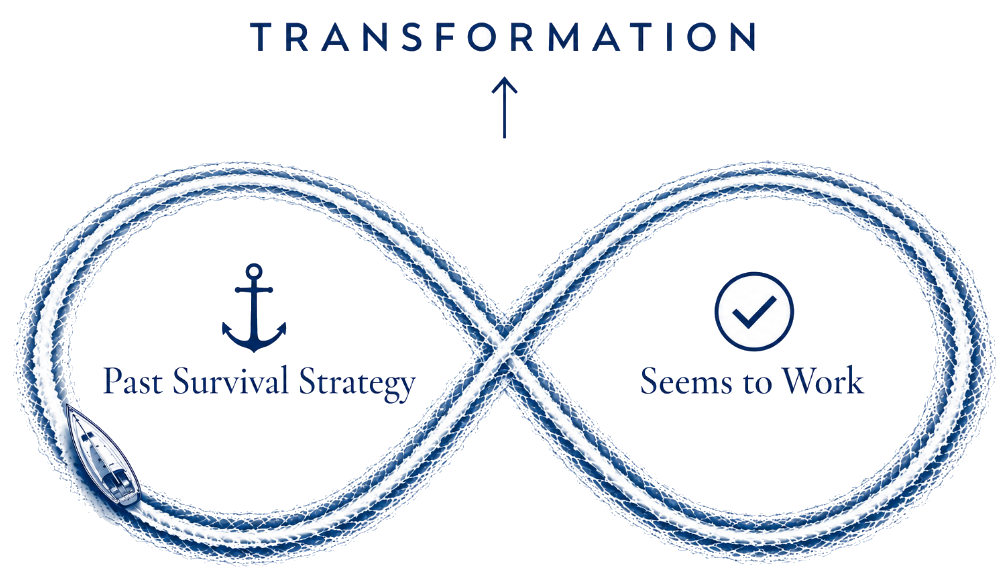
FIGURE 1 The Loop. Leaders often mistake movement for transformation. From within the experience they appear to be making progress. From a wider perspective they may be repeatedly organizing their leadership around the same underlying survival strategy. The challenge is not to move faster. It is to step outside the recurring loop.
03 – The Invisible Operating System
When I ask executives to describe their leadership style, I hear words like strategic, collaborative, analytical, decisive, innovative. None of those answers are wrong. They simply answer the wrong question. Leadership is revealed less by how we behave when everything is going well than by who we become when uncertainty arrives. Pressure exposes the operating system beneath the personality.
Think back to the chief executive from the opening. On good days that leader was thoughtful, empowering, and committed to developing the team. On difficult days someone else arrived without anyone noticing: asking more questions, though not out of curiosity; attending more meetings, though not needed; reviewing more decisions, though none required that expertise. It was an attempt to reduce uncertainty through control. Nothing about the intentions had changed, and everything about the operating system had.
Leadership runs on two systems. The first is the one we consciously develop, made of knowledge, judgment, and intentional decision-making, and it is the part executive education has always addressed.
The second operates beneath awareness. It is older, faster, and its purpose is not to make us better leaders but to keep us psychologically safe. When the two disagree, the invisible one almost always wins, not because it is wiser but because it has already acted before conscious thought arrives.
The reason is efficiency. Every repeated behavior becomes easier as pathways strengthen, and the same process occurs emotionally, until the brain stops asking what is the best response and begins asking what has worked before. The first question seeks effectiveness. The second seeks survival, and when uncertainty rises, survival speaks first.
Brilliant Adaptations
This is why I resist describing the Nine Loops as weaknesses. Every Loop began as an intelligent solution to a real problem. A child discovers that careful preparation prevents criticism, and years later becomes the executive everyone depends on. Another discovers that being indispensable creates connection, and years later becomes the one everyone trusts.
In every case the strategy worked, which is exactly why it survived. The nervous system does not preserve ineffective strategies. It preserves successful ones.
The difficulty was never that these adaptations exist. It is that success hides what they cost. The executive promoted for being indispensable eventually cannot delegate. The one celebrated for perfection slows every decision. The organization keeps applauding the visible strength while paying the invisible price.
THE PRICE OF THE CROSSING Success is the best camouflage a Loop ever gets. A pattern that produced failure would have been examined years ago. This one produced promotions, and the promotions are the reason no one looked.
Three Questions Every Leader Carries
Beneath the diversity of leadership styles lie three human questions, the same three the third paper in this series identified as the organizing concerns beneath every Adaptive Loop.
The first is Security: am I safe? Uncertainty feels dangerous and the leader seeks structure and control. The second is Worth: am I enough? Achievement becomes a way of answering a question no title permanently resolves. The third is Belonging: will I remain connected? Relationships become the primary source of emotional security.
Every leader carries all three. What differs is which one organizes behavior when pressure arrives. A controlling executive may not be seeking power so much as security. A conflict-avoidant executive may not lack courage at all, but be protecting belonging. The behavior is visible. The question underneath it usually is not.
These three concerns are energized by three fundamental emotional states: fear, sadness, and anger. These are better understood as sources of information than as obstacles, since fear alerts us to uncertainty, sadness reminds us what we value, and anger protects what feels important.
None of them is the problem. The trouble begins when they fuse with an automatic strategy, so that fear hardens into chronic control, sadness into endless striving, and anger into rigid protection. The emotion stays healthy. The unconscious repetition does not.
Two leaders receive identical feedback. One hears an opportunity to improve and the other hears evidence of failure. The event is the same and the interpretation is not, because the operating system determines meaning before conscious reasoning has fully begun. Once leaders understand that they are managing not only people but the code through which they interpret them, the questions change. Instead of how do I delegate better, they ask why letting go feels unsafe.
The chief executive from the opening eventually reached that shift. One afternoon, after describing another week spent rescuing projects that belonged to the team, there was a pause, and then a smile.
I finally see it. I am not managing the business anymore. I am managing my own anxiety.
That moment changed that leadership more than any competency model could have, because for the first time the object of attention was not the organization. It was the operating system through which the organization had been led.
04 – The Nine Loops
When I first began assessing executives, I assumed every leader’s story would be unique. Yet after enough conversations the stories were different and the patterns were not. The chief executive who micromanaged, the founder who could never finish, the executive who exhausted herself saving everyone, the perfectionist who waited for one more piece of information: different people, and the same emotional choreography.
From Personality to Pattern
For more than a century, psychology has tried to understand people by describing personality, and each framework contributes something valuable. Readers who know the Enneagram will recognize this architecture, and the resemblance is not accidental. But a type and a Loop are different objects. A type describes who a person is, is carried for a lifetime, and holds whether the day is calm or catastrophic. A Loop describes what a leader reaches for when uncertainty arrives, which is a narrower question and, for this work, a more useful one. The same executive may run one Loop in the boardroom and a different one at home. Nine types are a map of persons. Nine Loops are a map of pressure.
Nearly every Loop can be understood by answering two deceptively simple questions. The first: what feels threatened? For some leaders uncertainty threatens Security, for others Worth, for others Belonging.
The second: how does the leader respond to that threat? Again only three broad movements appear. Some contract, tightening control, working harder, and reducing ambiguity. Others expand, generating possibilities and reaching for significance. Still others oscillate, moving between competing strategies: helping and resenting, connecting and withdrawing, driving and avoiding.
Three concerns crossed with three directions yield nine recurring strategies. The framework was not designed in advance. The nine Loops emerged from observation, and only afterward did I see how much older the ground underneath them was. What makes it useful is that it explains leaders rather than labeling them. Instead of asking why this executive is so controlling, we ask what uncertainty is being managed. Here are three samples.
The Controller
The Controller believes, usually without realizing it, that if things stay under control everything will be all right. Controllers often become outstanding operational leaders, bringing discipline to complexity, and organizations depend on them until complexity exceeds what one person can manage.
Then the Controller starts reviewing work others could do, approvals accumulate, and the organization quietly learns that nothing happens until one person has spoken. The strategy that once created reliability now creates dependence. The leader is no longer building capacity but has become it.
The Achiever
The Achiever asks a different question: how do I know I matter? Achievement becomes the answer, goals become evidence, and recognition becomes reassurance. Organizations reward these leaders because they produce results others cannot. Yet every achievement brings only temporary relief before another summit appears, and the success eventually feels empty. No external accomplishment can permanently answer an internal question, and climbing faster is not the same as arriving.
The Pleaser
The Pleaser organizes around harmony, so relationships become the measure of security and conflict begins to feel dangerous. These leaders build extraordinary cultures, and people trust them and feel heard by them. Yet the same strength carries an invisible cost. Hard conversations get postponed, so peace is preserved at the cost of authenticity. Everyone feels comfortable, and very few people know where the leader actually stands.
The most dangerous characteristic of every Loop is that it provides immediate relief. Control reduces anxiety, achievement restores confidence, approval creates connection, and the nervous system experiences that relief as genuine. So it repeats the behavior, the repetition strengthens the pathway, and the Loop becomes self-reinforcing.
Recognition Is the Turning Point
The purpose of the Nine Loops is not to categorize leaders. It is to create a moment of recognition. Every executive I have coached eventually stops talking about the people around them and begins talking about themselves. I always thought I was just decisive. I never realized how much I needed to be needed.
Those moments are unexpectedly quiet, with no fireworks, only a growing clarity that what had been assumed to be identity is in fact a strategy, one that was once brilliant and may no longer be necessary. The moment it becomes visible it is no longer entirely in charge.
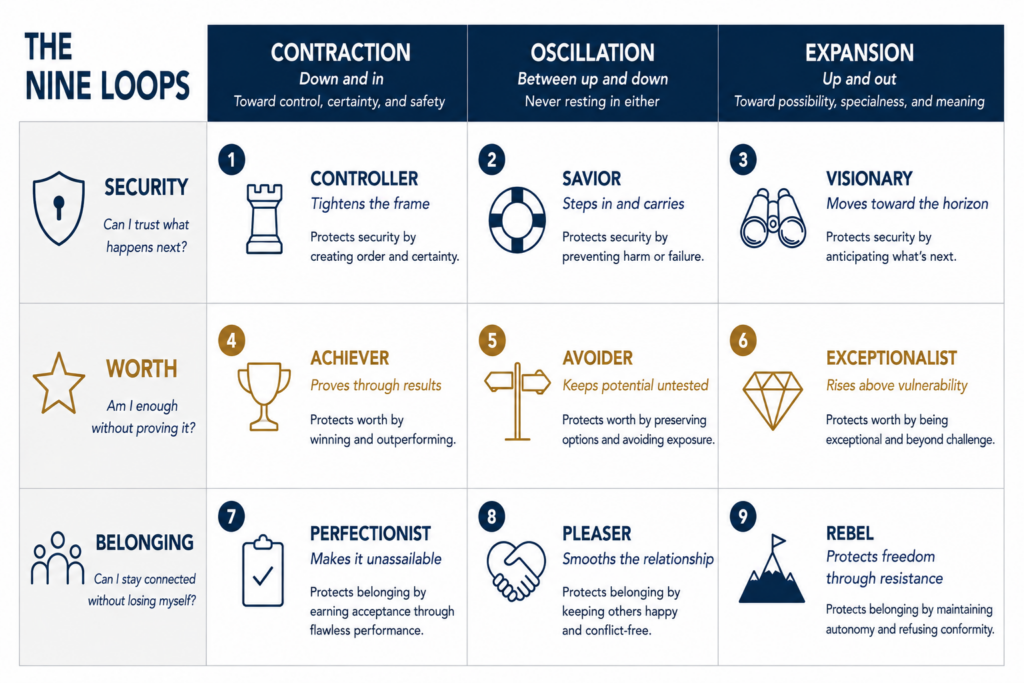
FIGURE 2 The Nine Loops. Three human concerns crossed with three adaptive directions. Security, Worth, and Belonging describe what feels threatened; contraction, oscillation, and expansion describe how the leader moves in response. The nine intersections are the recurring strategies this paper describes.
05 – Beyond the Loop
Several months after the work with the chief executive described at the opening, we met again. I expected to hear about organizational changes. Instead I heard about one meeting. The team had presented a recommendation that drew strong disagreement, and the familiar impulse rose: explain why they were wrong, take over, solve it alone.
Then came the noticing, not after the meeting and not on the drive home, but in the meeting. My Controller Loop is here. For the first time nothing happened. One more question, and then another, and twenty minutes later the team had reached a better decision than the one that had been waiting.
It was not my team that changed. It was the amount of space between my first impulse and my first action.
For most of our lives that space is almost invisible. Years of repetition have compressed perception and action into a single movement, so the Controller controls, the Achiever achieves, and the Pleaser accommodates. Leadership maturity is measured less by how rarely we feel those impulses than by how quickly we recognize them.
From Subject to Object
Developmental psychologist Robert Kegan described one of the central movements of adult development as the shift from Subject to Object. At first we are inside our assumptions and our protective strategies, and they feel like reality because we cannot yet see them. Gradually the pattern that once possessed us becomes something we can observe.
We stop saying I have to control this and begin saying part of me wants to control this. Those sentences look similar and are psychologically worlds apart. The first leaves no room for choice. The second creates it.
Crossing the Inflection Fence
Through the whole Arc runs a single developmental threshold, the Inflection Fence, named in the first paper of this series and taken apart board by board in the fifth. Below the Fence, development is largely horizontal: we accumulate competencies and refine technique, all of it essential.
Eventually every successful executive reaches a point where acquiring another competency produces diminishing returns. The next level comes not from adding something new but from seeing something old, and the question shifts from what should I learn to what has been quietly leading me. Competence brings a leader to the threshold. Awareness carries them past it.
Presence Instead of Protection
When leaders first encounter the Nine Loops, they ask me which Loop they should eliminate. My answer is always the same. None of them. Every Loop began as an intelligent adaptation and every one contains a genuine strength: Controllers bring order, Achievers create momentum, Pleasers cultivate trust. The goal is not to erase these capacities but to reclaim the freedom to choose them.
THE PRICE OF THE CROSSING The Loop is not defeated by becoming its opposite. A Controller who forces a hand open, a Pleaser who resolves to be blunt, an Achiever who makes a discipline of resting, is still taking direction from the pattern. Reacting against a Loop is one more thing the Loop can organize.
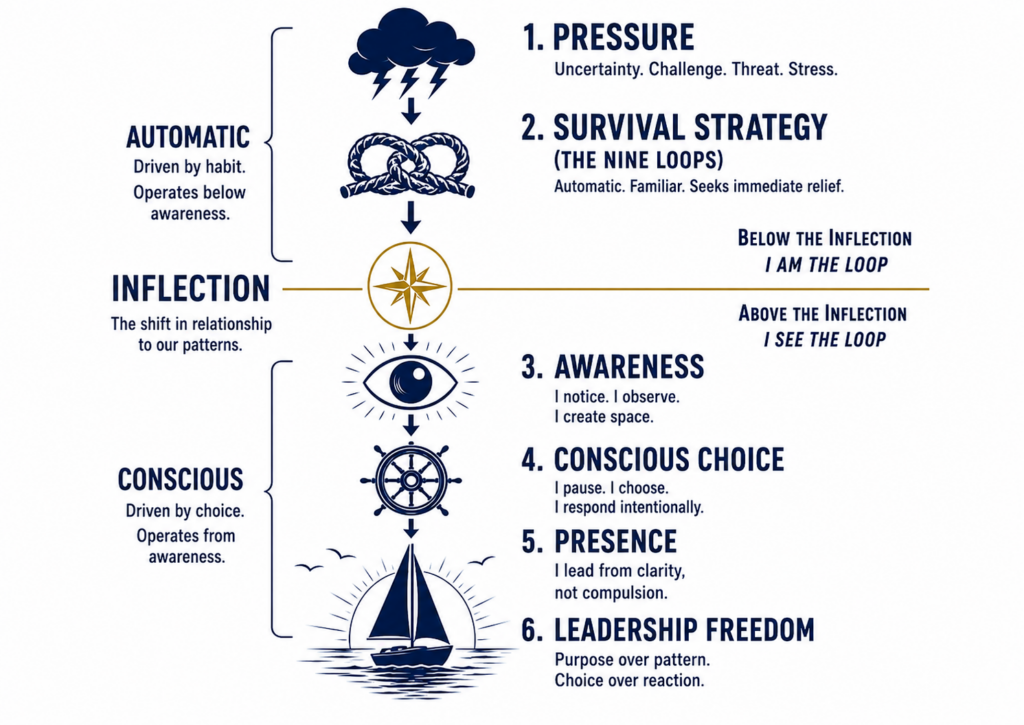
FIGURE 3 Leadership transformation is not the elimination of our protective patterns but a shift in our relationship to them. Before the Inflection Fence, the Loop unconsciously shapes perception and behavior. After it, awareness creates the freedom to choose responses aligned with purpose rather than survival.
Healthy leaders still control, but only when control serves the task. They still achieve, though achievement no longer determines their worth. The Loop has not disappeared. The compulsion has, and that is the difference between protection and presence.
The Organization Always Knows
Organizations inevitably mirror the inner life of their leaders. A Controller creates an organization waiting for permission. An Achiever creates a culture where exhaustion becomes a badge of honor. A Pleaser creates meetings where everyone appears to agree while the difficult issues go untouched. Culture is built by repeated emotional patterns, and when a leader becomes more aware, everyone around them gains a little freedom.
06 – Who Is Making the Next Decision
The question is not whether we have Loops, but whether our Loops have us.
For many years I believed the defining characteristic of exceptional leadership was intelligence. Later I believed it was emotional intelligence. Today I think something more fundamental lies beneath both. Awareness: the capacity to notice our own operating system while it is running, and to catch yesterday’s survival strategy before it becomes today’s decision.
Transformation, then, is not the elimination of our protective patterns but a shift in our relationship to them. Competence still matters, but it is no longer sufficient on its own.
The Nine Loops are not the destination. They are a map, and maps tell us where we are, not who we are. Perhaps that is the deepest purpose of leadership: not simply to guide others, but to become less governed by the patterns that have been guiding us.
Five Questions
Development accelerates when leaders stop asking what to acquire and begin asking what has been deciding. Before turning the page, sit with the following for a few minutes.
— When uncertainty arrives, what do I reach for first?
— Under pressure, which question runs me: am I safe, am I enough, or will I belong?
— What have I been praised for so consistently that I stopped examining it?
— How much space is there between my first impulse and my first action?
— If my pattern were named out loud by my team, would anyone be surprised?
The answers may reveal less about how capable you are than about who has been deciding.
CONTINUE THE CONVERSATION
What decides before you do?
Every executive is somewhere on this journey, and almost every one of them is organized by a pattern they did not choose and cannot see from the inside. Some are discovering the power of disciplined action, others are expanding their capacity to think systemically, and a few have found that leadership reaches its highest expression not in what they accomplish but in the quality of presence they bring.
That is the difficulty. We are poor judges of our own development. We know what we have achieved, and we are far less certain about what has been deciding for us.
The Leadership Arc Assessment identifies a leader’s developmental coordinates, surfaces the Loop organizing that leadership under pressure, and clarifies the next crossing on the journey.
The objective is not simply to become more capable. It is to become the one choosing.
Because every meaningful journey begins by knowing where you are.
The next paper in this series follows the leader who has seen the Loop and decided to become its opposite. It looks like transformation, and it very often is not, because a life organized against an expectation is still organized by it. That paper examines the counterfeit of self-authorship, why it is so convincing from the inside, and what separates a leader who has genuinely found their own center from one who has simply changed which authority they answer to.
NOTE: Bibliography and references available upon request. The ideas, arguments, frameworks, and conceptual architecture presented in this paper are the original work of the author. Artificial intelligence was used as a collaborative writing and editorial tool to assist in drafting and refining the prose. All substantive judgments, interpretations, and conclusions are the author’s, who retains full responsibility for the final content.
© 2026 CaMiNa Consulting. All rights reserved.