
Why every leader learns the same lessons, and why the only real question is when understanding arrives.

01 – Executive Summary
Every executive has been given some version of the same advice: the best way to learn leadership is to lead. It is sound advice and there is no way around it. Judgment matures under pressure, humility arrives through failure, and no classroom reproduces the weight of a decision that will change other people’s lives.
What the advice leaves out is the price. Experience will teach the lesson regardless of whether the leader is ready to receive it, and it does not wait to be invited; the only real variables are what the tuition comes to and who ends up paying it. Neither variable is fixed, and neither is evenly distributed.
That price is the subject of this paper, and it follows directly from the argument of the first. The first paper argued that leadership cannot be read from behavior alone, because behavior emerges from an underlying stage of development, and named the threshold every paper since has returned to. If development is a change of stage rather than an accumulation of skill, then how a leader arrives at the next stage, and what the arrival costs, becomes the immediate question.
Leadership grows along two paths. On the first, the leader learns through pain: experience delivers the lesson and the meaning is worked out afterward, sometimes years afterward and almost always at full price. On the second, the leader learns through understanding, carrying a developmental map that lets the lesson be recognized while it is still unfolding, which is the only point at which recognition can change anything.
Both paths include experience. What separates them is when understanding arrives, and what the delay costs in the meantime.
Pain teaches after the event. Understanding teaches before it and during it.
This is not an argument against experience, and there is no such argument to make, since no framework has ever substituted for responsibility. It is an argument that leaders have a choice about how they primarily develop, and that the choice compounds. A leader who learns only by collision pays full price for every lesson and frequently pays it more than once, because a lesson that was never consciously understood has no way of announcing itself the second time. A leader who learns with a map still pays, but the tuition falls, the cycle shortens, and what would have taken decades of trial and error compresses into an accelerated timeframe of intentional development.
The organizations that develop executives fastest over the coming decade will not be the ones that expose leaders to more experience, since every organization already does that. They will be the ones that stop paying twice for lessons their leaders have already been taught.
This paper is the second in a series introducing the Leadership Arc.
02 – What Experience Charges
Early in my career a senior leader told me that the best way to learn leadership is to lead. He was right, and the advice has held up ever since.
Experience teaches what nothing else can. It teaches the difference between a decision that looks correct on a slide and one carried into a room full of people whose livelihoods depend on it, and that authority reliably produces compliance while rarely producing commitment. It teaches humility, because it eventually humbles everyone. Some knowledge cannot be transferred; it has to be earned.
Experience is also the most expensive teacher available, and its curriculum arrives disguised as disappointment, conflict, attrition, a failed launch, a broken partnership, or a season in which nothing works. We remember those lessons precisely because they cost us something. Experience deposits events; understanding is what converts events into development, and until that conversion happens the account keeps growing without ever compounding.
Experience is the teacher that bills you first and explains the lesson later.
Who Actually Pays the Tuition
The cost is seldom the leader’s alone, and it is almost never recorded anywhere a board would see it. When an executive learns delegation the hard way, the invoice arrives first as a capable manager who quietly stops raising problems, then as the two people she was developing, then as the eighteen months required to rebuild a bench that used to be three deep. When a leader learns the limits of control the hard way, it arrives as a launch that shipped before anyone felt safe enough to say it was not ready. When he learns that expertise does not produce trust, it arrives as an engagement score, and then as a resignation letter from the one person who was genuinely hard to replace.
None of this is ever booked as a development expense. It appears as attrition, as rework, as a quarter that missed, as a culture that has learned not to volunteer bad news. And by the time the leader understands what he was being taught, the people who paid for the lesson have generally moved on. That is what turns unnecessary pain from a personal matter into a governance one.
The repetition is the part that should trouble a board most. A lesson that was never consciously understood does not announce itself when it returns. It simply arrives again wearing different clothes, and the organization pays for it again, usually at a larger scale, because the leader has been promoted in the interval.
03 – What Each Path Costs
Picture two travelers crossing the same unfamiliar range. The mountain is identical for both, and so are the weather, the altitude, the distance, and the effort the climb demands. What differs is what the crossing takes out of them.
The first traveler carries no map, so every decision becomes an experiment and every obstacle has to be met before it can be understood. He arrives, because determined people usually do. But he arrives having spent what he cannot recover: four days of daylight burned on a valley that led nowhere, supplies consumed on a ridge he then had to descend again, and a margin of strength he no longer has when the weather turns near the summit. He is not merely late. He is depleted in ways that shape everything after.
He is also not the only one who paid. Someone provisioned a crossing meant to take three weeks and taking seven. Someone else waited on the far side and made commitments on the assumption he would arrive when he said. The party behind him inherits a route drawn from his errors, worth something, though far less than it cost to produce.
The second traveler carries a map, and it changes none of the terrain. The mountain is the same height, the weather is no more forgiving, and the climb still has to be walked step by step. What the map changes is the bill. She does not spend four days establishing that the eastern approach is impassable in spring, because the map already says so, and the strength she does not spend there remains available to her higher up, where it matters considerably more.
The map does not make the climb shorter. It makes it cost less.
Leadership development follows the same pattern, and the two paths can be described plainly.
Path One: Learning Through Pain
Experience arrives, trial and error follows, and the leader hits a wall, absorbs the impact, and eventually recognizes the pattern the wall was pointing at, sometimes years later. Growth is real, but it is slow, expensive, and prone to repeat, and the interval between the impact and the understanding is where nearly all of the damage is done.
Path Two: Learning Through Understanding
Experience still arrives, since nothing removes it, but the leader carries a developmental map that converts raw event into interpretable information. Reflection becomes deliberate rather than accidental, patterns are recognized earlier and sometimes while they are still forming, and the cost of each lesson falls because the interval between impact and understanding narrows.
BOTH PATHS INCLUDE EXPERIENCE Nothing here suggests a leader can develop without experience, and no executive has ever managed it. The distinction is not experience against understanding but sequence. On the first path, understanding arrives after the event has finished teaching and after the invoice has been issued. On the second, it arrives while the event is still underway, which is the only point at which it can change what the event costs.
DEVELOPMENTAL MOVEMENT After the invoice ▸ After the event ▸ During the event ▸ Before the next one
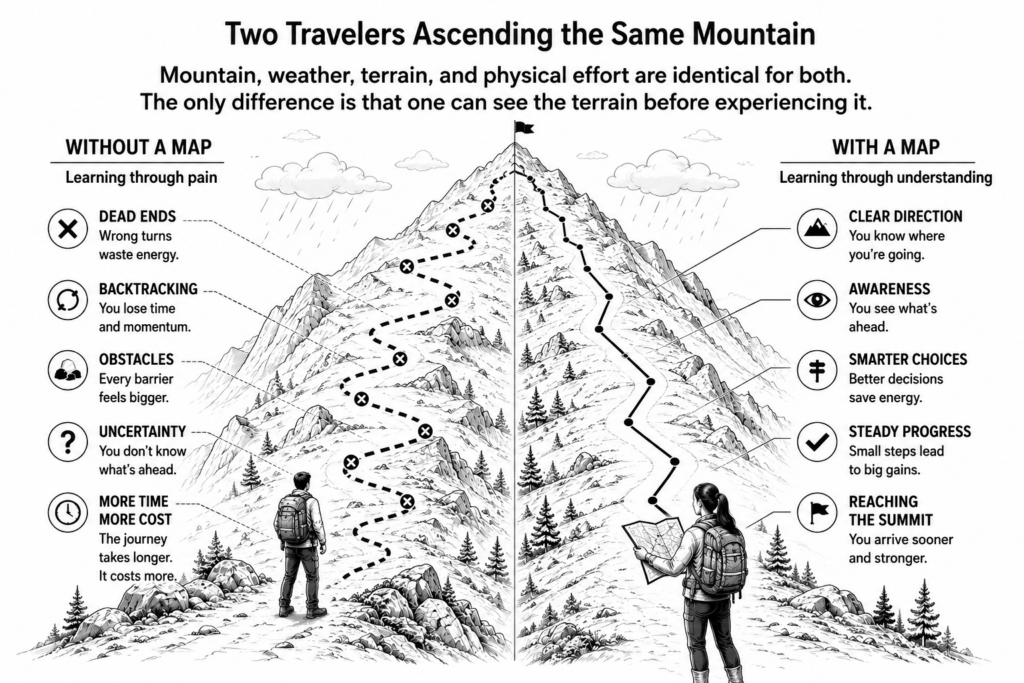
FIGURE 1 A developmental map does not change the terrain. It changes what crossing the terrain takes out of the traveler.
04 – Why the Second Path Is Newly Available
For most of history the first path was the only one on offer. If wisdom was to be gained, life had to administer it; if judgment was to mature, responsibility had to test it; if an assumption was to be revised, reality had to break it. Experience was not merely the best teacher available, it was the only one taking students.
That is no longer true, and the change is recent enough that most executives have not adjusted to it. Researchers in adult development, developmental psychology, leadership studies, and systems thinking have spent entire careers on questions earlier generations could answer only by living them. How do adults continue to develop after formal education ends? What happens when the way a leader constructs meaning stops growing while his responsibilities keep expanding?
No single body of work explains leadership development completely, and these traditions do not always agree on language. Read together, though, they converge on something consequential: development is not random. There are recognizable stages, recurring challenges that appear as responsibility increases, and capacities that emerge in roughly the order complexity demands them. There is, in other words, a landscape. A landscape that can be described can be mapped.
From Research to Navigation
Research discovers and translation applies. They are different disciplines, and the gap between them is where a great deal of executive development quietly fails, because a finding that cannot be used on a Tuesday morning is not yet a tool.
The Leadership Arc was built to close that gap. It is not offered as a new theory of human development and does not seek to replace the scholarship it stands on; its contribution is translation, rendering decades of developmental research into a navigational framework built around four questions. Where am I, why am I meeting these particular challenges now, what capacity is this season asking me to develop, and what does the next crossing require?
Those questions change the nature of the work. An executive who asks only what he should do will improve; one who also asks what he is becoming will develop. For a while the two outcomes look nearly identical from outside. Then they do not, and the gap turns out to have been accumulating the entire time.
ON SCREEN The Big Short
Michael Burry does something almost no one else in the film does: he reads the loan documents himself. What he finds is not a secret, it is public, available to anyone willing to look, and priced as though it were not there at all. The rest of the market learns the identical lesson two years later at full cost, and most of that bill is settled by people who were never consulted about any of it. The film is a study in what understanding is worth when it arrives before the event rather than after.
Executive reflection. What am I currently pricing as though it were not there, and who pays if I have that wrong?
05 – What Makes a Map Worth Carrying
Not every map is worth its weight. Some are beautifully drawn and impossible to use; others describe the territory in detail without helping the traveler decide which way to turn. The value of a map is not how much it contains but whether it improves the next decision.
Leadership has no shortage of frameworks. Personality instruments describe preference, competency models catalogue behavior, and books supply principles, practices, and techniques, much of it genuinely useful. Yet executives keep arriving at questions none of it answers. Why has leadership become harder at precisely the moment I became more skilled? Why are the approaches that built my reputation producing diminishing returns? What is this season asking of me?
Those are developmental questions, and they require a developmental map.
A professor of mine in business school opened his first session by telling us that anyone who wanted certainty should leave. He would give us only questions, he said, because defining the problem is the only genuinely difficult part of the work, and once it is defined properly the answer is frequently obvious. I took it at the time as a remark about analysis. It took me two decades to recognize that he was describing leadership.
That is the function a developmental map performs. It does not hand an executive the answer, and any framework claiming to is describing a simpler world than the one he actually leads in. What it does is locate the question. Leaders in this position are rarely failing to solve their problem. They are solving a well-defined version of the wrong one, often with considerable skill. That is precisely why the effort produces so little movement, and why the lesson has to be delivered a second time.
A map does not answer the question. It tells the leader which question he is standing in.
Beyond that, a map earns its place by doing three things.
It explains the terrain. Growth rarely feels like progress while it is happening. It begins as friction: responsibilities expand, complexity increases, relationships become harder to hold, approaches that once worked stop working. A map lets a leader recognize that these are not interruptions to development but what development feels like from inside. That is the difference between enduring a season and using it.
It names the next capacity. Most models describe what leaders should do. A developmental map describes what a leader must become, which is a different order of question. Every stage asks for more than additional knowledge; it asks for wider perspective, steadier ground, and a larger capacity to hold competing realities without collapsing them into false simplicity.
It guides the next step. A framework that cannot be acted on is an interesting theory. A map should name the capacity to cultivate now, the assumption to examine now, and the practice that will support the crossing actually in front of the leader rather than the one he would prefer to be facing.
A map of this kind works by locating rather than ranking, and where a leader stands carries no verdict about his worth, only about what the next stretch of terrain will require of him. What position actually means, and how an executive establishes his own with enough accuracy to act on it, is the subject of the paper that follows this one.
06 – When Understanding Changes Experience
A developmental map does not make leadership easier. Organizations stay complex, people stay unpredictable, markets keep moving, and every executive will still meet disappointment, resistance, and stretches of genuine uncertainty. The mountain does not shrink. What changes is the meaning of what happens on it, and meaning is what determines the price.
Without a map, events arrive as isolated incidents. A hard conversation is just a hard conversation, a failed initiative is another failure, resistance is read as resistance, and uncertainty is read as evidence that something has gone wrong. Every challenge demands an immediate answer and leadership turns reactive. The executive spends extraordinary energy solving today’s problem without noticing that it has now arrived four times wearing different clothes.
With a map, the same events read differently. The difficult conversation may indicate that influence has outgrown authority. The failed initiative may expose assumptions built for an organization half this size. The resistance may be an invitation to move from directing people toward developing them, and the uncertainty may be a sign not that leadership is failing but that it is growing. The circumstances have not changed. Their meaning has, and with it what they will cost.
Without understanding, the question is how do I solve this. With understanding, a second question appears: what is this problem trying to develop in me?
Both questions matter. The first improves performance today; the second builds the capacity tomorrow will require. Executives who ask only the first can post excellent results for years while quietly ceasing to develop, which is why the plateau so often surprises the person standing on it.
Technical Problems and Developmental Ones
When every challenge is treated as technical, the search naturally turns technical: another workshop, another book, another operating cadence, another communication model. Each may help, but none of them addresses the possibility that the moment is asking for something other than new information.
Technical challenges ask us to learn something new; developmental challenges ask us to become someone new. Confusing the two is the most common and most expensive error in executive development, because the leader responds by working harder at exactly the level he has already outgrown. The effort is real and the pattern persists anyway, and the organization funds both.
ON SCREEN Whiplash
Terence Fletcher believes pain is the only serious teacher and that anything gentler produces mediocrity. He is not entirely wrong about the standard and he is catastrophically wrong about the method. What the film exposes is the true cost of a curriculum built on collision: it produces a few survivors, mistakes their survival for proof that the method works, and never counts the students who were broken along the way. Organizations run this experiment constantly and almost never audit the results.
Executive reflection. Where have I decided that someone who reports to me should learn this the hard way, and what did that decision cost the last time I made it?
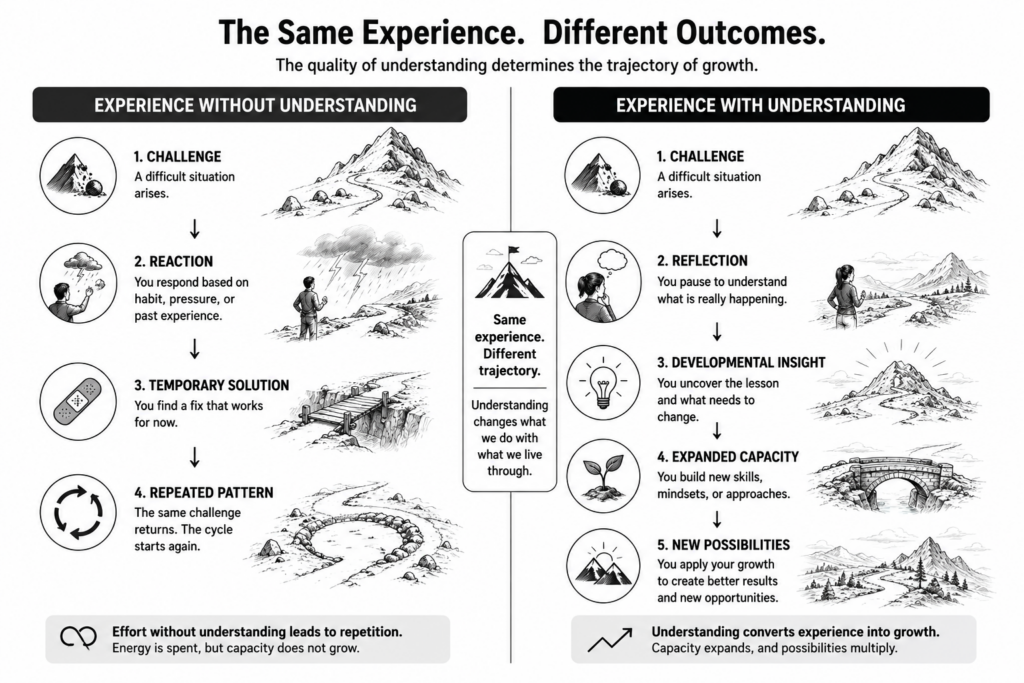
FIGURE 2 The challenge is identical. What differs is what the leader is able to make of it, and how much the making costs.
07 – The Question That Remains
I still think about the advice I was given early on: the best way to learn leadership is to lead. Years of leading, coaching, assessing, succeeding, and failing have only confirmed it. No framework replaces experience, no model substitutes for accountability, and no amount of study removes the courage leadership demands. Every executive must climb the mountain personally.
I would add only a clause to it now. The best way to learn leadership is to lead, and to understand what leadership is teaching you while it is still teaching you, because that is the only window in which the understanding is worth anything.
That opportunity is genuinely new. Previous generations left us more than their stories. They left the patterns underneath the stories, drawn out through decades of careful observation and hard practice. To ignore that inheritance is to cross unfamiliar mountains while refusing to carry a map. It remains possible. It is simply more expensive than it needs to be, for the leader and for everyone provisioning the trip.
Every leader will encounter pain. Not every leader will seek understanding.
So the honest version of the thesis is not that wise leaders embrace both paths. Every leader experiences both. The question is not whether experience will shape us, because it inevitably will, but whether understanding arrives before the lesson or only after it.
Pain is inevitable. Unnecessary pain is not.
The purpose of a developmental map is not to eliminate struggle, and any coach who promises that is selling something. It is to reduce the suffering a leader must undergo in order to grow, by helping him recognize the lesson before life is compelled to repeat it. It is also to reduce what everyone around him absorbs on his behalf while he works it out.
Compression is the whole of what a map offers. Not the removal of difficulty and not a shortcut around responsibility, but a shorter interval between the event and the understanding of it, repeated across a career until decades of trial and error have become an accelerated timeframe of intentional development. In any single quarter the difference is invisible. Over the years it compounds into a different leader, and a different organization behind him.
Leadership, in the end, is not measured by the positions held, the authority accumulated, or even the results delivered. It is measured by the person the leader is becoming, and every decision, every disappointment, every difficult conversation, and every season of uncertainty offers another occasion to become someone. Life will supply the experiences. The invitation is to bring understanding to them while they are still happening.
Five Questions
Development accelerates when leaders stop waiting for experience to explain itself. Before turning the page, sit with the following for a few minutes.
— Which lesson has my career now taught me more than once?
— What did that lesson cost the first time, and how much of the cost was carried by someone else?
— Where am I currently working harder at a level I may have already outgrown?
— When something goes wrong, do I ask what to fix, or what it is asking me to develop?
— If understanding arrived one season earlier than it usually does, what would that be worth?
The answers may reveal less about your circumstances than about which path you have been traveling.
CONTINUE THE CONVERSATION
Which path are you on?
Every executive is learning something right now. The only question is whether the lesson is understood while it is happening or filed away to be repeated later at a higher price. Most leaders cannot answer that about themselves, because the pattern is visible only from outside it.
That is the work I do. The Leadership Arc Assessment locates an executive’s developmental coordinates, surfaces the assumptions that are limiting further growth, and sets out what the next crossing will actually require.
The objective is not to remove the climb. It is to stop paying twice for the same lesson.
Because every meaningful journey begins by knowing where you are.
The next paper in this series takes up the question this one leaves open. If the cost of learning late falls as understanding arrives earlier, everything depends on a leader knowing where he currently stands, and that is the one thing executives are least able to establish about themselves. It asks what developmental position means, why self-assessment misses it, and how a coordinate is fixed with enough precision to act on.
NOTE: Source bibliography and/or client references available upon request. The integrated ideas, arguments, frameworks, and conceptual architecture presented in this paper are the original work of the author. Artificial intelligence was used as a collaborative writing and editorial tool to assist in drafting and refining the prose. All substantive judgments, interpretations, and conclusions are the author’s, who retains full responsibility for the final content.
© 2026 CaMiNa Consulting. All rights reserved.