
The missing principle in leadership development, and why direction is meaningless until location is known.

01 – Executive Summary
The first paper in this series argued that executive development has reached the limits of the competency model, and that leadership matures along a developmental arc rather than accumulating as a list of skills. The second argued that experience will teach every leader the same lessons regardless, and that the only real variables are what the tuition comes to and who ends up paying it.
Both arguments arrive at the same unanswered question. If development follows a landscape, and if understanding arriving early is what lowers the price, then everything depends on leaders knowing where they currently stand. That is the one thing executives are least able to establish about themselves.
This paper takes up that question directly. It argues that many of the most persistent leadership problems are, at their root, problems of navigation. No navigator charts a route before establishing position, and development works the same way. The leader has to be located before the path can be prescribed.
The greatest mistake in leadership development is confusing direction with location.
The governing question stops being how we help this leader improve and becomes, more simply, where this leader is standing.
The stakes are the ones the second paper described. Advice delivered to a leader whose position was never established does not merely fail to help. It leaves the original lesson intact to be delivered again later, at a larger scale and a higher price.
This paper is the third in a series introducing the Leadership Arc.
02 – The Assumption We Rarely Question
Every serious profession begins with the same kind of first question. In medicine it is the diagnosis. In engineering, the failure mechanism. In law, the facts. In navigation, position. The order is not incidental. No competent physician prescribes before understanding the condition, no engineer proposes a fix before identifying the fault, and no navigator sets a route without first knowing where the ship is.
Leadership development routinely reverses this sequence. We observe behavior, identify deficiencies, and recommend interventions. Delegate more. Become more strategic. Increase executive presence. Develop emotional intelligence. Build trust. Each recommendation may be entirely appropriate. Each may also be entirely premature.
Without first understanding the leader’s developmental location, even excellent advice becomes generic, and the same counsel that accelerates one leader’s growth can quietly reinforce another’s limitation. The problem is rarely the quality of the advice. It is the sequence in which the questions get asked.
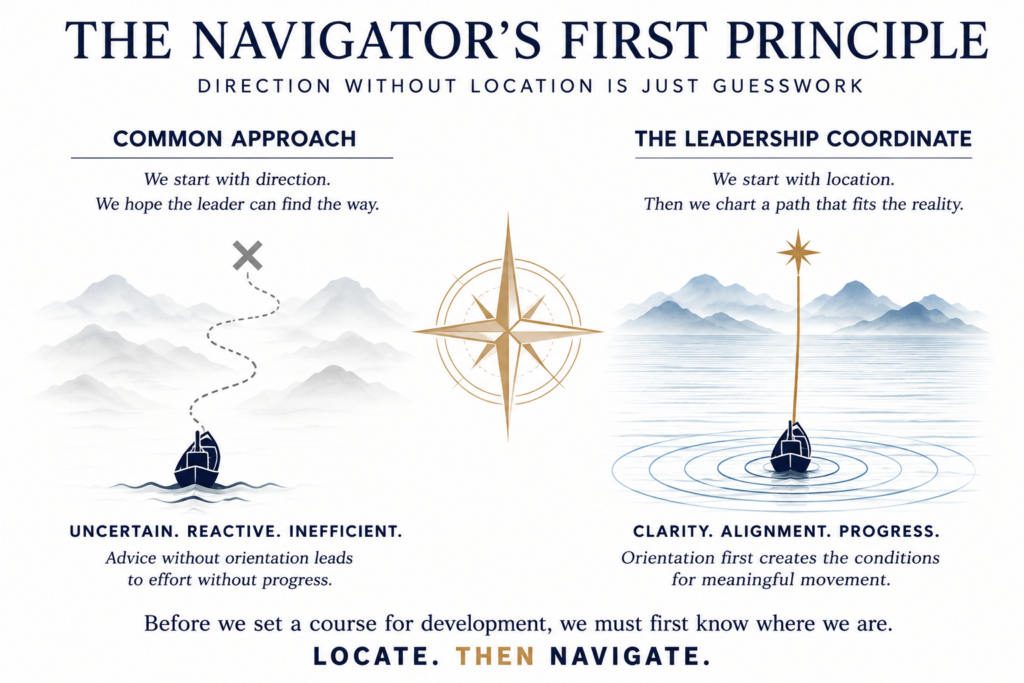
FIGURE 1 Every serious profession establishes position before prescribing a route. Leadership development routinely reverses the order, offering direction to leaders whose location was never established.
That sequence carries a price, and it is larger than it appears. A development plan aimed at the wrong coordinate does not simply produce no result. It absorbs a year of the executive’s attention, a line of the organization’s budget, and the patience of a board that will now conclude this leader cannot change. Meanwhile the actual developmental question goes unaddressed, and it returns later, when that leader’s span of responsibility has doubled.
03 – Why Leaders Cannot Locate Themselves
An obvious objection arrives at this point. If location matters so much, why not simply ask the leader? Executives are intelligent, self-aware, and generally well supplied with feedback. Surely they know roughly where they stand.
They do not, and the reason is structural rather than a failure of candor or intelligence.
A developmental location is not something a leader has. It is the position from which the leader sees. Asking executives to identify their own coordinate is asking them to inspect the instrument they are inspecting with. The assumptions organizing their perception do not present themselves as assumptions. They present themselves as the way things are. A leader who experiences delegation as risk does not experience holding a belief about delegation. What that leader experiences is a genuinely risky situation.
Three further difficulties compound the first.
Achievement is legible. Position is not. Executives can inventory what they have built, delivered, and survived with considerable accuracy, and that record feels like an answer. It is not. It describes the terrain already crossed rather than the ground currently occupied, and the two diverge most sharply in exactly the leaders whose track record is strongest.
Feedback describes behavior, which is downstream. Multi-rater instruments, engagement scores, and board commentary are all reports on what a leader does. They are useful and they are late. Behavior is the last thing that happens in a long sequence, and describing it accurately says very little about the structure producing it.
The last crossing is easily mistaken for the current one. Leaders who genuinely made a difficult developmental movement five years ago will keep narrating themselves from that movement long after it has consolidated. The story is true. It is simply no longer where they are standing.
Leaders can inventory everything they have achieved and still not know where they are standing.
This is why position has to be established rather than reported, and why establishing it takes a second party. Not because the executive lacks insight, but because the thing being looked for is the lens, and no lens examines itself.
04 – Two Executives
The central idea of this paper did not arrive as a single insight. It arrived through accumulation, across more than two decades of executive assessment, as a phenomenon existing models explained only partially. Leaders displaying nearly identical behaviors often required fundamentally different developmental responses, while leaders with entirely different personalities and management styles kept struggling with the same underlying challenge. The pattern held across industries, cultures, functions, and levels of seniority. The surface varied endlessly. The structure underneath stayed consistent.
Consider two senior executives, each described by colleagues in almost identical terms. Brilliant. Works too hard. Needs to delegate. Has trouble letting go. Traditional development reaches a familiar conclusion: both should strengthen their delegation skills. Behaviorally the recommendation is sound. Developmentally it may be exactly wrong.
The first executive experiences delegation as a threat to certainty. Work done by others never feels fully reliable, and control has become the mechanism through which psychological safety is maintained. The issue is not delegation. It is security.
The second executive experiences delegation as a threat to identity. Achievement has fused with personal worth, and remaining indispensable is the standing proof that their value cannot be questioned. Delegation is not the issue here either. Worth is.
The behavior is the same. The developmental architecture underneath it is entirely different. Send both leaders to the same delegation workshop and both will learn the vocabulary without making the movement that would let them actually delegate. One of them needed to build tolerance for uncertainty. The other needed to separate their worth from their output. Neither was going to arrive there through a module on empowerment.
05 – Behavior Is the Last Thing That Happens
Leadership literature focuses on behavior for an understandable reason. Behavior is observable. Organizations can measure it, colleagues can describe it, coaches can discuss it. But behavior sits at the end of a much longer sequence, downstream of perception, which is itself downstream of interpretation. Beneath interpretation lies the developmental structure through which reality is experienced in the first place.
This points at something easy to say and hard to absorb, and it is the idea on which the rest of this paper stands.
Leaders do not make decisions from reality. They make decisions from the reality they experience.
A difficult conversation is conflict for one executive and opportunity for another. A reorganization reads as possibility to one leader and instability to the next. The event is identical. The reality is not, and neither reading is arbitrary, because each follows a coherent developmental logic.
This explains one of the more puzzling features of organizational life. Leaders rarely disagree because they hold different information. More often they disagree because they inhabit different realities, and information concerns facts while reality concerns meaning. Two executives can sit through the same meeting, hear the same words, watch the same events, and leave with entirely different accounts of what happened. Where one sees commitment, another sees resistance. Where one sees healthy debate, another sees disrespect.
It is tempting to believe we perceive reality objectively and only afterward interpret it. Developmental psychology suggests the reverse. Interpretation does not follow perception. It shapes it. From Piaget’s account of how children construct reality to Kegan’s work on how adults keep transforming the structures they think with, the finding recurs across a century of research, and more recently in a neuroscience that describes the brain as a prediction engine rather than a passive recorder. Human beings do not merely receive the world. They organize it into meaning, and leadership cannot be understood apart from that.
DEVELOPMENTAL MOVEMENT Behavior ▸ Perception ▸ Interpretation ▸ Position
ON SCREEN Rashomon
Four witnesses describe the same killing in the same clearing, and no two accounts agree. The film is not making the easy point that people lie. Each account is internally coherent and each is faithful to the reality its narrator actually occupied. Executive teams run this problem constantly, and almost always treat it as a disagreement about facts.
Executive reflection. When my team last split badly over a decision, was the argument really about the evidence, or about two different readings of what was at stake?
06 – What a Location Is Made Of
A coordinate on a chart means nothing in the abstract. It exists only as the intersection of dimensions, latitude crossing longitude. A developmental location has to work the same way, which means the interesting question is not where a leader stands but along what.
Whatever the dimensions are, they must be few enough to hold in mind and general enough to apply to every leader, in every industry, at every level. They cannot be competencies, because competencies number in the hundreds and shift with each role. They have to be the underlying capacities that competencies draw upon.
The first paper named them: Initiative, Innovation, Intrinsic, and Immersive, the capacities to will, to think, to feel, and to be. What that paper described as four currents through which leadership matures do something more specific here. They are the axes along which a location is fixed. Leaders are never simply developed. They are developed to some degree along each of four dimensions, and the pattern across those four is the coordinate.
This is also where the distinction between competence and capacity stops being philosophical and becomes practical. Competencies describe what a leader is currently able to do. Capacity determines whether a newly acquired competency integrates deeply or remains a routine performed by repetition. Anyone can memorize the language of delegation. Far fewer can relinquish control as uncertainty rises. Competencies account for present performance and capacity for future performance, and a coordinate measures the second.
Locations are rarely even. Most executives arrive at senior responsibility with one capacity well developed and others carrying much less weight, and the pattern is usually a record of what the career rewarded rather than a statement of what the person is capable of. A leader promoted repeatedly for decisiveness will have a deep Initiative. One who built a reputation on analysis will have Innovation running well ahead of others. Neither is a deficiency in the ordinary sense. Each is the accumulated shape of a working life.
That unevenness is what makes a coordinate useful. If leaders developed uniformly there would be nothing to locate, only a general level to report. Because they do not, the interesting information sits in the gaps: which capacity is carrying the load, which one this season is asking for, and how far apart the two have drifted. A leader who knows the overall level knows almost nothing actionable. A leader who knows the shape knows where the next crossing is.
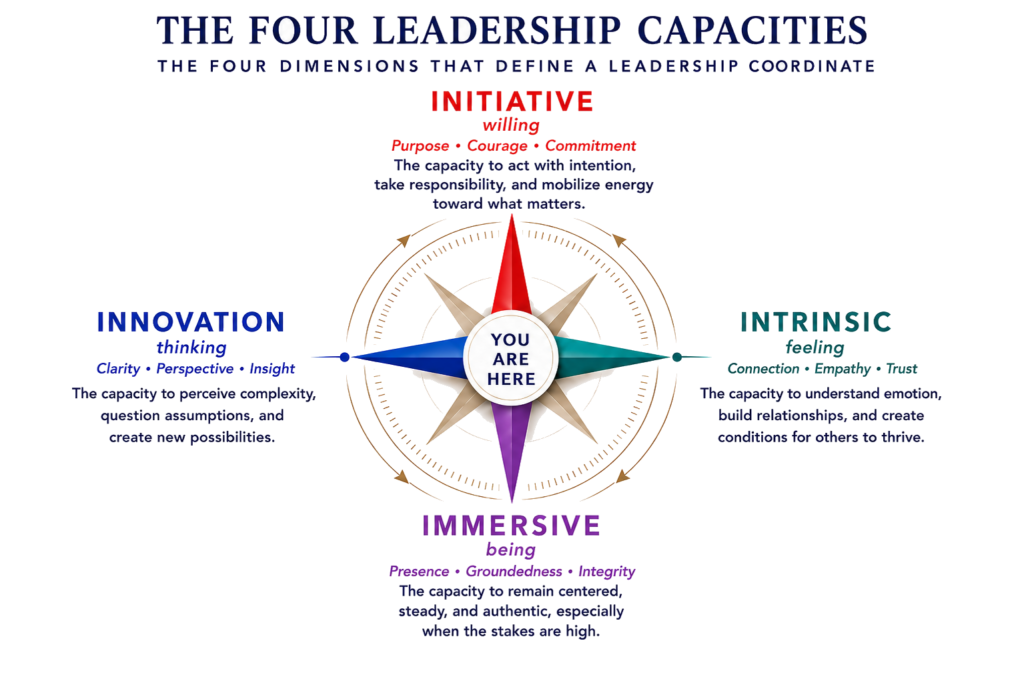
FIGURE 2 A leadership location is fixed along the four capacities: Initiative, Innovation, Intrinsic, and Immersive. Together they describe not what leaders possess, but how they engage reality.
07 – Development Meets Gravity
If leadership were only development, transformation would be relatively straightforward. Leaders would take on new perspectives, practice new behaviors, and grow steadily more capable. Growth is rarely that linear. Executives routinely report a moment of real insight followed by a period in which old patterns quietly reassert themselves. A leader who has genuinely learned to trust others begins micromanaging under pressure. Another who has grown comfortable with hard conversations avoids the one that matters most.
These moments are usually read as failure. They are not. They reveal that development never happens in isolation, and that every movement toward greater freedom meets forces organized long before the leader entered the room.
The navigational metaphor holds here too. A navigator never assumes direction alone determines movement. Every voyage is shaped by forces that cannot be seen directly: wind, current, tide. A ship can be pointed perfectly at its destination and still arrive somewhere else.
Development provides the bearing. Adaptive patterns create the current.
Consider what this means across an ordinary quarter. A chief executive returns from an intensive program genuinely changed, resolved to stop solving every problem personally and to let the team carry more. For three weeks the new bearing holds. Then a major account wobbles, the board grows anxious, and without deciding anything the executive is back in every meeting, rewriting every deck, holding every decision. Nothing about the insight was false. The bearing was real. But under load the old current reasserted itself, because it was laid down first and runs deeper. The leader did not fail to understand. They underestimated the tide.
Across thousands of conversations, these currents resolve into a small number of organizing concerns. Some leaders are organized around security, others around worth, others around belonging. The concerns themselves are universal. The strategies used to protect them vary enormously, and a later paper in this series sets out the nine that recur most often across senior leadership. I have come to call the resulting structures Adaptive Loops, and the word is deliberate. A loop is not a trait and not a diagnosis. It is a self-reinforcing pattern in which each behavior creates the conditions that justify its own continuation.
THE LOOP IN ONE LEADER A capable executive organized quietly around security tightens control to keep outcomes certain. The team stops taking initiative and waits to be told. Their passivity proves the work needs close supervision. The need for security is confirmed, and the grip tightens again. Nothing in the sequence is irrational. Each turn makes the next turn look necessary.
The power of a loop is that it manufactures its own evidence. Control produces dependency, and dependency confirms the need for control. Achievement wins recognition, and recognition reinforces the belief that worth depends on achieving. Avoidance prevents conflict, and the absence of conflict proves the avoidance was wise. This is the current beneath the waterline, and it explains why sincere resolutions so rarely hold on their own.
What the loops change immediately is the coach’s task. Repeated behavior is not irrational. The leader who insists on controlling every important decision may be seeking predictability rather than power. The one who avoids hard conversations may have learned, years earlier, that preserving a relationship required suppressing conflict. Viewed from outside these look like problems. Viewed developmentally they become coherent, and coherence is the beginning of precision. I have come to think of this as structural empathy: not asking what a leader feels, but asking how, given the developmental reality they currently inhabit, this behavior could make perfect sense.
ON SCREEN The Caine Mutiny
Captain Queeg is neither stupid nor, at the outset, incompetent. He is a man organized around control who has been handed a crew he cannot fully control, and every measure he takes to restore certainty erodes the confidence that would have made certainty possible. By the time the strawberries go missing, the loop is running the ship. The tragedy is not that Queeg is a tyrant. It is that from inside his position, each decision he makes looks reasonable.
Executive reflection. Which of my own responses under pressure keeps producing the very conditions I then use to justify it?
FIGURE 3 Leadership movement is shaped by two simultaneous forces: developmental growth, which supplies the bearing, and adaptive gravity, which supplies the current.
08 – What the Coordinate Holds Together
By this point a fuller picture comes into view. Development explains why leaders grow more capable over time. Adaptation explains why they return to familiar responses under pressure. Neither account alone is sufficient. Together they describe something richer than either.
A Leadership Coordinate is therefore more than a developmental location. It marks the intersection of two simultaneous realities: possibility, the leader’s growing capacity to perceive, relate, think, and act with increasing complexity, and continuity, the adaptive structures that have organized their experience for years and sometimes decades. Every coaching conversation lives at that intersection, the future pulling forward and the past pulling back. Transformation was never about eliminating one in favor of the other. It was about seeing both clearly enough to choose consciously rather than react automatically.
If Coordinates Exist, They Must Be Discoverable
Every model eventually meets the same practical question. If this way of understanding leadership is correct, how is a leader actually located? My first instinct was to look for a better instrument, another profile, another algorithm for combining existing data into a sharper picture. I grew less convinced over time, not because assessments lack value but because coordinates are not objects waiting to be measured. They are patterns waiting to be recognized. A physician’s diagnosis works the same way. Laboratory values, imaging, and history all matter, and none of them alone is the diagnosis, which emerges only as the observations resolve into a pattern no single data point contains.
No personality profile, competency assessment, or feedback report reveals a leader’s developmental location on its own. Each contributes a bearing. None establishes the coordinate. This is why the method that works is conversational rather than instrumental. Stories reveal what questionnaires cannot, and a hesitation, a contradiction, or a sudden flash of frustration often tells more than a carefully prepared answer. A later paper in this series is devoted entirely to how that conversation is conducted.
From Models to a Map
Looking back, many of the ideas I developed over the years first appeared unrelated. The Leadership Arc described the broad developmental journey. The four capacities described what matures along it. Adaptive Loops explained why growth keeps meeting resistance. The Inflection Fence named the threshold where many leaders plateau. Each addressed a different question, and for years I treated them as separate contributions. Only gradually did I see that they were describing different dimensions of a single landscape.
The Leadership Coordinate is not one more framework added to the collection. It is the organizing principle that explains why the collection exists. What once looked like separate maps turns out to be a single geography.
Once the principle is visible it becomes difficult to confine to coaching. The same structure governs any situation in which two people occupy different realities and mistake it for simple disagreement: the negotiation that stalls because each side is standing in a different world and arguing about facts, the political divide that no quantity of evidence seems to close, the succession that fails because a board evaluated a successor’s competence and never located their capacity. In each case the visible conflict is downstream of an invisible difference in position, and clarification cannot resolve what orientation created.
09 – The Last Word
Every navigator understands a truth so obvious it is rarely spoken aloud. Direction is meaningless until location is known. A perfect heading from the wrong position leads perfectly astray.
Leadership has largely reversed that order. We have become skilled at telling leaders where they should go: delegate more, think more strategically, build more trust, lead with more presence. We have spent far less time understanding where they actually are, and so we offer excellent direction to leaders whose position we never established, then wonder why so much sound advice produces so little lasting change.
The maps are not wrong and the advice is not poor. We have simply forgotten the first discipline of navigation.
Locate. Only then steer.
Before deciding how a leader should move, we have to know where the leader stands. Everything that follows, every decision, every conversation, every act of leadership, is shaped by the answer to a single question.
Where am I?
That is the promise of the Leadership Coordinate. Not another way of describing leaders, but a better way of helping them find their way, and a considerably less expensive one than the alternative.
Five Questions
Development begins with position rather than direction. Before turning the page, sit with the following for a few minutes.
— If someone asked where I stand developmentally, would I describe my position or recite my record?
— Which of my convictions about how leadership works feel less like beliefs and more like plain facts?
— When I last received difficult feedback, did it describe my behavior or reach the structure underneath?
— Which of the four capacities do I reach for under pressure, and which do I quietly avoid?
— What am I working hard to solve that may not be a problem at all, but a position?
The answers may reveal less about your capability than about the ground you are standing on.
CONTINUE THE CONVERSATION
Where are you standing?
Every executive occupies a developmental location, whether or not anyone has named it. Some are still building the disciplined action a career is founded on, others are sharpening the judgment that turns effort into insight, and a few lead from conviction and presence rather than consensus and control. Most are strong in the capacities that made them, and unaware of the currents quietly pulling them off the bearing they believe they are holding.
That is the difficulty. We are poor judges of our own position. We know what we have achieved, and we are far less certain about where we actually stand or which forces are shaping the view.
The Leadership Arc Assessment establishes a leader’s coordinates. It maps position across the four capacities, surfaces the adaptive patterns influencing judgment, and identifies the developmental movement now being invited, turning the fog of self-assessment into a clear set of bearings.
The objective is not simply to become more capable. It is to become better oriented.
Because every meaningful journey begins by knowing where you are.
The next paper in this series takes up what the coordinate most often reveals: the capable leader who has stopped moving without ever having failed, held in place by the very success that built the career, and why the crossing that follows asks for a change of orientation rather than more effort.
NOTE: Source bibliography and/or client references available upon request. The integrated ideas, arguments, frameworks, and conceptual architecture presented in this paper are the original work of the author. Artificial intelligence was used as a collaborative writing and editorial tool to assist in drafting and refining the prose. All substantive judgments, interpretations, and conclusions are the author’s, who retains full responsibility for the final content.
© 2026 CaMiNa Consulting. All rights reserved.