Why so many capable leaders stall, and why the last thing the crossing needs is more effort.

01 – Executive Summary
The first paper in this series argued that executive development has reached the limits of the competency model, and that leadership matures along a developmental arc rather than accumulating as a list of skills. The second argued that experience will teach every leader the same lessons regardless, and that the only real variables are what the tuition comes to and who ends up paying it. The third argued that neither insight can be used until a leader knows where they are standing.
This paper takes up what the coordinate most often reveals. The leader is not failing. They have stopped moving.
Most executives who feel stuck are succeeding by every conventional measure. They hit the numbers, hold the team, master the subject, and win the comparison. Nothing appears as failure anywhere a board would see it. Yet effort has begun to rise while the sense of forward motion falls. The leader has reached the ceiling of a world they did not build, and mistaken that ceiling for the sky.
The ceiling was never the sky. It was only the roof of the harbor.
The Leadership Arc names four capacities through which leadership matures: Initiative, Innovation, Intrinsic, and Immersive, the capacities to will, to think, to feel, and to be. This paper reads them by those human verbs, as willing, thinking, feeling, and being, because a stall is easier to recognize in the verb than in the name. They are the same four axes along which the third paper fixed a leader’s coordinate.
Each capacity matures through recognizable stages, and each contains one decisive threshold. The first paper called it the Inflection Fence and placed it on the seven-level Arc between Vision and Resonance, at the point where leadership stops being organized around performance and begins to be organized around alignment. Read capacity by capacity, as this paper reads it, the same crossing appears four times over.
That is the central claim here, and it is the most consequential pattern in the framework. When the four capacities are stacked together, their thresholds line up. The crossing sits in the same place every time.
Below that line is the world of the reliable performer, the strong competitor, the trusted colleague, the credible expert. It is comfortable, it is rewarded, and for most careers it is entirely sufficient. Above it is something organizations cannot train directly and rarely reward on schedule: the capacity to author rather than execute, to create rather than compete, to lead from conviction rather than consensus, and to remain present in uncertainty rather than managing it away.
The most capable leaders meet this ceiling precisely because they have mastered the world beneath it. The question is not whether a leader has reached it, since almost everyone has in at least one capacity. The question is whether they can see it.
This paper is the fourth in a series introducing the Leadership Arc.
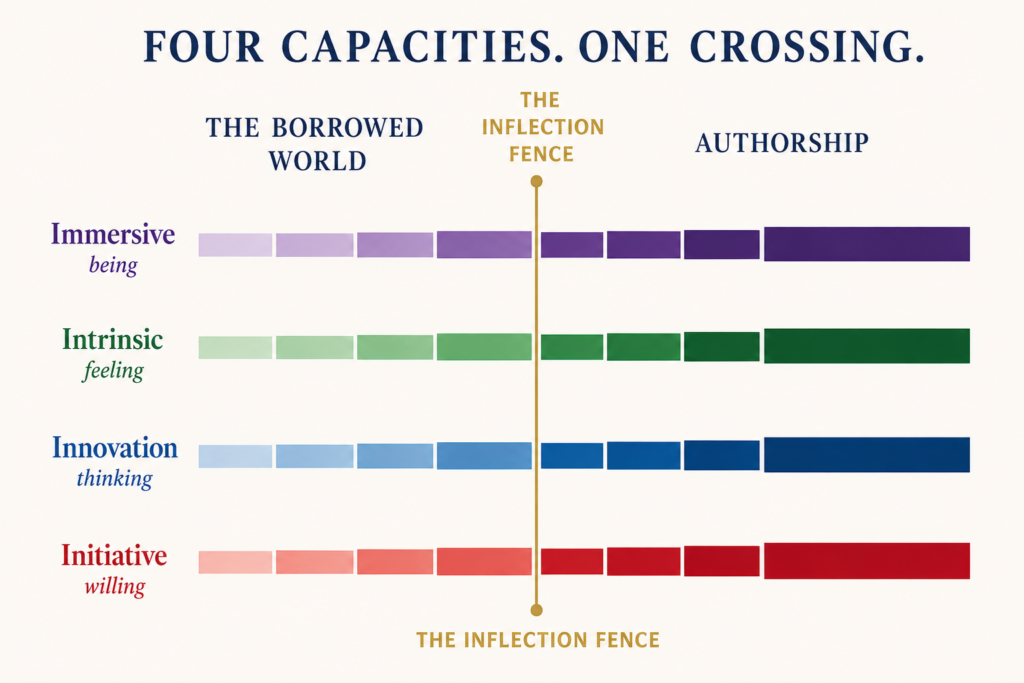
FIGURE 1 The four capacities, one crossing. Each capacity develops through its own progression, yet all cross the same threshold. To the left of it lies the borrowed world of inherited frameworks and external definitions of success. To the right lies authorship. The thresholds align because the underlying shift is the same.
02 – The Comfortable Ceiling
The space below the Inflection Fence is seductive for the simplest of reasons. It works. It is the place of the dependable performer, the sharp competitor, the trusted colleague, the respected expert. Organizations reward it, promotions flow toward it, and most senior executives live there and have built distinguished careers on it.
But the space carries a signature that repeats across all four capacities. The leader is still operating from frameworks they did not write. The goals arrive from outside, the rules of the competition are inherited, the definition of success is borrowed from approval and consensus, and truth is whatever the existing models happen to measure. Inside that field a leader can be genuinely excellent and still not be free. I have come to call it the borrowed world, and its most reliable feature is that nothing inside it feels borrowed.
The same ceiling appears differently in each capacity.
Willing: Reliable, but on Someone Else’s Course
Below the fence, willing looks like dependable execution. The leader delivers consistently, meets objectives, and steers the ship faithfully across predictable water. It feels responsible, and it is. But the voyage stays tied to charts drawn by others, and the leader rows hard toward a horizon someone else selected. The motion is real. The authorship is not.
Thinking: Mistaking More Analysis for More Insight
Below the fence, thinking sees clearly, but only within the frame it was handed. The leader benchmarks, models, and analyzes with real skill, stacking charts in the conviction that enough data will finally produce the answer. The insight can be dazzling. It is also trapped inside inherited assumptions, so the leader plays the existing game brilliantly without asking whether the game still serves them. Perception has become the rearranging of known information rather than the seeing of what the models were never built to measure. When those models fail, and eventually they do, there is no vantage point outside them from which to look.
Feeling: Steering by Borrowed Stars
Below the fence, feeling navigates by approval, harmony, and consensus. The leader is skilled at fitting in, keeping order, and reading the room, and it feels both safe and steady. Beneath that competence sits a quiet fragility. When external voices clash or ambiguity rises, there is no inner compass to fall back on. Meaning is borrowed, so confidence is conditional, and the crew rows hard while wondering who they are rowing for.
Being: Managing Uncertainty Instead of Inhabiting It
Below the fence, being cannot sit still. Faced with an unresolved moment, the leader reaches for activity, for certainty, for the next move, for anything but the discomfort of remaining present while the situation is still unformed. The grip on the wheel tightens. Control becomes a defense against ambiguity and motion becomes a way to avoid the exposure of not yet knowing. It reads as decisiveness, and sometimes it is. But a leader who can only manage uncertainty, never inhabit it, has no steadiness to offer a room when the answer has not yet arrived. Presence is the one thing that cannot be manufactured through effort, and effort is the only tool this leader trusts.
Four capacities, one recognizable posture: capable, busy, respected, and contained. This is what it is to lead below the line, working inside the boundaries rather than expanding them, productive and quietly looping.
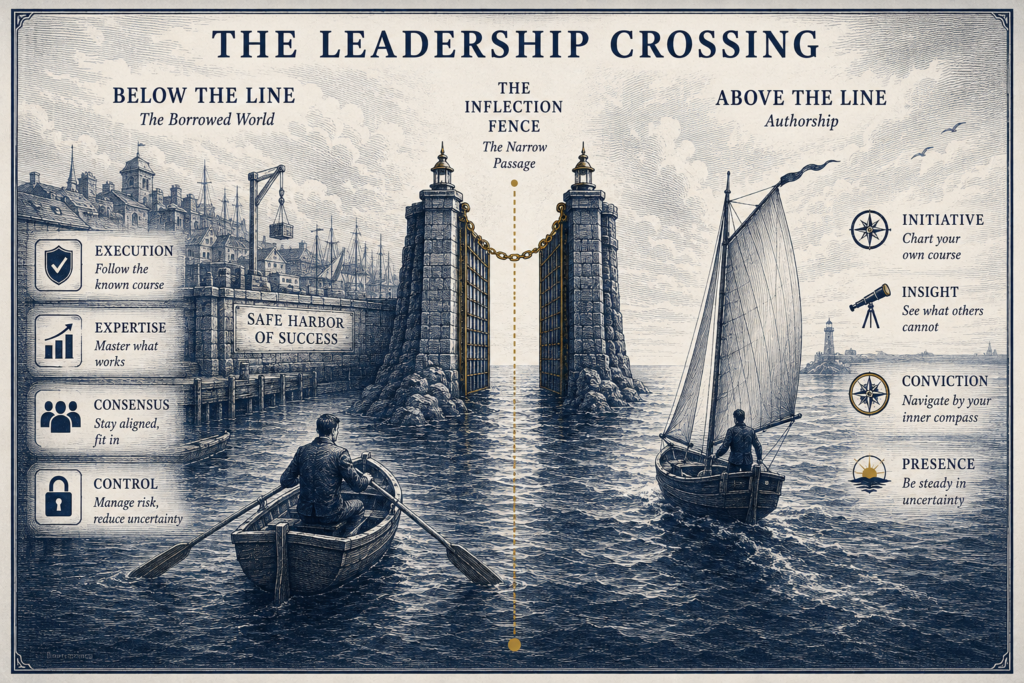
FIGURE 2 Below the line and above the line. The Inflection Fence marks a shift in orientation rather than in effort. Below the line leaders row harder within the same harbor. Above it they raise the sail toward open water. The circumstances look similar. The source of the leadership has changed.
03 – What the Ceiling Costs
The second paper argued that experience issues an invoice and that someone always pays it. The stalled executive is the hardest version of that argument to make, because there is no incident to point at. Nothing fails. The quarter closes, the team holds, the reputation stands. The cost is real anyway, and it is paid in three places.
It is paid by the bench. A leader operating below the line hands out assignments rather than authorship. The strongest people on the team become excellent at executing a frame they did not write, because that is the only thing the relationship has ever asked of them. Five years later the organization looks at its succession slate and finds four reliable executors and no authors, and concludes it has a talent problem. It has a developmental one, and it built it deliberately, one well-run project at a time.
It is paid by the organization’s ceiling. The first paper observed that cultures come to reflect the developmental maturity of the people entrusted with authority. A leader who cannot sit inside an unresolved moment builds an organization that cannot either, and one that fills every silence with activity. The stall does not stay in the leader. It becomes the altitude at which the whole enterprise flies.
It is paid twice. A lesson that was never consciously understood does not announce itself when it returns. It arrives again wearing different clothes, at a larger scale, because the leader has been promoted in the interval. The stall that cost a department in one decade costs a division in the next.
None of this is ever booked as a development expense. It appears as an engagement score that moves half a point and then stops, as a bench that is two deep where it used to be four, as a strategy refresh that reads like last year’s with new dates, as capable people who leave for reasons they describe as personal. The organization is not being failed. It is being held level, which is harder to see and considerably more expensive over a career.
Stalled leaders do not appear on any report. They appear in what their organizations quietly stop attempting.
04 – Why the Pull Is So Strong
If the territory above the Inflection Fence is better, why does anyone stay below it? Because the space below is defended by four forces that each feel like a virtue. The harbor is not held together by fear. It is held together by success.
It is known. The territory is mapped, the rules are legible, and competence here carries a name and a reputation. The water beyond offers no such guarantees, and the familiar exerts a pull of its own.
It is rewarded. The organization pays for reliability, competitiveness, agreeableness, and expertise. The behaviors that now cap leaders are the same ones that got them here, which is why those behaviors keep returning under pressure and are praised each time they do.
It is safe. Inside the fence the rules hold and effort earns reward. Crossing means trading the brittle comfort of certainty for open water. To those still inside, the leap looks reckless rather than developmental.
It is invisible to the one inside it. Leaders below the fence usually believe they are already past it. The self-story, that they are innovators, that they lead from conviction, outruns the behavior by years. Blind spots, self-protective narrative, and the distortions of past success make accurate self-placement nearly impossible.
The third paper named the mechanism underneath all four. Adaptive Loops are self-reinforcing patterns in which each behavior creates the conditions that justify its own continuation, and the harbor is built from them. Reliability earns responsibility, and the responsibility proves the reliability was the right bet. Expertise attracts the questions only the expert can answer, and the questions confirm the expertise. Each force manufactures its own evidence, which is why sincere resolutions so rarely hold on their own. The harbor is not a place a leader chooses. It is a loop with an excellent reputation.
The fourth force matters more than the other three combined, because growth in each capacity is not linear. Every stage is roughly an order of magnitude more complex than the one before it. A leader can be genuinely strong and still have no felt sense of the magnitude of what the crossing asks. From inside the harbor, the open ocean does not look like freedom. It looks like risk with no map.
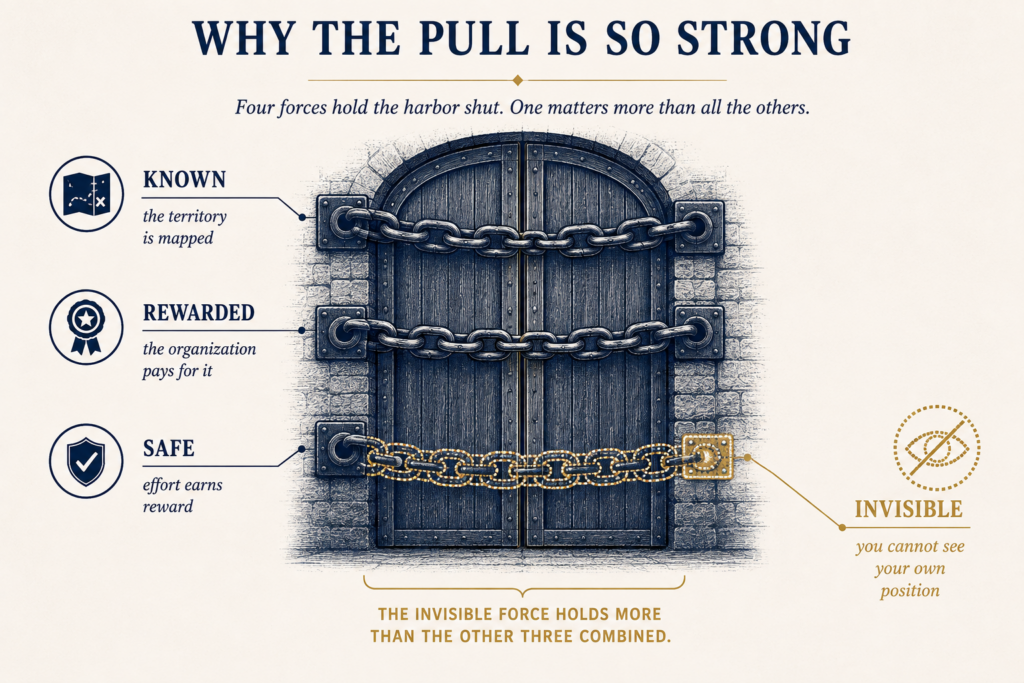
FIGURE 3 The four forces defending the harbor. The known, the rewarded, the safe, and most powerful of all the invisible, the inability to see one’s own position. Together they make the harbor feel secure precisely because it has been successful.
THE PRICE OF THE CROSSING The four forces are not weaknesses to be scolded. They are the accumulated rewards of everything that has worked so far. That is exactly why the crossing is refused so often. It asks leaders to surrender the very things that made them successful, before the next thing has proven it will hold their weight.
05 – What the Crossing Actually Requires
Crossing the Inflection Fence is not a matter of working harder. Harder effort is the harbor move, rowing furiously when the wiser act is to raise the sail. The crossing is a change of orientation, and while it looks different in each capacity it always points the same direction, from outside in to inside out.
In willing, stop waiting for the assignment. Author one small act of forward motion that nobody handed over: a pilot, a question, a course correction. It does not need to be a restructure. It needs to be the leader’s own.
In thinking, stop adding data to a question the data cannot answer, and ask the disruptive one instead. Why must it be this way? The point is not to analyze the given game more finely but to notice the game itself.
In feeling, notice where the performance is aimed at approval, and act once from conviction instead. Let the final bearing come from the leader’s own values rather than the room’s expectation.
In being, loosen the grip on control. When the answer has not yet arrived, resist the reflex to fill the silence with activity. Stay in the unresolved moment long enough to be steady inside it rather than rushing to manage it away, and let presence rather than motion be what settles the room.
None of these is a heroic leap. The discipline is not to live above the line at all times, because nobody does. It is to raise the frequency of the attempt through repeated, deliberate efforts at authorship, creation, conviction, and presence. Over time those attempts bend the curve.
And because the capacities interlock, growth in one cascades into the others. Leaders who steady themselves at the edge of being find their feeling deepening into authenticity, their thinking gaining coherence, and their willing growing more grounded. Light at a higher altitude falls across the whole vessel.
| DEVELOPMENTAL PROGRESSION: Effort > Discipline > Judgment > Authorship |
ON SCREEN Shackleton
When the ship is crushed by the ice and the expedition’s original goal becomes impossible, Shackleton does not drive his men harder toward a destination that no longer exists. He absorbs the loss, reorients around a new object, bringing every man home alive rather than crossing the continent, and holds the party steady through months of unresolved waiting. His authority in the crisis comes not from force but from a presence that refuses to panic when the answer has not yet arrived. It is the crossing made visible under pressure, a change of orientation rather than more effort.
Executive reflection. When the plan I set out with is no longer available, do I row harder toward the old horizon, or can I stay steady long enough to author a new one?
06 – The Mirror You Cannot Hold for Yourself
The third paper established why leaders cannot locate themselves. A developmental position is not something they have. It is the place from which they see, and no lens examines itself. I will not rebuild that argument here. I will add only the part I learned at full price.
I built a career on articulation. Give me a confused situation and I could find the frame that organized it, name the pattern underneath, and hand it back in language a room could use. It was a real strength. It was rewarded for years, it was the reason people called, and it was the thing I was most sure of about myself.
So when my own leadership began to flatten, I did what the strength knew how to do. I analyzed it. I read more, built more, refined the architecture, and produced an increasingly precise account of what was happening to me. The account was accurate. It was also the most sophisticated form of avoidance available to me. I was thinking brilliantly inside a frame I had never thought to question, and every hour spent sharpening the explanation was an hour not spent making the movement the explanation described. What that season was asking for was not a better map. It was the willingness to act without one.
It took someone standing outside my own instrument to say so, and I did not receive it well. I defended the work, the record, the reasoning. I was still defending it when I noticed that the defense was itself the evidence. Nothing about my capability had changed in that hour. Only my picture of where I stood, and that recognition is where the movement actually started.
The capacity that carried a leader this far is usually the one now standing in the way.
That is the shape of the trap. It is not weakness, and it is not a competency anyone is missing. It is a genuine strength used past the point where it still develops the person using it. Overused strength is the most respectable form of avoidance there is, because it produces visible output, earns continued praise, and looks from every angle like the leader is working on the problem. I have since found some version of this in nearly every executive I have assessed, and I recognize it faster now for having lived inside it.
This is what a rigorous, framework-based assessment provides. It is not a verdict. It is a mirror. It establishes the coordinates the third paper argued every act of development has to begin from: where a leader is rowing, where they are drifting, and where they may already be lifting past the line. With that clarity development stops being guesswork, and every practice can be aimed at the crossing that actually matters.
Almost everyone is stuck below the Inflection Fence in at least one capacity. That is not a failure of talent or effort. It is the natural ceiling of the borrowed world, and the most capable leaders reach it because they have mastered that world so completely. What comes next is not more mastery of the same field. It is the willingness to author what lies beyond it.
07 – What Comes After Mastery
Organizations are well equipped to make leaders better at what they already do. Nearly every development dollar goes there, and it should, because early in a career each new capability produces real returns. What almost nothing in the system is built to do is tell a leader that the capability itself has become the constraint.
That message is unwelcome in a way ordinary feedback is not. Telling executives they are deficient in something asks them to add. Telling them that their defining strength is now the thing holding them level asks them to loosen their grip on the very asset their identity is built from. Most leaders would rather hear that they need to work harder, and most organizations would rather say it, because both parties know how to respond to that sentence.
The leaders who cross are rarely the ones who found more effort. They are the ones who accepted an accurate picture of where they were standing and stopped arguing with it. Talent is not what separates them, and neither is ambition. What separates them is the willingness to be located, and then to move.
The harbor is not the enemy. It is where competence is built, and no leader reaches the fence without having earned everything the harbor gave them. But a harbor is a place to depart from, and a career spent perfecting the mooring is still a career spent tied to the dock.
Five Questions
Development stalls quietly when a strength stops being examined. Before turning the page, sit with the following for a few minutes.
— Which capacity am I most clearly excellent in, and is that excellence still running on someone else’s course?
— What is the strength I am most known for, and where has it lately produced output rather than movement?
— Which of the four forces, the known, the rewarded, the safe, or the invisible, holds me most firmly in place?
— When did I last author something no one assigned to me?
— If an independent observer mapped my leadership honestly, where would the mirror disagree with my own account?
The answers may reveal less about what you lack than about what you have overused.
CONTINUE THE CONVERSATION
Where have you stopped moving?
Every executive is somewhere on this journey. Some are still building the disciplined action a career is founded on, others are sharpening the judgment that turns effort into insight, and a few have begun leading from conviction and presence rather than consensus and control. Most are strong below the line in the capacities that made them, and quietly held at a ceiling they cannot see from the inside.
That is the difficulty. We are poor judges of our own development. We know what we have achieved, and we are far less certain about who we are becoming.
The Leadership Arc Assessment maps a leader against the four capacities, turning the fog of self-assessment into a clear set of coordinates. It surfaces the assumptions that may now be limiting further growth, identifies which crossing matters most, and turns development from guesswork into direction.
The objective is not simply to become more capable. It is to become the author of your own leadership.
Because every meaningful journey begins by knowing where you are.
The next paper in this series returns to the threshold itself. If the crossing sits in the same place in every capacity, the question becomes what a leader actually surrenders at that line, why the years on either side of it feel like regression rather than growth, and what it costs an organization when the executive turns back and calls it pragmatism.
NOTE: Bibliography and references available upon request. The ideas, arguments, frameworks, and conceptual architecture presented in this paper are the original work of the author. Artificial intelligence was used as a collaborative writing and editorial tool to assist in drafting and refining the prose. All substantive judgments, interpretations, and conclusions are the author’s, who retains full responsibility for the final content.
© 2026 CaMiNa Consulting. All rights reserved.