Why the logic of leadership growth changes, and what a leader is actually asked to set down at the threshold.

01 – Executive Summary
The Fence is not built by failure. It is built by success.
Somewhere in every successful career, a fence goes up. It rises not out of failure but out of success, one board at a time, from every strength that ever worked. Leaders never see it going up, because each board looks like an achievement. Then one day the open country beyond it, where the best leaders are supposed to end up, turns out to sit on the far side of a wall they built themselves.
The first paper in this series argued that executive development has reached the limits of the competency model, and that leadership matures along a developmental arc rather than accumulating as a list of skills. The second argued that experience will teach every leader the same lessons regardless, and that the only real variables are what the tuition comes to and who ends up paying it.
The third argued that neither insight can be used until a leader knows where they are standing. The fourth argued that where they are standing is most often still, held at a ceiling built by their own success.
This paper goes to the ceiling itself and asks what it is made of. There comes a point at which the accumulation of capability stops producing proportional growth: leaders keep learning while their leadership changes very little.
The phenomenon is neither unusual nor accidental. It reflects a predictable developmental threshold, the Inflection Fence, named in the first paper of this series and mapped capacity by capacity in the fourth. Below the Fence, leadership expands through accumulation; above it, leadership matures through liberation, which is a quieter and far more difficult thing. It does not ask for one more board. It asks instead for a few of them to come down.
Below the Fence, growth is something leaders add to. Above it, growth is something they set down.
Readers of the earlier papers will recognize the four capacities along which the Leadership Arc tracks growth: Willing, Thinking, Feeling, and Being. Each matures through recognizable stages, and each eventually meets the same test. The highest stages of leadership are defined not by possessing more capability than everyone else but by being less constrained by the identities that capability once created.
This paper is the fifth in a series introducing the Leadership Arc.
02 – The Developmental Assumption
Modern leadership development rests on an idea so familiar it is rarely examined: if leaders wish to improve, they must acquire more capability. Business schools promise sharper analysis, executive education develops strategic judgment, and organizations build competency models around senior behaviors. For much of a professional life the assumption is not merely useful; it is true. A new manager benefits from learning to delegate, a senior director from sharper strategic thinking. Competence compounds, and growth looks linear.
That very success makes the next transition hard to recognize. When progress slows the response feels obvious: another capability, another book, another program, another coach. For a long time it delivers, and then one day it stops. The moment is usually read wrong. Organizations call it plateauing, leaders call it burnout, consultants point to a changing business environment. Each explanation holds part of the truth and none of them names the shift underneath. Growth has not stopped. It is simply no longer organized by the same principle.
ON SCREEN Moneyball
The scouting room has a century of accumulated expertise in it, and that expertise is precisely what cannot see the problem. Billy Beane’s difficulty is never a shortage of baseball knowledge; it is that the knowledge has hardened into an identity the room is obliged to defend. Every objection raised against him is competent, experienced, and beside the point.
Executive reflection. Where has one more capability stopped producing one more breakthrough, and what might that be trying to tell me?
03 – Where the Logic Changes
A chief executive sits at the head of a board table. A hard question lands, and before it has fully settled the answer is already there. The answers are good, and they have been good for fifteen years, and being first to them built a reputation, a confidence, and eventually a sense of who this executive is.
What that executive cannot see is that the team stopped thinking out loud years ago. They bring problems now instead of solutions, because someone always gets there first. The greatest strength in the room has become the ceiling on everyone in it, and nothing about the situation looks like a problem. That is exactly the problem.
There is a difference between solving increasingly difficult problems and becoming a fundamentally different kind of leader, and for many years the two look identical. Capability and maturity seem inseparable right up until they come apart. This divergence is among the most consistent observations to emerge from two decades of executive assessment. The career remains successful and the expertise keeps deepening while genuine transformation grows more elusive. Such leaders have not failed. They have reached a developmental threshold.
That threshold is the Inflection Fence. It is not a deficiency and not another stage of leadership to be mastered; it marks the point where development changes its governing logic. Below the Fence, accumulation creates expansion. Above it, accumulation remains valuable and stops being sufficient, because the invitation now emerging is no longer about capability.
It concerns the leader’s relationship to the identities that competence has constructed along the way, which is why so many accomplished leaders find the threshold confusing. Nothing that brought them here was wrong and nothing needs to be discarded. The difficulty was never competence itself. It is unconscious attachment to competence.
A leader who possesses expertise is free to use it, or not, according to what the moment requires. A leader who is the expert experiences every conversation through the need to preserve expertise. Once capability has become identity, what is needed is not another rung on the ladder but a different relationship with the ladder itself.
This is what makes the Fence so hard to see and so hard to cross. A fence built by failure would be easy to resent and easy to tear down. This one is made of the leader’s proudest moments, so being asked which boards to remove feels less like development than like ingratitude toward the very strengths that carried the leader here.
THE PRICE OF THE CROSSING The Fence asks a leader to loosen the very identities that produced their success, before any new way of leading has proven it will hold their weight. That is why the crossing is so often refused. It does not feel like growth. It feels like dismantling the thing that worked, in full view of the people who admired it.
FIGURE 1 The Inflection Fence, built not by failure but by success: expertise, achievement, certainty, control, indispensability, recognition, one board at a time.
04 – Every Strength Solves Yesterday’s Problem
Human development is remarkably efficient. We meet a challenge, find a response that works, repeat it, and master it, until conscious effort becomes instinct. A young manager learns that decisive action creates momentum, another discovers that careful analysis prevents costly mistakes, a third finds that empathy builds trust. Because they work they are repeated, and because they are repeated they are rewarded. This is how expertise gets built, and it is how identity gets built alongside it.
The progression is nearly invisible. The organization confers those identities gradually and the leader accepts them without noticing, until no distinction remains between possessing a strength and being known by it. The shift happens beneath the surface. Leaders begin to experience a particular way of contributing not simply as something they do but as something they must continue to be.
The executive repeatedly rewarded for having answers grows uncomfortable not knowing. The founder admired for relentless commitment finds rest unsettling. The advisor who built a career on wisdom starts speaking sooner and listening less. These rarely look like weaknesses; they look like virtues carried one step too far, which is exactly why they are so hard to see.
Nothing here is a loss of capability. It is a loss of freedom. Action becomes the need to act, knowledge the need to know, care the need to be needed, presence the need to remain indispensable.
The behavior may still look admirable while the internal experience has changed completely, because the response is no longer chosen for what the situation requires; it is protecting an identity that has become inseparable from success. That is also why so many accomplished leaders carry a fatigue workload alone cannot explain. Maintaining an identity means proving what has already been proven and defending what no longer needs defending.
Every time we defend an identity, we quietly nail another board onto the Fence.
And each board goes up in good faith. The executive defending a decision is not being small but is protecting something that has kept them safe for years. Each of these strengths began as a genuine victory over something, and none should be regretted. What changes is never the capacity. It is the grip. The Fence never rises through a single dramatic act. It rises through a thousand reasonable defenses, until leaders are standing inside a structure they can no longer see over.
05 – The Four Capacities and the Same Test
Willing, the energy of action
Leaders enter the world through action, learning to move, decide, and create momentum. Below the Fence this capacity grows more forceful. The test arrives when action becomes the need to act, and stillness starts to feel like exposure.
Thinking, the energy of insight
Action alone stops being enough. Leaders learn to think systemically and imagine possibilities beyond conventional solutions, and below the Fence the analysis deepens. The test arrives when the leader can no longer sit with a question the data cannot answer, because not knowing has become intolerable.
Feeling, the energy of connection
Attention turns inward and outward at once. Values clarify and leadership grows less dependent on external validation. The test arrives when connection becomes the need to be needed, and care bends toward approval.
Being, the energy of presence
Leaders discover the capacity to remain present within uncertainty, participating in complexity rather than controlling it. The test arrives when presence becomes the need to remain indispensable, and the leader can no longer let a room hold its own silence.
These are four increasingly expansive relationships with reality rather than four separate competencies, and each meets the same question at the Fence. Will this capacity remain a tool, or has it become an identity? Below the Fence, a leader’s strengths grow more sophisticated. Beyond it, those same strengths grow more available. That distinction may be the defining difference between accomplished leadership and transformative leadership.
DEVELOPMENTAL MOVEMENT Sophistication ▸ Attachment ▸ Recognition ▸ Availability
ON SCREEN Twelve Angry Men
Juror 8 holds a position against eleven men without ever needing to be the one who is right. He acts, reasons, reads the room, and stays present in an unbearable afternoon, and not one of those capacities hardens into something he has to defend. He keeps handing the question back rather than winning it, which is why the room eventually gets there without him.
Executive reflection. Which of my strengths would be hardest to set down for a single quarter, and what does that difficulty tell me?
06 – Recognizing the Fence
The Inflection Fence is not difficult to understand, only difficult to recognize while standing inside it. From the inside nothing looks unusual, and the leader is simply doing what has always worked. Recall the chief executive from the opening of this paper, and what happened when that leader was finally shown the fence they could not see.
A CASE FROM PRACTICE When that leadership was mapped against the four capacities, the executive disagreed with nearly every conclusion, defending a record, an instinct, and a set of results, all of it genuinely earned. Then a single question landed: what would happen in that room if, for one meeting, you simply did not answer? There was no ready response, which for this executive was rare enough to be worth noticing.
Six months later the same boardroom produced the same kind of question, and this time the silence was allowed to sit until it was uncomfortable. A vice president two seats down, someone who had spent years deferring, worked the problem out loud and arrived somewhere better than the reflex would have taken them.
Nothing about the executive’s intelligence had changed. One board had stopped being nailed into place, and for the first time in years the room grew taller than the person leading it. Recognition took nothing away. It gave back a choice that had been lost without notice.
The Fence’s most reliable indicators never appear in organizational charts or performance reviews. They show up in the quality of a leader’s relationship with uncertainty: whether they can enter a meeting without needing to be the smartest person in it, hear criticism without defending their competence, delegate without quietly reclaiming the work, or stay present when they do not know.
These are questions about freedom rather than technique. Leaders at the Fence often notice a peculiar contradiction: they hold more knowledge than ever and rely on a progressively narrower range of responses. What has gone missing is not capability. It is choice. Transformation begins the moment choice returns.
THE PRICE OF THE CROSSING Seeing the Fence is not the same as crossing it. Recognition removes the comfort of not knowing without yet supplying a new way to lead. Many leaders reach this clearing, feel the loss of certainty, and quietly retreat to the strength they came in with. They call it pragmatism. It is the crossing refused.
07 – The Years That Feel Like Regression
The first paper described the crossing in a sentence that deserves more than a sentence. There is a period, sometimes a long one, in which the old strategies have lost their power and the new ones have not yet been earned. Nothing in this series has stopped inside that period, and it is where most crossings are actually decided.
What makes the middle so difficult is that it does not feel like development. It feels like decline. The leader who has stopped answering first is not yet the leader whose silence draws a room out; for a while they are only slower. The one who has loosened a grip on the analysis has not yet acquired the judgment that will replace it; for a while they are only less certain.
Every instrument these leaders have ever trusted reads worse than it did a year ago, and the instruments are not lying. No gauge distinguishes a leader who is failing from a leader who is between ways of leading.
The people around them cannot tell either. What they see is a decisive executive who has grown hesitant and an expert who has started admitting to not knowing. Boards are trained to read those as warning signs. So the most consequential stretch of an executive’s development is also the one they are least able to explain and most likely to be talked out of.
Most do, and the retreat never presents itself as a retreat. The leader experiences it as maturity, as a sober correction after an experiment that was not working. The strength returns, the organization is relieved, and the episode is filed as a season of trying something new that did not take. That is what the word pragmatism is doing in this series. It is the name a leader gives the crossing after declining it.
The second paper argued that every lesson learned late issues an invoice and that someone always pays it. The refusal is the most expensive version of that argument, because the organization has already paid the tuition. It funded the assessment, the coaching, and the year of attention, and what it purchased was not a crossing but a defense.
The leader has been to the edge and come back, and the record of the attempt becomes the evidence that the crossing was not for them. The next person who raises the subject is arguing against experience.
The larger cost is that the crossing becomes harder to propose anywhere in the organization. Cultures learn from what they watch senior people do, and what they watched was a leader look over the fence, come back, and be rewarded for it. The bench takes the lesson accurately, and the fourth paper described where that ends: a succession slate of executors and no authors.
None of this is a failure of character. The third paper named the mechanism. The leader returns to the strength, the strength produces results, the results prove the return was wise, and another board goes up on the way back.
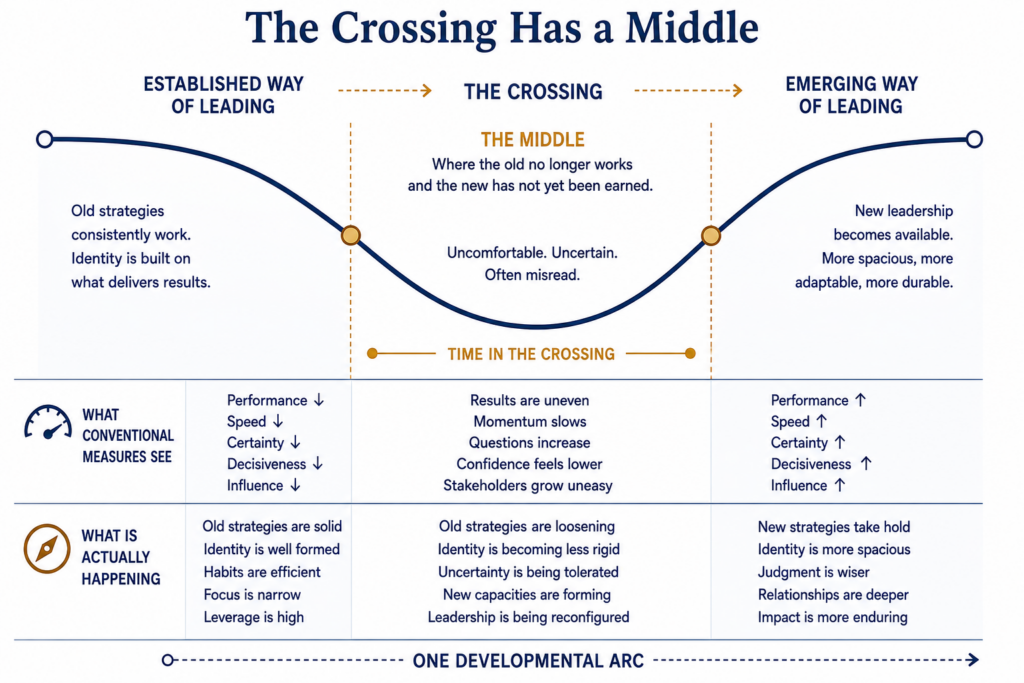
FIGURE 2 The crossing has a middle. Measured against the instruments of the world below, a leader inside it reads as declining rather than developing.
08 – The Mirror I Did Not Have
The third paper established why leaders cannot locate themselves: no lens examines itself. At the Fence that limitation becomes acute, because by then the observer has grown identified with what is observed. I will say here what it is like to stand there with no one to hold the mirror.
The fourth paper named my own strength plainly. I built a career on articulation, and when my leadership began to flatten I analyzed the flattening, which was the most sophisticated form of avoidance available to me.
What I did not say there was how long I stayed in it, or why. Nothing in my environment corrected me. The results were still good, the praise still arrived, and everyone around me had excellent reason to keep telling me what had always been true, which was that this was the thing I was best at.
What I lacked was not effort, and it was not willingness. It was two things I could not supply for myself. I could not see the fence, because it was built out of the parts of me I was least likely to examine. And I could not see what was on the other side of it, because from where I stood there was nothing there.
Open country is not visible from inside a structure assembled from your own achievements. What was visible was the ground I had built, and it was good ground. I stayed on it a great deal longer than I needed to.
I name it plainly because I have since found it in nearly every executive I have assessed. The problem at the Fence is rarely that a leader lacks the courage to cross. It is that no one has shown them there is a line, and no one has described the country beyond it in terms they can recognize as leadership rather than as loss.
Asked to give up certainty or indispensability with nothing named on the far side, any competent person declines. That is not a failure of nerve. It is a reasonable response to half a picture.
Both halves eventually arrived, and not from a program. They came from someone standing outside my instrument who was willing to say what they saw. I did not receive it well. I defended the record and the reasoning, and was still defending when I noticed the defense was itself the evidence. Nothing about my capability changed in that hour. What changed was that the fence became visible.
A rigorous assessment is not a verdict. It is a mirror, and its value is not the advice but the fact that the fence becomes visible.
That is what a framework-based assessment is for. It maps a leader against the four capacities and shows where each has moved from tool to identity, and it describes the far side, which is the half more often left out. Not as an ideal, and not as a personality anyone is required to acquire, but as the specific way that leader’s own leadership would work if one particular board came down.
09 – From Compulsion to Choice
The language of leadership development has been the language of accumulation, and it remains a worthy one. Yet the question eventually changes. Growth stops asking what else can I add and begins asking what am I no longer required to carry. The answer is never competence. It is attachment: to certainty, to expertise, to indispensability, to the identities competence patiently constructed.
Those identities deserve respect, because each emerged in response to a genuine challenge and each helped the leader navigate uncertainty and earn trust. The difficulty was never that we built them. It is believing we must stay confined within them.
Mature leadership is an act of increasing freedom rather than self-reinvention. The leader who no longer needs certainty becomes more discerning, the one who no longer needs recognition more generous, the one who no longer needs to be indispensable creates the conditions for everyone else to grow.
Not from weakness to strength, but from identification to freedom. Not from ignorance to knowledge, but from compulsion to choice.
10 – Standing at the Fence
The Fence does not come down all at once, and it should not. Its boards were earned and most still hold weight. The work is quieter than demolition: seeing the structure clearly enough to choose, board by board, which ones still raise you and which only block the view.
So it is worth standing at the Fence for a moment, not to evaluate anyone else, but to locate yourself. The questions below are not solved but lived, and leaders who can sit inside them without rushing to resolve the discomfort are already doing the one thing the Fence was built to prevent. They are looking over it.
Five Questions
Development accelerates when leaders ask what they are no longer required to carry. Before turning the page, sit with the following for a few minutes.
— Which of my strengths do I no longer use so much as obey?
— Where am I still adding to a problem that no longer calls for more?
— Can I say I do not know in a room that expects me to have the answer?
— When did I last let another person’s success emerge without reaching in to shape it?
— What am I still working to prove that was proven long ago?
The answers may reveal less about what you still need to acquire than about what you are no longer required to carry.
CONTINUE THE CONVERSATION
What are you still carrying?
Every executive is somewhere on this journey, and almost every one of them has a fence they cannot see from the inside. Some are still building the disciplined action a career is founded on, others are sharpening the judgment that turns effort into insight, and a few have begun leading from conviction and presence rather than consensus and control. Most are strong in the capacities that made them, and quietly held in place by them.
That is the difficulty. We are poor judges of our own development. We know what we have achieved, and we are far less certain about what we are still required to carry.
The Leadership Arc Assessment maps a leader against the four capacities and turns the fog of self-assessment into a clear set of coordinates. It surfaces where a strength has quietly become an identity, shows which board to reach for first, and describes what the leadership on the other side of it would actually look like.
The objective is not simply to become more capable. It is to become more free.
Because every meaningful journey begins by knowing where you are.
The next paper in this series takes up the machinery underneath the refusal. If the boards go up one reasonable defense at a time, something is handing the leader the hammer. It examines the self-reinforcing patterns that keep a capable executive circling the same ground for years, why each turn of a pattern manufactures the evidence that justifies the next, and why the leaders who stay inside one longest are so often the most intelligent people in the organization.
NOTE: Bibliography and references available upon request. The ideas, arguments, frameworks, and conceptual architecture presented in this paper are the original work of the author. Artificial intelligence was used as a collaborative writing and editorial tool to assist in drafting and refining the prose. All substantive judgments, interpretations, and conclusions are the author’s, who retains full responsibility for the final content.
© 2026 CaMiNa Consulting. All rights reserved.