
Why leadership is granted rather than given, and why the deepest legitimacy always flows in both directions.

01 – Executive Summary
Titles may compel compliance. Only legitimacy inspires commitment.
Every organization believes it knows how leaders are created. A search committee identifies exceptional candidates. Interviews are conducted, references are checked, the board deliberates, a decision is reached. An executive is appointed, a title is conferred, and formal authority is transferred. From the perspective of the organization, leadership appears to have begun. From the perspective of the people who must now choose whether to follow, it has not.
That distinction may be one of the least understood and most consequential realities of organizational life. Organizations appoint executives; communities create leaders, and those are not the same act. One is administrative and instantaneous, the other social and slow. One grants authority, the other grants legitimacy. Confusing the two lies behind many of the disappointments that accompany executive transitions.
Organizations frequently assume that once authority has been transferred, leadership will naturally follow, and they invest heavily in recruitment, succession planning, onboarding, and ninety-day plans. Those investments matter, and they address only the visible side of leadership.
Every organization is simultaneously two organizations: the formal one of reporting lines and decision rights, and the human one of trust, unwritten norms, and quiet influence carried by people whose names rarely appear on a succession plan. Executives inherit the first immediately and none of the second. That second organization must invite them in.
This explains why executive transitions confound even experienced boards. Two leaders may possess similar credentials and nearly identical records of success, and yet one rapidly gains the confidence of the organization while the other struggles to create momentum despite making sound decisions.
The difference is seldom found in strategy. It is found in legitimacy, which cannot be delegated, negotiated, or demanded. It exists only when people voluntarily decide that another person has earned the right to influence their future. Trust is confidence in a person’s reliability. Legitimacy is confidence in a person’s right to lead.
Every enduring institution has understood this. Political authority rests on the consent of the governed, judges on the standing of the legal system, religious communities on moral authority. When legitimacy erodes, formal authority remains intact for a time while its ability to mobilize commitment steadily declines. Organizations are no different.
THE SILENT WITHDRAWAL If legitimacy is granted silently, it is also withdrawn silently. There is no vote, no memo, no meeting at which a community informs a leader that it has quietly stopped following. The signals are almost imperceptible: candor thins, initiative slows, difficult information begins arriving late or not at all. A leader can retain every ounce of formal authority and have lost the organization months earlier without ever being told. Most executives who fail do not fail loudly. They preside, capably, over an organization that has stopped granting them the one thing their title cannot supply.
This places executive onboarding in a different light. The first hundred days are not primarily about learning a business, nor even about demonstrating competence. They are about entering a community, where every meeting is an act of introduction and every decision a piece of evidence. Each interaction quietly answers a question no employee ever asks aloud. Should we grant this person legitimacy? Everything else depends on that answer.
That question is where this series has been heading. The first paper argued that leadership cannot be read from behavior alone, because behavior emerges from an underlying stage of development, and named the threshold every paper since has returned to. The second established what it costs a leader to meet that threshold without a map, and who receives the invoice.
The third argued that a map is unusable until a leader knows where they are standing on it. The fourth took the resulting ceiling apart and found it built from a leader’s own successes, and the fifth mapped it capacity by capacity. The sixth set out the nine loops that keep capable people circling. The seventh separated authorship from the rebellion that imitates it. The eighth found the leader’s work moving from answering the question to making a better one possible, and the ninth traced the six principles of influence across the Arc and found each of them changing meaning at every level.
Every one of those papers examined what happens inside a leader. This one turns outward, to the people who decide whether any of it will matter. Authority gives leaders permission to act. Legitimacy gives people a reason to follow. The distinction appears subtle and it changes everything. And by the final pages it will change once more, because legitimacy does not flow in only one direction.
Authority answers the question of who has the right to decide. Legitimacy answers the deeper one of whom we are willing to follow.
This paper is the tenth in a series introducing the Leadership Arc.
ON SCREEN Master and Commander: The Far Side of the World (dir. Peter Weir, 2003; 20th Century Fox)
Aubrey holds a commission from the Admiralty, and so does Hollom. One of them the crew will follow into an unwinnable fight. The other they will not follow across the deck. Nothing in the paperwork distinguishes the two men. The ship has made a judgment the Navy never asked it to make, and it is the ship’s judgment that decides what happens next.
Executive reflection. Where in my organization does my authority currently exceed my standing?
02 – Why Communities Grant Legitimacy
Imagine two organizations. In the first, a new chief executive is appointed on Monday morning. The announcement is enthusiastic, the board unanimous. Employees attend a town hall where the executive presents an inspiring vision. When the meeting ends, everyone returns to work. The title has changed. The organization has not.
Now imagine a second organization. The same executive arrives and begins with questions rather than answers, spending weeks listening across every level. Decisions are made carefully, and existing successes are acknowledged before improvements are proposed. People notice something unexpected: this leader is trying to understand before trying to change. Months later, the organization embraces initiatives that would have been resisted on the first day. The strategy has not changed. The relationship has.
Leadership is never evaluated independently of the relationship between the leader and the community. Communities do not merely ask whether something is a good idea. They first ask whether this is a person whose judgment they trust. That is the function of legitimacy.
Legitimacy Solves a Human Problem
Organizations often describe themselves as systems, and so they are, though not mechanical ones. They are human systems, and human beings have always faced a fundamental challenge whenever leadership changes. How do we decide whom to trust? The question is ancient. Long before corporations existed, tribes, cities, guilds, universities, armies, and religious communities all confronted the same uncertainty. A new leader arrives, and the community must decide whether to follow, wait, or resist.
No community survives if it grants unquestioning allegiance to every new authority figure, and none survives if it refuses every new leader either. Communities therefore evolved something sophisticated. Authority answers the legal question of who has been placed in charge. Legitimacy answers the social one of whether this person has earned our confidence. Every healthy community performs that evaluation, not because people are resistant but because they are responsible.
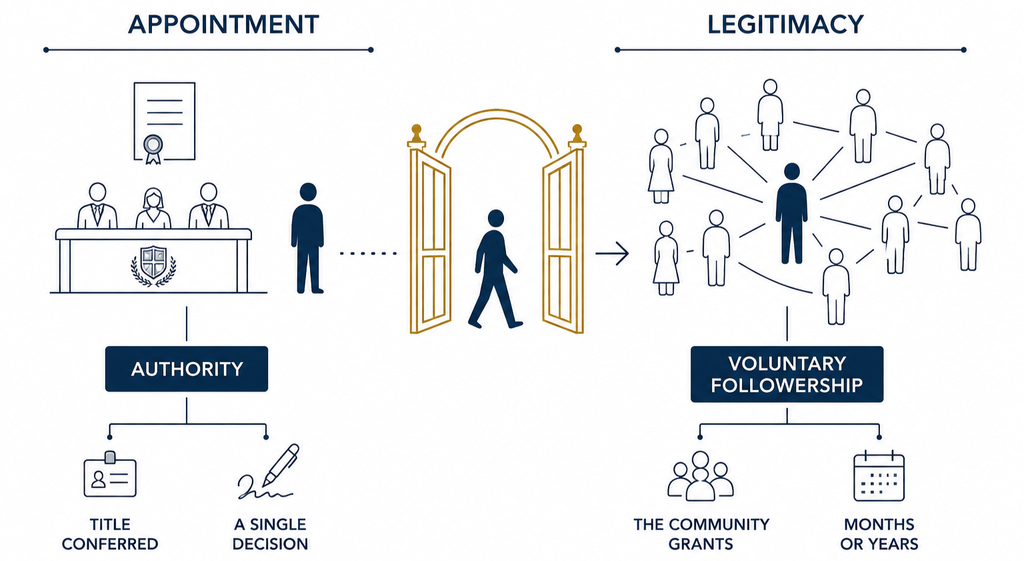
FIGURE 1 The Two Births of Leadership. Appointment transfers authority. Leadership begins only when a community grants legitimacy, turning positional authority into voluntary followership.
03 – The Organization Beneath the Organization
Most executives believe they are being evaluated on performance, and they are, though not initially. During the earliest weeks the organization is constructing a story about the new leader, and every meeting quietly answers questions no performance review ever includes. Does this person genuinely listen? Can disagreement be expressed safely? Will experience be respected? Does this executive make people feel larger, or smaller?
Almost none of those questions concern technical expertise, because the organization already assumed competence when the hiring decision was made. What employees are evaluating is far harder to measure: judgment, humility, presence, character, stewardship. These cannot be demonstrated through a résumé. They can only be experienced, which is why legitimacy develops so slowly.
There is a second, stranger truth hidden in that evaluation. In the earliest weeks, before the community has any direct experience of the leader at all, legitimacy is already moving, borrowed from others. When a respected veteran is seen speaking warmly with the new executive, when a trusted connector chooses to explain rather than withhold, the community reads it instantly. Someone we already believe in has decided to extend belief. Legitimacy is contagious before it is personal.
This is why whom a leader is seen with in the first month matters more than what a leader says, and why the fastest way to squander a transition is to arrive flanked only by outsiders. A community will lend a newcomer the credibility of the people it already trusts, but only for a while, and only as an advance against legitimacy the leader is still expected to earn in person.
The organization beneath the organization rarely appears in leadership textbooks, and it determines whether strategies spread or stall, whether change accelerates or quietly dies, and whether authority eventually becomes leadership. It consists of conversations, shared memories, trust accumulated over years, invisible loyalties, and cultural expectation. Successful integration therefore depends less on understanding reporting relationships than on identifying the trusted advisors and cultural connectors who shape how legitimacy actually moves.
Why Expertise Is No Longer Enough
For much of the twentieth century, organizations could assume that technical expertise naturally produced authority, and the person who understood the business best frequently became the leader. Knowledge is now democratized, artificial intelligence can summarize markets, and algorithms can recommend decisions. Technical expertise remains indispensable and is simply no longer sufficient.
The defining challenge of executive leadership is no longer possessing the best answers. It is creating the conditions under which intelligent people choose to solve difficult problems together, and that requires something technology cannot manufacture. Legitimacy is what turns compliance into commitment, coordination into collaboration, and authority into leadership. Which brings us to the central challenge of every executive transition. If legitimacy cannot be appointed, how is it earned?
Communities do not withhold legitimacy because they distrust authority. They withhold it until authority has demonstrated that it can be trusted with the community itself.
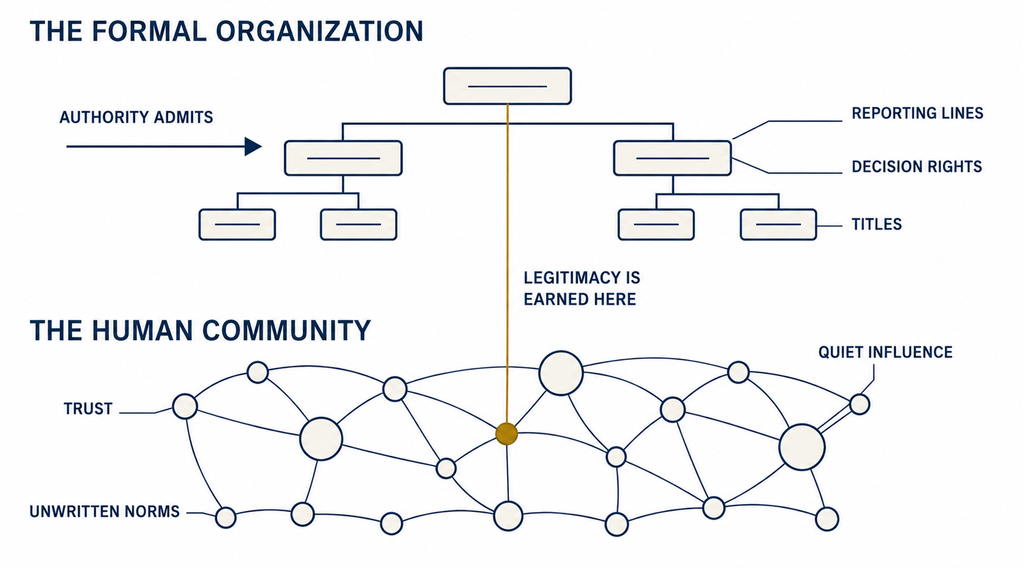
FIGURE 2 The Two Organizations. Every enterprise is at once a formal institution and a human community. Authority admits a leader to the first. Legitimacy is earned only in the second.
04 – The Five Thresholds of Legitimacy
Communities rarely hold explicit discussions about legitimacy. Instead it emerges through a sequence of thresholds, each requiring something the last did not. This is not a checklist a leader completes. It is a series of crossings a community permits. People begin with caution and move toward trust, trust becomes confidence, confidence becomes commitment, and commitment eventually becomes something a community will defend as its own. The process is almost invisible while it is happening.
Across a great many executive transitions I have watched from close range, the same pattern keeps appearing. Communities grant legitimacy through five successive thresholds, each making the next possible, each answering a deeper human question, and each asking something of the leader in return.
The First Threshold: Invitation
The first gift a community offers a new leader is a fragile one. It allows the leader to see it. Not the polished version presented in annual reports, but the real organization, with its aspirations and frustrations, its heroes and disappointments, its unwritten rules and unfinished conversations. This is not automatic. Communities reveal themselves only to leaders who demonstrate genuine curiosity. When executives arrive believing their primary responsibility is to explain, organizations protect themselves. When leaders arrive intending to understand, organizations begin opening doors.
Invitation is therefore more than information gathering. It is permission, and understanding always begins as a gift rather than an entitlement. The community opens the door. It has not yet decided to let the leader stay.
The Second Threshold: Vulnerability
Trust is often misunderstood. Many assume it develops through charisma, others that it grows from confidence. In reality it emerges from consistency, and consistency is only tested when something is at risk. People notice whether promises are kept, whether difficult conversations are welcomed, and whether humility remains visible after authority has been granted.
But the deeper movement here is mutual. A community does not merely watch the leader take risks. It begins taking risks of its own. Someone voices a dissent they would once have kept silent. Someone shares a failure rather than concealing it. Each time the leader receives that exposure without punishing it, the community risks a little more.
Trust is not the leader proving reliable to a passive audience. It is two parties becoming willing to be hurt by each other, one careful act at a time. That is why legitimacy cannot be accelerated. Vulnerability is never the product of a single extraordinary moment. It is the cumulative result of hundreds of ordinary ones in which no one was made to regret their openness.
The Third Threshold: Recognition
Once trust begins to develop, something subtle changes. The organization starts introducing the executive to its invisible network, recommending whom to meet, explaining historical context, quietly translating the unwritten language. The executive discovers that influence rarely follows the organizational chart, moving instead through people who accumulated credibility over years of faithful contribution.
Yet recognition, like trust, runs in both directions. As the community reveals its true influence carriers, the leader is asked to recognize them in turn: the modest title that carries enormous weight, the quiet veteran whose blessing moves a room, the contributor whose judgment the organization has trusted for a decade.
The leader who honors what those people have built is recognized as a leader in return. The one who mistakes the org chart for the organization is quietly filed as an outsider who never understood the place. Influence is not inherited with authority. It is exchanged.
The Fourth Threshold: Shared Identity
There comes a point when the executive and the organization stop solving problems in parallel and begin solving them as one. Initially the organization evaluates the leader, later it collaborates with the leader, and eventually the boundary blurs. This is the true crossing. Ideas become collective, victories become shared, and success is no longer read as the achievement of an exceptional executive but as evidence of who this organization is now becoming.
This is why the purpose of early wins is so widely misread. Their value is not to showcase the executive’s capability. It is to let the community feel itself becoming more capable in the leader’s presence.
When people begin saying we where they once said the new executive, identity has crossed a line that strategy never could. Communities grant legitimacy most readily not when the leader succeeds, but when the community succeeds and recognizes the leader as part of the reason.
The Fifth Threshold: Stewardship
At the first four thresholds, legitimacy flows one way. The community evaluates, extends, and grants. The fifth is where that direction reverses, and it is the crossing most leaders never consciously recognize. Leadership at this point is no longer declared or even earned. It is entrusted.
One day people stop referring to the new executive and the adjective quietly disappears. Meetings become more candid, difficult information arrives earlier, and people ask not what the executive wants but where we are going. The leader now faces the question legitimacy exists to pose. Having been trusted with a community’s future, what will they do with it?
This is stewardship, and it is the moment the leader begins granting legitimacy back. Having been recognized, they now recognize others. Having been trusted, they extend trust. Having been invited in, they begin opening doors for people who could not open them alone.
The community made the leader possible, and the leader now makes the community more than it believed it could be. Only here does leadership become what it was always meant to be: not the exercise of power, but the acceptance of responsibility by someone a community has decided to follow, in service of people who will one day surpass them.
THE PRICE OF THE CROSSING Each threshold asks the leader to surrender the protection of the last. To be invited in, the executive must give up the safety of explaining and risk not yet knowing. To earn trust, they must let the community wound them without retaliating. To be recognized, they must accept that the real map of the organization is not the one they were handed, and honor its keepers. To share identity, they must let my achievement dissolve into ours. And to reach stewardship, they must surrender the sweetest reward of all, which is being the one the story is about. The leader who insists on legitimacy has revealed they never crossed the first threshold. The leader who hoards it has stopped at the fourth.
DEVELOPMENTAL MOVEMENT Invitation ▸ Vulnerability ▸ Recognition ▸ Shared identity ▸ Stewardship
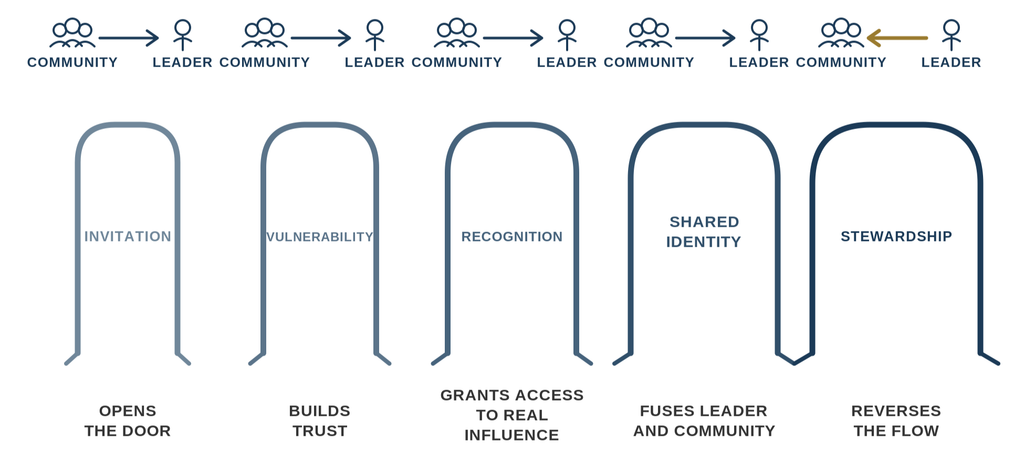
FIGURE 3 The Five Thresholds of Legitimacy. Invitation opens the door, vulnerability builds trust, recognition grants access to real influence, shared identity fuses leader and community, and stewardship reverses the flow.
05 – Legitimacy Flows Both Ways
When executives describe the most important moments of their careers, they speak about promotions, acquisitions, or strategic breakthroughs. Rarely do they mention the moment they actually became leaders, perhaps because no one ever sees it happen. There is no ceremony and no change in title, and yet something important has occurred. The organization no longer follows because it must. It follows because it chooses to.
Most treatments of leadership would end there, and for most of this paper we have written as though the story runs in a single direction: the community evaluates, the community grants, the leader receives. That account is true. It is simply incomplete. The leaders a community remembers longest are not the ones who received legitimacy most fully. They are the ones who gave it back.
Consider what the fifth threshold actually asked. A community, over months or years, decided to entrust a leader with its future, extending the rarest thing a group of human beings can offer another person: the voluntary right to shape what happens to them. That gift places the leader in possession of something they did not manufacture and cannot keep by holding tightly.
Legitimacy is not a possession to be accumulated. It is a current to be completed.
This is the reversal the whole journey was moving toward. The community’s gift to the leader is legitimacy, the right to be followed. The leader’s gift to the community is larger and stranger: the experience of discovering capacities it did not know it had, ambitions it had been afraid to name, a version of itself it could not have reached alone.
One party grants the right to lead and the other grants the ability to become, and neither is complete without the other, because a current only carries force when it flows both ways.
This is why the finest leaders grow more humble rather than more certain as their legitimacy deepens. What they hold was never theirs to begin with. It was entrusted, and it is spent not by keeping it but by giving it away.
The executive who develops successors, builds institutions that will outlast them, and lifts people into rooms they were told they did not belong in is not being generous with legitimacy. They are completing it. Legitimacy that is only received curdles into entitlement. Legitimacy that is returned becomes legacy.
DEVELOPMENTAL MOVEMENT Appointed ▸ Tolerated ▸ Trusted ▸ Entrusted ▸ Returned
06 – Beyond Executive Transitions
Although this paper has focused on executive appointments, its central insight reaches much further. Every promotion, merger, and newly formed team creates a new community, and even founders must continually earn legitimacy as organizations grow beyond the intimate relationships on which they were built. Leadership therefore never becomes permanent.
Every new challenge asks the same two-sided question. Of the leader: will we continue following you? And of the community, though few leaders think to ask it: are we becoming more because of you, or merely managed by you?
The greatest leaders eventually discover that legitimacy is never something they possess. It is entrusted, and it is meant to be handed onward. That changes the purpose of leadership itself. It is no longer about directing people toward a destination. It becomes the stewardship of a community that has freely placed its confidence in another human being, confidence that cannot be commanded or inherited, only earned and then honored by being returned.
Each earlier paper in this series worked inward, toward a more complete leader. This one turns that around. Conversations construct shared reality, shared reality is what makes a community, and it is community rather than the organization that grants a leader the right to lead.
Willing, Thinking, Feeling, and Being were never capacities a leader accumulates for their own advancement. They were always capacities held in trust for other people, and the point of a more complete leader is a more complete community.
07 – What Leadership Is Remembered For
Perhaps the most enduring misconception about leadership is that organizations create leaders. They do not. Organizations appoint executives and communities create leaders. The first requires a decision and can happen in a single afternoon. The second requires a relationship and may take years. And the deepest act of all, the leader granting that legitimacy back, may outlast the leader entirely.
ON SCREEN It’s a Wonderful Life (dir. Frank Capra, 1946; RKO Radio Pictures)
George Bailey never keeps a ledger. Decades of unreciprocated giving look, by every measure he has been taught to use, like a life of failure. What the final scene reveals is not that his generosity was repaid. It is that a town had quietly been deciding, all along, what he was to them. The legitimacy was never his to count. It was theirs to return.
Executive reflection. If my organization were asked tomorrow what I have been to it, what would it say?
Every one of us can remember a leader who changed us, and not because of the authority they held or the strategies they chose. We remember them because in their presence we became more than we thought we were: more capable, more courageous, more fully ourselves. They saw something in us before we could see it and then made room for it to grow. That is what legitimacy, returned, actually feels like from the inside, and it is why years later we still measure ourselves against who they helped us become.
Leadership, in the end, is not remembered for the power it exercised but for the people it helped become. Organizations can appoint your authority and communities can grant your legitimacy. Only you can decide what to do with the trust once it has been given, and whether the people who followed you will leave larger than they arrived.
The community grants the privilege of leading. The leader grants the dignity of becoming. Between those two gifts, and nowhere else, leadership actually lives.
Five Questions
Legitimacy is the one thing about your leadership you cannot assess from inside your own office. Before turning the page, sit with the following for a few minutes.
— Where does my authority currently exceed my standing?
— Which threshold have I actually crossed, and which am I assuming I crossed?
— Who here holds influence that appears nowhere on the org chart, and have I honored it?
— When did someone last bring me difficult information early rather than late?
— What am I spending my legitimacy on, and who is larger for it?
The answers say less about the authority you hold than about what the organization has quietly decided to do with it.
CONTINUE THE CONVERSATION
Where does your leadership come from?
Every executive is somewhere on this journey. Some are still earning authority through competence and results, others have begun converting that authority into trust, and a few have crossed into legitimacy, the point at which people follow not because they must but because they choose to. Fewer still have reached the final crossing, where legitimacy is spent as fast as it is received, on the growth of everyone else. Most cannot say, from the inside, which of these is true of them.
That is the difficulty. We know the authority we have been given and are far less certain about the legitimacy we have earned, and we rarely think to ask whether we are returning it. Nobody is likely to volunteer the answer, because the moment a community stops granting legitimacy is the same moment it stops telling you things.
The Leadership Arc Assessment maps a leader against the four capacities, turning the fog of self-assessment into a clear set of coordinates. It identifies where authority is strong but legitimacy is still forming, surfaces the assumptions that may be limiting trust, and clarifies the crossing that matters most next.
The objective is not simply to become more capable. It is to become the leader others leave larger for having followed.
Because every meaningful journey begins by knowing where you are.
The next paper in this series leaves the boardroom for a much older story. Three thousand years ago a poet described a king who won his war and then spent ten years failing to get home, and the delay is the whole point. Every island, every storm, every setback in that voyage exists to change the traveler, and the four energies this series has followed run straight through it. That paper reads the journey as what it has always been: a developmental map, written long before anyone had the language for one.
NOTE: Bibliography and references available upon request. The ideas, arguments, frameworks, and conceptual architecture presented in this paper are the original work of the author. Artificial intelligence was used as a collaborative writing and editorial tool to assist in drafting and refining the prose. All substantive judgments, interpretations, and conclusions are the author’s, who retains full responsibility for the final content.
© 2026 CaMiNa Consulting. All rights reserved.