
Why every leadership capacity carries the seed of its own distortion, and why the strength that built a career is often the one that ends it.

01 – Executive Summary
To whom much is given, much will be required. Luke 12:48
Leadership development has always been understood as the expansion of human capability. We work to become more decisive, more inventive, more grounded, more present. We acquire competencies, widen perspective, and accumulate the kind of experience that cannot be taught. Progress looks like a steady accumulation of strength, and for a long stretch of a career that is exactly what it is.
After twenty-five years of assessing and coaching senior executives, I have come to notice a pattern that most leadership models leave alone. The capacities that distinguish an exceptional leader are very often the same capacities that later undo them. Determination hardens into control. Innovation drifts into novelty. Authenticity becomes an identity to be defended. Presence quietly becomes distance. The problem is not the capacity. The problem is stewardship.
Every increase in leadership capacity brings a corresponding increase in the responsibility required to carry it well. Left unattended, a developmental gift drifts away from the purpose it was given for, and the drift is almost never visible while it is happening.
Nothing in leadership is more dangerous than a strength that has stopped asking what it is for.
That claim rests on everything this series has built. The first paper argued that leadership cannot be read from behavior alone, because behavior emerges from an underlying stage of development, and named the threshold every paper since has returned to. The second established what it costs a leader to meet that threshold without a map, and who receives the invoice.
The third argued that a map is unusable until a leader knows where they are standing on it. The fourth took the resulting ceiling apart and found it built from a leader’s own successes, and the fifth mapped it capacity by capacity.
The sixth set out the nine loops that keep capable people circling. The seventh separated authorship from the rebellion that imitates it. The eighth located development in conversation rather than in insight. The ninth traced the six principles of influence across the Arc. The tenth argued that organizations appoint executives while communities grant legitimacy, and the eleventh found the same four movements already mapped in Homer.
Eleven papers about how capacity is built. This one is about what happens to capacity once it exists. It proposes a straightforward revision to how we think about leadership maturity. Leadership is not simply the expansion of capacity. It is the continual stewardship of capacity.
This paper is the twelfth in a series introducing the Leadership Arc.
ON SCREEN The Bridge on the River Kwai (1957), directed by David Lean
Colonel Nicholson’s initiative is real and, for a time, redemptive. It restores discipline, dignity, and purpose to men who had lost all three. Then the bridge stops being a means of preserving his soldiers and becomes proof of what he is, and by the closing scene he is defending it against his own side. Nothing in his character changed. His initiative simply found a new center to serve.
Executive reflection. Where has my involvement stopped being necessary and started being required by me?
02 – The Missing Conversation
Leadership literature has made real progress over the past half century. We can describe competencies with precision, measure emotional intelligence with reasonable confidence, and speak intelligently about resilience, influence, purpose, and adaptive work. Nothing here argues against any of them. They simply leave one question largely unanswered. What protects a leader’s greatest strengths from becoming their greatest liabilities?
Experience does not, since experience accumulates automatically and judgment does not. Competence does not, because competence describes range rather than direction. Character alone does not either, as anyone who has watched a genuinely good person become impossible to work for can attest.
History keeps producing the same demonstration. The decisive executive becomes controlling. The visionary stops listening. The servant leader develops a quiet dependence on being admired for serving. The wise leader withdraws from the action their organization needs them to take. In none of these cases did the leader abandon their strength. They became identified with it, which is a different thing entirely and much harder to see from the inside.
The paradox is structural rather than moral. Growth creates capacity, capacity creates influence, and influence creates a set of responsibilities the leader did not previously carry. When the ability to carry those responsibilities grows more slowly than the influence itself, growth begins working against the person who achieved it.
03 – The Direction of a Gift
What Competencies Cannot Tell Us
One of the central propositions of the first paper was that competencies alone cannot explain extraordinary leadership. Competencies describe what leaders do. They tell us whether an executive can negotiate a conflict, build a strategy, or deliver a result, and they answer a useful question: can this leader perform the task?
Capacities answer a different question. Can this leader hold the complexity the task requires? An executive may possess exceptional strategic competency and very little capacity to tolerate uncertainty. Another may communicate brilliantly and lose their center the moment the room turns hostile. Competencies explain behavior. Capacities explain the consciousness from which behavior emerges.
The Arc proposes four of them. Initiative is the capacity to generate movement. Innovation is the capacity to create new possibility. Intrinsic is the capacity to remain internally grounded. Immersive is the capacity to remain fully present inside complexity.
These are living capacities rather than static traits, and together they form the architecture by which a leader travels toward the purpose their leadership exists to serve.
A Different Definition of Shadow
Carl Jung introduced the shadow to describe the parts of ourselves that remain outside conscious awareness. The shadow this paper is concerned with is related but not identical. Leadership shadows do not arise only from what we repress. They arise from what we value most.
Every developmental capacity has a native direction. Initiative exists to create movement toward meaningful outcomes. Innovation exists to create value through new possibility. Intrinsic exists to align action with inner truth. Immersive exists to cultivate presence within uncertainty.
For as long as these capacities stay oriented toward service, they become steadily more generative. When they begin orienting instead toward preserving identity, reputation, certainty, or control, they start expressing themselves in distorted forms.
The capacity remains fully intact. Only its direction has changed. Leadership failure rarely begins with the loss of strength. It begins with the loss of orientation.
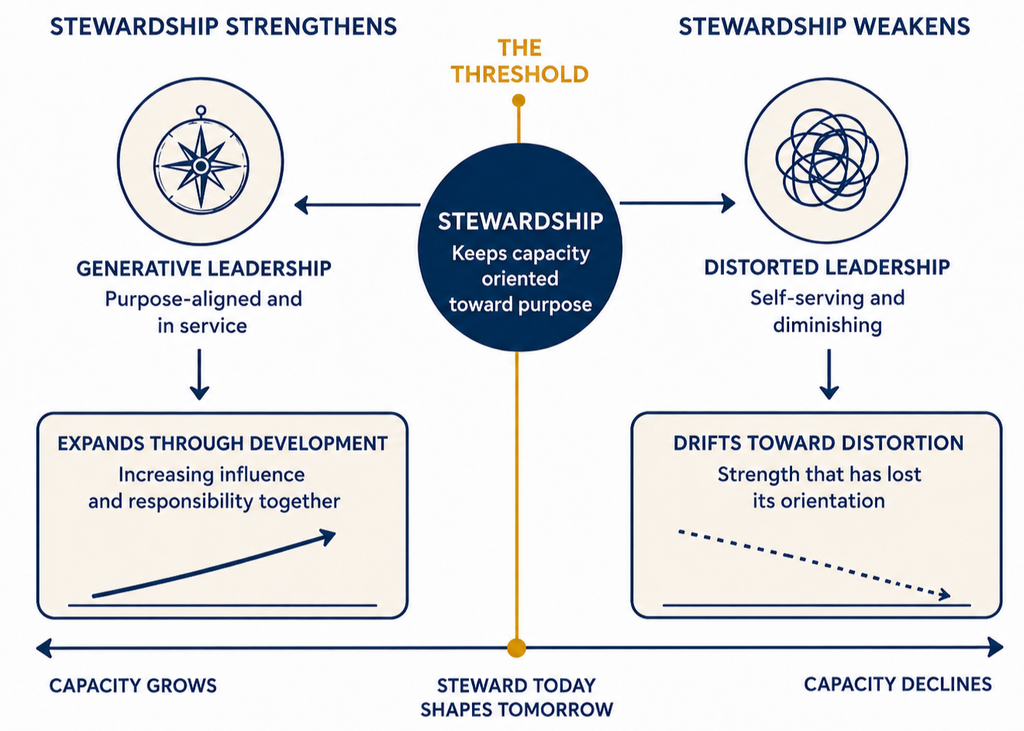
FIGURE 1. Every leadership capacity requires stewardship. Capacities expand through development, increasing influence and responsibility together. While stewardship keeps a capacity oriented toward purpose, it remains generative. When stewardship weakens, the same capacity drifts toward a predictable distortion. The shadow is not the opposite of strength. It is strength that has lost its orientation.
04 – The Long Conversation About Stewardship
If every leadership capacity tends toward distortion, the obvious question is why. Why should the capacities that make extraordinary leadership possible also contain the seeds of extraordinary failure?
The proposition is not new. Its roots reach back more than two thousand years, and across philosophy, psychology, and developmental science a series of remarkable thinkers have circled the same question: how does human strength become human wisdom?
Aristotle: The Ethics of Proportion
The first insight belongs to Aristotle. In the Nicomachean Ethics he proposed that excellence lies not in excess but in proportion, with every virtue positioned between two distortions. Courage sits between cowardice and recklessness, generosity between selfishness and extravagance. Virtue was never static for him. It required continual judgment: the right action, in the right measure, at the right time, for the right reason. Leadership works the same way. The useful question is never whether a leader possesses a quality, but whether they are expressing it in proportion.
The Arc accepts this completely and then extends it. Rather than treating leadership as the balancing of isolated virtues, it proposes that maturity emerges through the dynamic integration of four capacities, each continually regulating the others. Balance is not only an ethical matter. It is a developmental one.
Jung: The Psychology of Shadow
If Aristotle explained virtue, Jung explained why virtue alone is insufficient. He observed that every personality carries dimensions outside awareness, and his contribution was radical because it challenged the assumption that self-knowledge is ever complete. Human beings retain, permanently, the ability to deceive themselves.
Executive life confirms this daily. Few leaders consciously choose arrogance, and very few wake up intending to value reputation above truth. The movement is nearly always unconscious, which is exactly why it is nearly always denied.
Jung explains why we fail to see it. The Arc explains how it forms.
Frankl: Responsibility Beyond the Self
Viktor Frankl contributed what may be the most consequential idea in this lineage. Meaning is never discovered through self-preoccupation, and it always points beyond the individual. Leadership obeys the same law.
These capacities stay healthy only while they continue pointing beyond the leader, and the moment they begin protecting identity rather than advancing purpose, the drift has already started. Capacities do not become dangerous because they grow. They become dangerous when they stop serving something larger than themselves.
Kegan: The Development of Consciousness
Robert Kegan supplied the final piece. His work demonstrated that adult development is not primarily the acquisition of knowledge but the transformation of the structure through which we make meaning, and that each developmental achievement eventually becomes inadequate for the complexity that follows. The perspective that once made growth possible becomes the next limitation.
Leadership capacities behave in precisely this way. Development does not eliminate distortion. It refines it, which is why senior leaders so rarely fail in obvious ways.
What the Leadership Arc Adds
Aristotle teaches that virtue requires proportion. Jung teaches that self-awareness is never complete. Frankl teaches that meaning must point beyond the self. Kegan teaches that every developmental achievement eventually becomes insufficient.
The Arc attempts to gather these insights into a single developmental architecture, and its contribution is neither another list of competencies nor another theory of personality nor another stage model. It is a principle. Every leadership capacity contains within itself the potential for both contribution and distortion.
As a capacity grows, two movements occur at once. Its power to create value expands, and so does its power to distort value. Leadership maturity therefore cannot be measured by capability alone. It has to be measured by stewardship as well. This may be the missing conversation in executive development. We have devoted enormous attention to helping leaders become more capable and remarkably little to helping them carry that capability wisely.
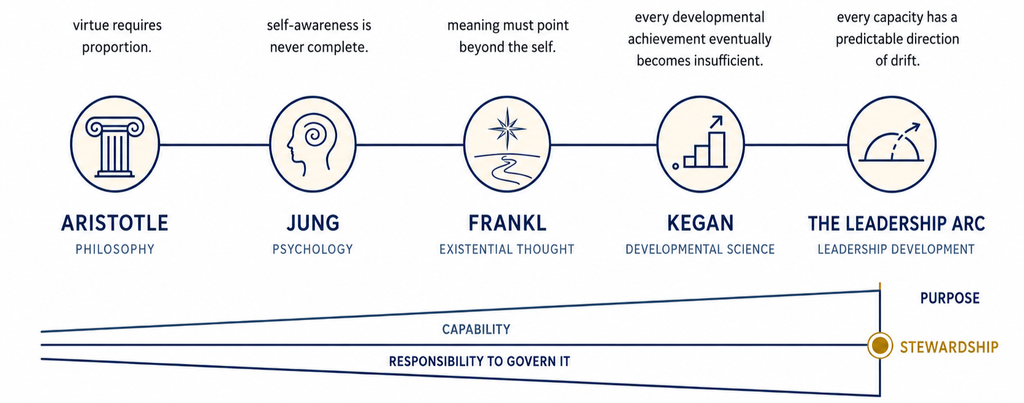
FIGURE 2. The evolution of stewardship. Across philosophy, psychology, existential thought, and developmental science, one pattern recurs. Human growth is not only the expansion of capability but the increasing responsibility to govern it. The Leadership Arc joins that line by proposing that every leadership capacity has a predictable direction of drift, and therefore requires continual stewardship to stay oriented toward purpose.
05 – The Four Capacities and Their Stewardship Risks
Every capacity exists for a reason. Each enlarges the leader’s ability to create value and moves the organization closer to its purpose. But no capacity is self-governing. Left unattended, each one gradually begins serving itself, and the gift that once enlarged the organization starts protecting the identity of the leader. This is not failure. It is gravity. Every developmental capacity experiences a constant pull toward self-preservation.
THE GRAVITY OF SUCCESS The pull is strongest immediately after a success, because success supplies both the evidence that the capacity works and the sense of identity that makes questioning it feel unnecessary. The most dangerous moment in an executive’s development is rarely the failure. It is the year following the win.
Initiative: The Capacity to Begin
Initiative turns intention into action. It accepts responsibility before certainty exists, and organizations depend on it because nothing meaningful starts until someone chooses to act. Healthy Initiative creates momentum and gives other people permission to move, which is why it tends to multiply itself throughout an organization and produce more leaders.
The qualities that make it powerful also create its danger. The leader gradually comes to believe that progress depends on their personal involvement. Responsibility becomes ownership, ownership becomes control, and control becomes identity.
The governing question changes without announcement, from what will best serve the mission to what happens if I do not do it myself. Initiative shifts from empowering people to replacing them, and the organization grows dependent on the very leader who set out to build independence. The capacity has not disappeared. Its direction has changed.
DEVELOPMENTAL MOVEMENT Ownership ▸ Delegation ▸ Development ▸ Succession
Innovation: The Capacity to Imagine
Innovation is the capacity to see possibilities that do not yet exist. It challenges assumptions, questions inherited maps, and creates value out of what others overlook. Healthy Innovation expands the future.
It also carries a particular temptation, and the temptation arrives in two forms. In the first, the leader begins identifying with being the visionary. New ideas become personally validating, projects multiply, complexity increases, and the organization grows fascinated with possibility while execution quietly weakens.
In the second, yesterday’s breakthrough hardens into today’s certainty, the innovator becomes the guardian of their own past success, and curiosity gives way to preservation. In both cases Innovation has stopped serving discovery and started serving identity.
DEVELOPMENTAL MOVEMENT Novelty ▸ Focus ▸ Discipline ▸ Renewal
Intrinsic: The Capacity to Stand Somewhere
Intrinsic is the capacity to lead from an internal center rather than external approval, and it marks one of the most consequential crossings on the Arc. Authority migrates from the opinions of others toward values the leader has actually examined, and authenticity becomes possible because they no longer need continual confirmation from the environment. People begin to experience consistency between what the leader believes and how they behave. Healthy Intrinsic creates legitimacy.
Then authenticity itself becomes an identity. The leader grows attached to being seen as authentic. Humility becomes performance, vulnerability becomes presentation, and values become reputation. The language does not change at all, which is what makes this risk the hardest of the four to detect. Only the center has moved. The leader goes on speaking about purpose while unconsciously protecting an image, and the capacity still exists. Its allegiance has changed.
DEVELOPMENTAL MOVEMENT Image ▸ Examination ▸ Congruence ▸ Legitimacy
Immersive: The Capacity to Remain Present
Immersive is the capacity to stay fully present inside uncertainty. Rather than reacting, the leader learns to perceive broader patterns, tolerate ambiguity, and respond from awareness rather than fear. Listening deepens, judgment quiets, and leadership becomes the work of creating conditions in which other people can do their best thinking. Healthy Immersive enlarges collective wisdom.
Presence can also become distance. Acceptance turns into passivity, discernment into hesitation, reflection into withdrawal, and the leader begins mistaking observation for leadership. The organization experiences calm, and alongside the calm a slowly gathering inertia. Immersive was never meant to replace Initiative. It was meant to mature it. Presence that no longer returns to action has stopped serving the organization and started serving the leader’s comfort.
DEVELOPMENTAL MOVEMENT Withdrawal ▸ Noticing ▸ Discernment ▸ Return
One Pattern Beneath All Four
The four capacities look different, but their stewardship risks follow an identical sequence. The capacity creates value. Value creates success. Success strengthens identity. Identity seeks preservation. And the capacity begins protecting the leader rather than serving the mission.
Nothing dramatic happens along the way. Nothing unethical has necessarily occurred. The leader often looks more successful than ever, which is precisely why stewardship matters.
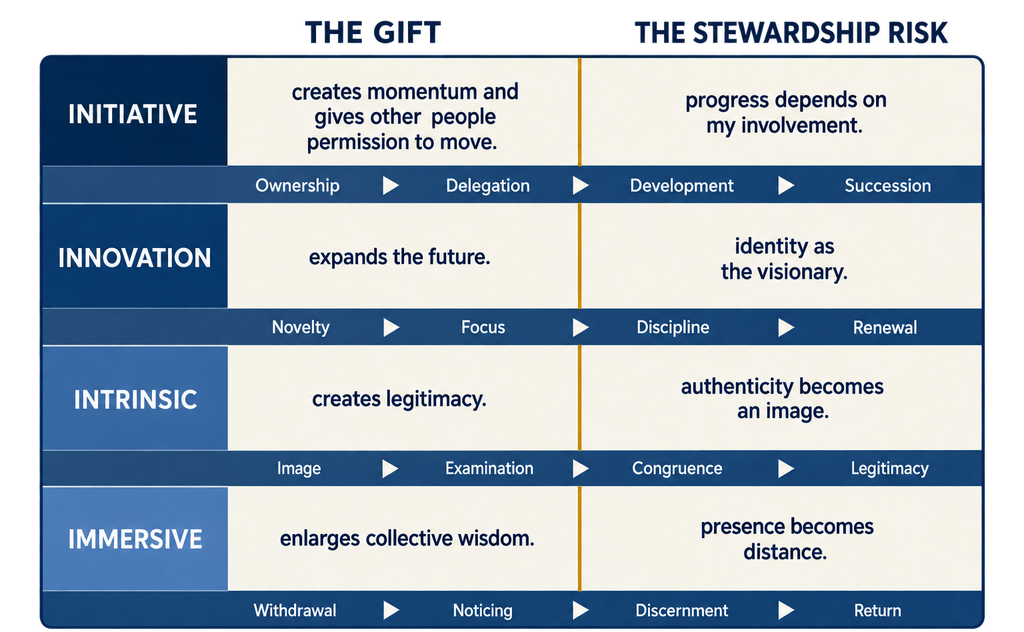
FIGURE 3. Every capacity carries a gift and a stewardship risk. The risks do not arise because the capacities are flawed. They arise because every developmental gift tends toward self-preservation unless it is continually reoriented toward service, relationship, and purpose.
06 – The Discipline That Holds Them
Every serious leadership journey eventually arrives at the same recognition. The challenge is no longer learning new skills, or acquiring new knowledge, or even expanding new capacities. The challenge becomes learning how to carry those capacities without being possessed by them. The more capable we become, the more carefully we have to hold what we are capable of.
It would be tempting to call stewardship a fifth capacity, and that would be a mistake. Stewardship does not stand alongside the other four. It is what the fourth one does when it turns outward.
Immersive is the capacity to remain fully present inside complexity, and presence has two faces. Turned inward, it is the leader observing their own thinking, their own attachments, their own drift. Turned outward toward an organization, that same observation becomes stewardship: the continual work of asking what each capacity is currently serving.
The eleventh paper described the interior face and called it Being. This paper describes the exterior one. They are not two capacities. They are one capacity facing two directions.
So stewardship is the practice of continually asking what a capacity is serving. Is Initiative advancing the mission, or protecting my sense of being indispensable? Is Innovation creating value, or reinforcing my identity as the visionary? Is Intrinsic deepening truth, or maintaining an image of authenticity? Is Immersive enlarging awareness, or letting me avoid a decision I do not want to make? These questions cannot be answered once and filed. They become the ongoing discipline of mature leadership.
Which creates an obvious difficulty. If the fourth capacity is the one that stewards, what stewards the fourth? Nothing internal does, and the last of those four questions is the one a leader is least equipped to answer about themselves. That is not a flaw in the architecture. It is the reason the rest of this argument is about other people.
Why This Cannot Be Done Alone
One of the strongest themes running through the Arc is that transformation never happens in isolation. Competencies develop through experience. Capacities expand through development. Stewardship develops through relationship.
Left alone, every leader eventually becomes convinced that their current direction is the right one, because identity is remarkably persuasive. It explains. It justifies. It rationalizes. It quietly rearranges the evidence until the leader can no longer distinguish between serving the mission and serving themselves.
This is why legitimate relationships are not a nicety but a structural requirement. Only a trusted relationship carries enough legitimacy to challenge a leader’s greatest strength without threatening their dignity, and only such a relationship can ask the questions that matter.
Has your determination become control? Has your innovation become novelty? Has your authenticity become identity? Has your presence become distance? No one reads their own compass as accurately as those traveling beside them.
THE STEWARDSHIP QUESTION Most executives have someone who can tell them they are wrong about a decision. Far fewer have someone permitted to tell them they are becoming someone they did not intend to become. The second relationship is the one that determines how a career ends.
The Measure Most Organizations Miss
Organizations evaluate leaders by visible outcomes: revenue, growth, innovation, execution, retention. These are necessary and they are not sufficient. The Arc asks a different question. What is happening to the leader while those outcomes are being produced? Are they becoming more expansive, or merely more effective? More legitimate, or simply more influential? More free, or more attached to the very capacities that created the success?
The ultimate product of leadership is not organizational performance alone. It is also the continual development of the human being entrusted with producing it.
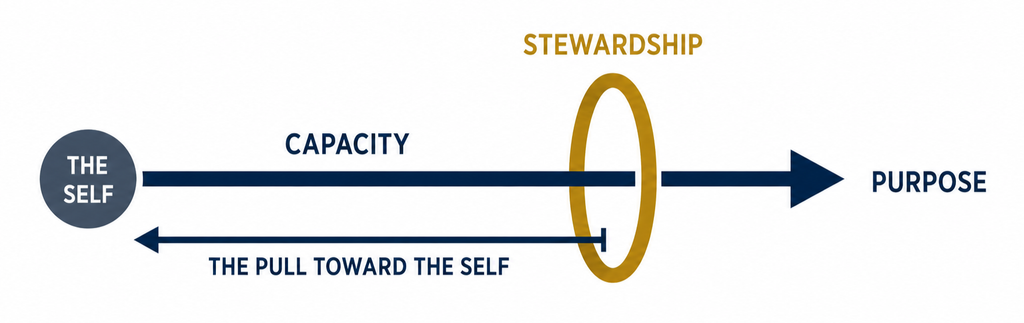
FIGURE 4. A capacity does not stay pointed where it started. Stewardship is the discipline that keeps it aimed at purpose, intercepting the pull back toward the self before its direction changes.
07 – Becoming Worthy of Our Capacities
If this paper contributes one idea to the field, it is this. Every increase in leadership capacity must be matched by an equal increase in leadership stewardship. When stewardship grows more slowly than capacity, distortion follows as reliably as gravity. When the two grow together, leadership becomes increasingly generative.
The principle scales in both directions, applying to the new supervisor leading four people and to the executive leading forty thousand. Power itself has never been the problem. Power without stewardship is.
ON SCREEN The Remains of the Day (1993), directed by James Ivory
Stevens has cultivated presence to an extraordinary degree. He notices everything, absorbs everything, and disturbs nothing. What the film exposes is the cost of a composure that never converts into action: a house sliding toward catastrophe, a life unlived, and a man whose restraint has become indistinguishable from absence.
Executive reflection. When did my presence last produce a decision rather than a delay?
Proportion, shadow, meaning beyond the self, and the insufficiency of every achievement converge here. The Arc gathers these insights into a developmental architecture, and its proposition is simple. Leadership capacities are gifts. Every gift creates influence. Every influence creates responsibility. Every responsibility requires stewardship.
Which is why leadership is never finally achieved. It is continually entrusted, and each day a leader is invited to answer the same question. Not how do I become more powerful, but whether I have yet become worthy of the power I already hold.
Beyond competencies. Beyond capacities. Beyond influence. Toward stewardship.
Five Questions
Capacity is easier to measure than stewardship, which is generally why stewardship is the thing that goes unattended. Before turning the page, sit with the following for a few minutes.
— Which of my strengths has become most closely tied to how I see myself?
— If that strength had begun to drift, who in my life would actually tell me?
— What is my Initiative serving right now, the mission or my sense of being necessary?
— Where have I mistaken presence for leadership, or motion for contribution?
— Have I become worthy of the influence I already possess?
The answers tend to say more about the next decade of a career than any performance review ever will.
CONTINUE THE CONVERSATION
Where is your strength pointing?
Every executive carries a signature capacity, the one that built the career and the reputation. Far fewer can say with confidence what that capacity is currently serving. Determination and control can look identical from the outside, and so can presence and withdrawal, and the difference is rarely visible to the person standing in the middle of it.
The Leadership Arc Assessment identifies a leader’s developmental coordinates, surfaces the stewardship risks attached to their strongest capacities, and lays out a practical way of keeping those capacities oriented toward purpose.
The objective is not simply to become more capable. It is to become worthy of the capability.
Because a gift that goes unstewarded eventually stops being a gift.
The next paper in this series returns to the fourth capacity and asks what it actually is. Intelligence has been measured for a century and emotional intelligence for a generation, and both quietly assume something neither of them names: a leader who remains consciously available when leadership becomes difficult. That paper argues availability is itself a capacity, gives it a name, and shows why it determines whether the other three remain reachable at all.
NOTE: Bibliography and references available upon request. The ideas, arguments, frameworks, and conceptual architecture presented in this paper are the original work of the author. Artificial intelligence was used as a collaborative writing and editorial tool to assist in drafting and refining the prose. All substantive judgments, interpretations, and conclusions are the author’s, who retains full responsibility for the final content.
© 2026 CaMiNa Consulting. All rights reserved.