
Why the next stage of leadership begins with a different question

01 – Executive Summary
A professor of mine opened the first day of business school with an unexpected warning. Anyone looking for certainty, he said, had enrolled in the wrong course. He would give us questions rather than answers, because defining the problem was the only genuinely difficult part of the work. Once the problem was understood correctly, the answer was usually obvious.
I assumed he was describing analysis. It took me nearly twenty years to understand that he was describing leadership.
Early in a career, a leader creates value by having answers. Organizations promote people because they know something others do not, and when problems are relatively contained that is exactly what leadership requires.
As organizations grow more complex, the equation quietly changes. The challenges facing senior executives are rarely problems a single person can fully understand. They span functions, stakeholders, cultures, technologies, and time horizons, and each participant sees a genuine part of the reality. No amount of intelligence allows one person to see all of it.
Yet many leaders go on behaving as though their responsibility is to produce the answer. It is an understandable instinct. It is also increasingly the wrong one. Beyond a certain level of complexity, organizations do not primarily need better answers. They need better questions.
Below the Fence, a leader creates value by solving the problem. Above it, by helping the organization discover which problem it should be solving.
That distinction sounds smaller than it is. Questions are not requests for information. They determine what we notice, what we ignore, and what kind of answers become possible at all. A poorly framed question produces brilliant answers that move an organization nowhere. A well-framed one reorganizes how an entire leadership team understands its situation.
The difficulty is that no one reliably discovers those questions alone. Our questions arise from the assumptions through which we already understand the world. Leaders are remarkably good at solving the problems they know how to see, and remarkably poor at recognizing the assumptions that made those the problems in the first place.
That is why conversation becomes indispensable. Not because it is a better way to communicate, and not because collaboration is inherently virtuous. Conversation matters because it is the only place where different perspectives interact long enough for hidden assumptions to become visible, and for a better question to emerge than anyone carried into the room.
ON SCREEN [The King’s Speech (2010), dir. Tom Hooper, screenplay by David Seidler.]
A future king arrives for treatment expecting technique. His therapist holds no medical credential and no rank, and refuses to begin until the two of them can speak as equals, in his rooms, on his terms. What follows is not instruction. It is a long and uncomfortable conversation in which the question changes from how a man might control a stammer to what he has been carrying since childhood that makes speech unbearable. The voice arrives only after the question does.
Executive reflection. When did I last let a conversation change what I believed the problem was?
Every paper in this series has pointed toward the same crossing. The first argued that leadership is shaped less by behavior than by the way a leader constructs meaning. The second showed that understanding shortens the distance between experience and growth. The third argued that a developmental map is useless until leaders know where they are standing on it.
The fourth took the resulting ceiling apart and found it built from a leader’s own successes. The fifth mapped that ceiling capacity by capacity. The sixth traced the recurring patterns that hold capable leaders in place. The seventh separated genuine authorship from its counterfeit. This paper is the eighth in a series introducing the Leadership Arc.
02 – The Changing Work of Leadership
Every promotion changes the work. What is less obvious is that every promotion also changes the question. A supervisor asks how today’s work gets done. A manager asks how the team performs. An executive eventually discovers that neither question is large enough, and the question becomes: what are we not seeing?
Early leadership is largely additive. Knowledge creates value because problems are bounded enough that expertise usually produces the correct answer. Better analysis leads to better decisions, and better decisions lead to better outcomes. The leader’s value lies in knowing.
As complexity grows, something changes quietly. The organization becomes too complicated for any individual to understand completely. Finance sees one reality, operations another, marketing a third, human resources a fourth. Each perspective is accurate and incomplete at the same time.
The executive who keeps trying to be the smartest person in the room unintentionally creates a less intelligent room. People begin orienting themselves toward the leader’s conclusions instead of contributing perspectives the leader cannot possibly hold. The organization becomes steadily more efficient at answering the leader’s question, and whether it is the right question is never examined.
That is why the work itself changes beyond the Fence. The executive’s value no longer comes primarily from supplying better answers. It comes from creating the conditions under which the organization can discover a better question than any individual could have found alone. The leader becomes less an expert solving a puzzle and more the architect of an environment in which collective intelligence can appear.
THE PRICE OF THE CROSSING Below the Fence, reducing uncertainty quickly is a virtue. Above it, reducing uncertainty too quickly prevents the organization from discovering what it most needs to learn. The crossing asks leaders to give up the very speed that earned them the position, and to be seen, for a while, as slower than the people who once came to them for resolution.
That is not a rejection of answers. It is a recognition that the quality of every answer is limited by the quality of the question that produced it. The mature leader learns to protect inquiry before protecting conclusions.
DEVELOPMENTAL MOVEMENT Knowing ▸ Deciding ▸ Inquiring ▸ Convening
This explains why conversation becomes more important, not less, as leaders mature. Information can be exchanged through reports. Understanding cannot.
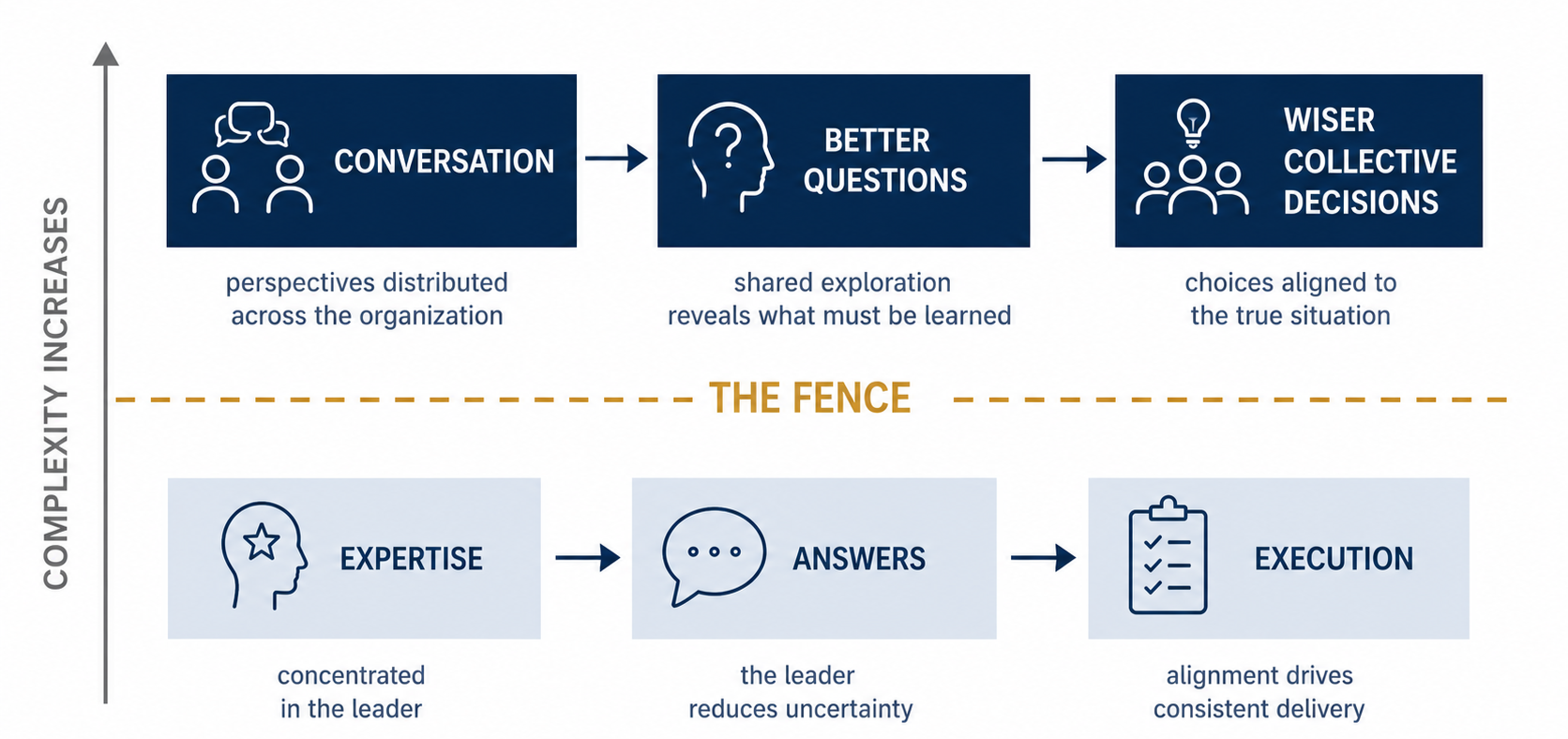
FIGURE 1. The Developmental Shift in Leadership. At lower complexity, value moves from expertise to answers to execution. Higher up, it moves from conversation to better questions to wiser collective decisions.
03 – Why Conversation Matters
If the leader’s work is to help an organization discover better questions, an obvious objection follows. Executives are expected to think. They read, reflect, analyze, and decide every day. Why should discovering the right question require other people at all?
Because questions are born from perspective. Every leader sees the world through a particular frame shaped by experience, expertise, success, responsibility, and past failure. That frame is not a weakness. It is what makes judgment possible. Without it, every situation would feel equally important and every decision equally uncertain.
The same frame that makes judgment possible also limits it. We see what our assumptions prepare us to see. We ask the questions our experience has taught us to ask. We rarely notice the assumptions underneath those questions because, from inside our own thinking, they simply feel like reality.
The greatest obstacle to executive development is seldom a lack of intelligence. It is the invisibility of one’s own perspective.
The executive does not need more information. The executive needs help seeing what information has been left out, and that is remarkably difficult to do alone. You cannot easily step outside the frame you are already looking through. Someone else has to help you.
Information and Perspective
Most organizational conversations exchange information. Developmental conversations exchange perspectives. Those are different activities. Information tells me something I did not know. Perspective allows me to see something I could not see. One adds to my knowledge. The other reorganizes my understanding.
That distinction explains why some conversations are forgotten within the hour and others stay vivid for decades. We rarely remember every fact presented. We remember the moment someone asked a question that stopped the whole room from thinking in the old way.
A finance executive says something operations never considered. A customer describes an experience in language no dashboard could capture. Someone in human resources names a pattern everyone else dismissed because it did not fit the current explanation. For a moment the conversation slows, not because progress has stopped but because understanding has begun.
This is why mature leaders become protective of conversations that look, on the surface, inefficient. They have learned that the fastest route to an answer is not the fastest route to understanding, and that the most productive thing a team can do is sometimes stay with a question long enough for its assumptions to surface. That requires a kind of patience organizations rarely reward: the willingness to resist the first plausible answer in order to find out whether anyone is asking the right question at all.
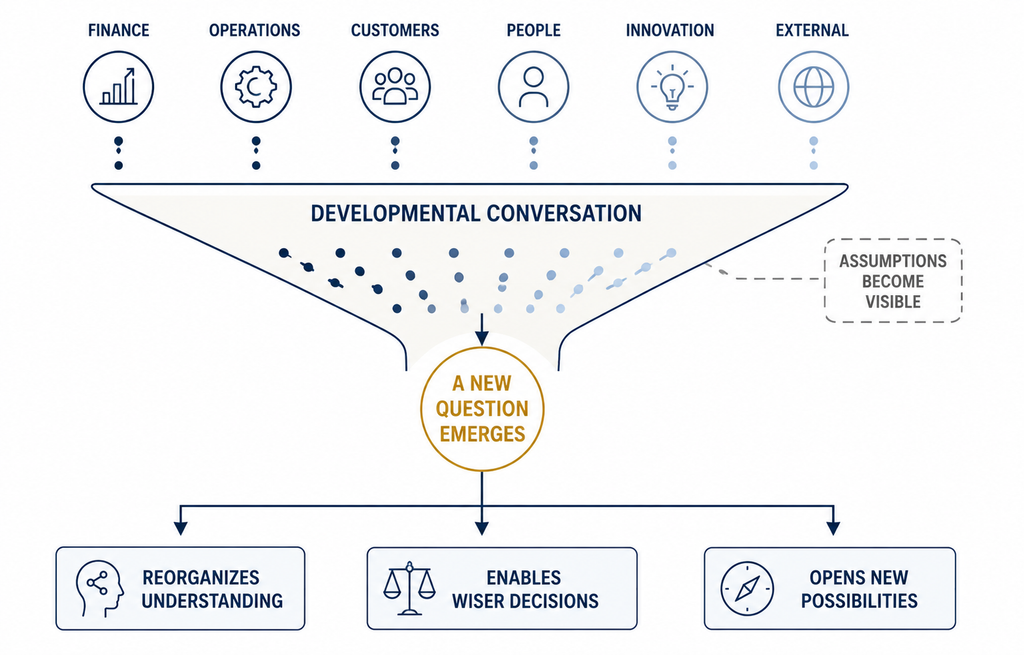
FIGURE 2. The Question Engine. Perspectives enter a conversation carrying different assumptions. As those assumptions become visible, a question emerges that no individual brought into the room.
04 – The Leader Becomes the Environment
If conversation is where better questions emerge, the leader’s role changes once more. The leader is no longer the person responsible for bringing the answer into the room. Nor is the leader responsible for bringing the right question. The leader becomes responsible for creating the environment in which the right question can emerge.
Below the Fence, a leader’s presence tends to narrow uncertainty. People look upward for direction because that is where value has traditionally been found. Questions move up, answers move down, and decisions are concentrated because expertise is concentrated. That model works well when the problem is primarily technical. It becomes inadequate as complexity grows.
No executive, however capable, holds the perspective needed to understand a complex adaptive system alone. The organization knows more than the leader because the organization sees more than the leader. The task is therefore not to outthink the organization. It is to help the organization think.
The more senior the leader, the less individual intelligence is worth relative to the intelligence a leader can convene.
This is why developmental leadership requires a different relationship with certainty. Most executives have been rewarded for eliminating ambiguity: clarifying the difficult issue, resolving the disagreement, moving the stalled decision. These are valuable instincts. They are also incomplete.
The danger at senior levels is not uncertainty. It is premature certainty. The first answer offered by the most senior person in the room often becomes the last answer anyone examines, not because it is correct but because authority quietly reshapes the conversation. Alternative views go unspoken, doubts stay private, and the room concludes that the thinking is finished. The leader has provided an answer. The organization has lost a question.
Developmental leaders work against that dynamic deliberately. They ask before they advocate and inquire before they conclude. They become curious about perspectives that do not fit their own. Most importantly, they resist closing a conversation before the organization has understood the problem. This is not passive facilitation. It is disciplined stewardship of collective intelligence.
Creating that environment is not a technique. It draws on the four capacities this series has been describing, each doing particular work inside a conversation.
Initiative the willingness to begin. It opens the subject no one wants to name and asks the question the room has been circling for months.
Innovation the capacity to see differently. It notices the assumption everyone else is standing on and offers the reframe that makes another reading possible.
Intrinsic the ground a leader stands on. It allows a leader to hear a perspective that contradicts their own without needing to defeat it or dissolve into it.
Immersive the ability to remain present. It holds the room inside uncertainty long enough for a better question to surface, rather than closing the gap with the first plausible answer.
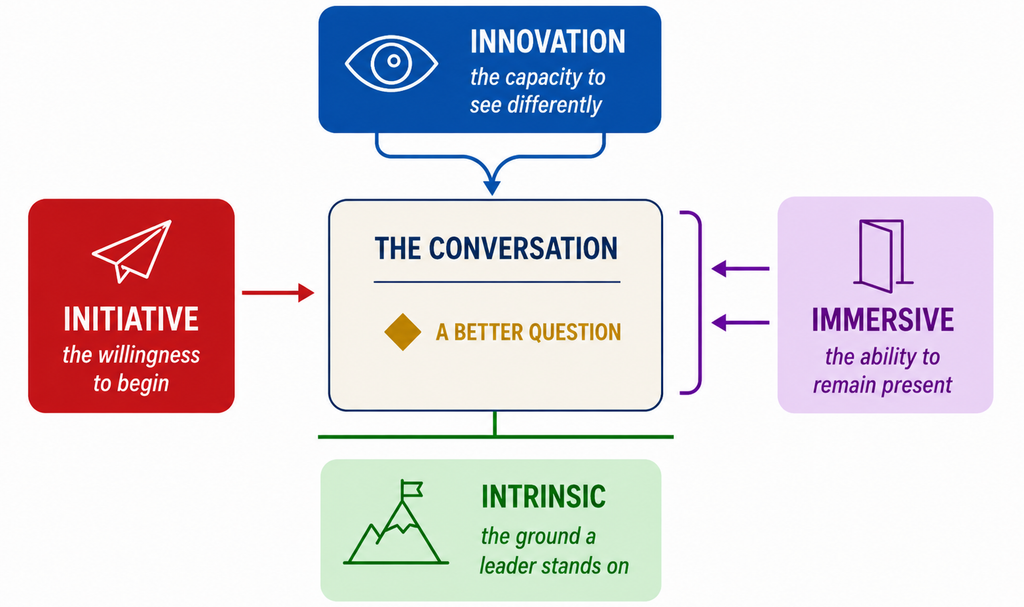
FIGURE 3. The Leader as the Environment. Initiative opens the conversation, Innovation reframes it, Intrinsic steadies it, and Immersive holds it open long enough for a better question to arrive.
05 – The Conversation That Changes the Organization
The practical question is what this looks like. Most leadership conversations do not begin with someone announcing that the team has been asking the wrong question. They begin ordinarily: a quarterly business review, a strategy session, a discussion about why customer retention keeps slipping.
The meeting proceeds as these meetings do. Finance recommends pricing adjustments. Operations argues for process improvements. Marketing proposes a different campaign. Human resources points to engagement. Every recommendation is intelligent and every one addresses a real part of the situation. The discussion is disciplined, analytical, and productive.
It is also organized around an assumption no one has questioned. The problem has already been defined.
Then someone asks a different question: what if retention is not actually the problem? The room goes quiet, not because anyone knows the answer but because everyone suspects they may have been solving the wrong thing.
Finance observes that the numbers measure repeat purchases rather than loyalty. Marketing admits to months spent studying customer behavior without ever asking customers what they value. Operations recognizes that the organization has optimized efficiency around assumptions no one has revisited in years. Within minutes the discussion has changed.
No solution has been reached. No decision has been made. Yet everyone understands the situation differently than they did half an hour earlier. From the outside the meeting appears to have slowed. From the inside it has accelerated in the only way that finally matters.
This is the moment leaders most often interrupt. The silence feels uncomfortable and the uncertainty feels wasteful, so the executive, wanting to help, offers an answer. The meeting regains momentum. It also loses the opportunity that had just begun to open.
Developmental leaders learn to recognize that moment and to become curious about it rather than resolving it. They read silence not as the absence of progress but as evidence that assumptions are reorganizing themselves. The room is thinking, and it is thinking collectively.
Most organizations treat intelligence as something individuals possess. Developmental organizations understand that it also lives between people. No one in that meeting discovered the better question. The conversation did, as each perspective challenged another until a question emerged that belonged to no one because it had been made by everyone.
That is collective intelligence. Not agreement, and not consensus. Shared discovery. And because an organization can never become wiser than the conversations it is capable of having, the leader’s highest responsibility is not to improve decisions but to improve the conversations those decisions come from.
ON THE PAGE [Plato, Meno]
Socrates is asked whether virtue can be taught and answers that he does not know what virtue is. He then takes an untutored boy and, asking nothing but questions, walks him to a geometrical proof the boy did not know he could reach. Socrates supplies no answer at any point. He supplies the sequence of questions, and the understanding that arrives belongs to the boy. The oldest argument for inquiry is not that questions are gentler than answers, but that they produce a kind of knowing answers cannot deliver.
Executive reflection. What in my organization is already known but has never been asked for?
06 – When the Question Changes the Leader
There is one final reversal. We tend to imagine that developmental conversations exist to change other people. The best ones change everyone in the room, including the leader. That possibility is what makes this work both powerful and uncomfortable.
When a leader enters a conversation intending to deliver the right answer, the outcome stays largely under control. The leader has already decided where the conversation should end. When a leader enters seeking the right question, that control disappears. The conversation may reveal that the original problem was misunderstood. It may expose assumptions the leader did not know were shaping decisions. It may show that someone else in the room understands the situation more completely.
That is not a failure of leadership. It is leadership.
THE PRICE OF THE CROSSING A leader who genuinely opens a conversation gives up the right to know where it ends. The price is the possibility of being wrong in front of the people who report to you, and of having that visible before there is any new answer to replace the old one. Leaders who cannot pay it keep the appearance of inquiry and lose the substance.
The executive who cannot be changed cannot lead genuine inquiry, and sooner or later people notice. They learn that questions are welcome only when they confirm a direction already chosen. Conversations become performances of curiosity rather than acts of discovery. People contribute what is safe instead of what is true, and the organization looks increasingly aligned while quietly becoming less intelligent.
Developmental leaders accept a different risk. They understand that any conversation they genuinely open may change them before it changes anyone else. That takes an unusual kind of humility. Not the humility of thinking less of yourself, but the humility of recognizing that no perspective, including your own, is sufficient for understanding the whole.
The paradox is worth sitting with. The stronger a leader’s identity becomes, the less threatened that leader is by changing their mind. Only leaders secure in themselves can afford to discover they were asking the wrong question. That is one reason development accelerates beyond the Fence: confidence gradually shifts away from being right and toward creating the conditions in which truth has the best chance of appearing.
DEVELOPMENTAL MOVEMENT Certainty ▸ Persuasion ▸ Curiosity ▸ Availability
The governing question changes with it. It moves from how do I convince people to what does reality require us to understand. One seeks agreement, the other seeks understanding. One protects conclusions, the other protects inquiry. One measures leadership by influence, the other by learning.
Conversation does not change organizations. Organizations change only because people do, and people change when they become willing to see through one another’s eyes long enough for a larger reality to appear. That reality belongs to no individual. It belongs to the conversation.
07 – The Leadership Question
The defining moments in leadership are rarely the moments when someone finally produces the perfect answer. They are the moments when someone asks a question that changes what everyone believed the problem to be. From there, different answers become possible because a different reality has come into view.
That changes the standard by which a leader measures the work. It asks less whether I solved the problem and much more whether we left understanding the problem more deeply than when we entered. Those are not the same achievement. One produces decisions and the other produces development. One improves today’s performance and the other expands tomorrow’s capacity.
It also explains why organizations mistake activity for progress. Meetings fill calendars, information moves quickly, decisions get made, and the organization keeps returning to the same problems because no one has changed the question underneath them.
Answers have a short half-life. Questions reshape how an organization thinks long after the meeting has ended.
Markets change, technology advances, competitors adapt, and every solution gives way to a new problem. A better question outlasts all of it. It changes the conversations people have when the leader is not in the room, and alters what they notice, what they challenge, and what they are willing to imagine together. In that sense the question becomes part of the culture.
An organization that has been led this way gradually becomes able to ask what once would have seemed impossible. What are we assuming? What are we protecting? What reality have we overlooked? What if our greatest certainty is the very thing keeping us from seeing clearly?
That may be the defining mark of mature leadership. Not that the leader always knows, but that people become more capable of knowing in that leader’s presence. Early in a career, people seek out a leader for answers. Later, they seek out that leader because they think more clearly nearby. The leader has become an environment for development.
My professor gave us exactly what he promised. He never gave us certainty. He gave us questions. At the time I thought he was withholding answers. I understand now that he was teaching us how leaders develop, and that the quality of our thinking would always be limited by the quality of our questions.
Every executive eventually reaches a level of complexity where intelligence alone is no longer enough. The next breakthrough will not come from working harder, gathering more data, or refining yesterday’s answer. It will come from creating the kind of conversation in which a different question finally appears.
That is the Leadership Question. Not what is the answer, but what conversation must I create so that together we can discover the question we cannot yet see. Every crossing beyond the Fence begins there. One conversation. One question. One leader becoming a little more capable of helping others see what none of them could have seen alone.
Five Questions
Count the conversations that changed the question rather than the answer. Before turning the page, sit with the following for a few minutes.
— In my last conversations, how often did we change the question rather than improve the answer?
— What problem am I solving today that may no longer be the most important problem?
— Who sees something I cannot, and how often do I create the space for that perspective?
— Do we leave my meetings with clearer answers, or with a deeper understanding of the question?
— If my greatest contribution were the conversations I create, what would I begin doing differently?
The answers may reveal less about what you know than about the kind of thinking your leadership makes possible.
CONTINUE THE CONVERSATION
Who helps you discover the questions you cannot see?
Every executive eventually reaches problems that intelligence alone cannot solve. They require perspectives the leader does not hold and questions no one person can generate in isolation. That is where development either accelerates or stalls, and it rarely announces which one is happening.
The Leadership Arc Assessment identifies where a leader currently stands developmentally, the assumptions shaping the questions they naturally ask, and the capacities required for the next crossing.
It is built for executives who have run out of road on their own answers and suspect the constraint is somewhere they cannot see from where they are standing.
Every meaningful journey begins not with an answer, but with the willingness to ask a different question.
The next paper stays inside the conversation and turns to what happens when a leader tries to move another person. It takes the most durable principles of influence, the ones every executive has been taught, and asks what each becomes as a leader matures, where each turns into its own counterfeit, and what separates influence that develops people from influence that merely moves them.
NOTE: Bibliography and references available upon request. Films and texts discussed are referenced as commentary and criticism and remain the property of their rights holders. The ideas, arguments, frameworks, and conceptual architecture presented in this paper are the original work of the author. Artificial intelligence was used as a collaborative writing and editorial tool to assist in drafting and refining the prose. All substantive judgments, interpretations, and conclusions are the author’s, who retains full responsibility for the final content.
© 2026 CaMiNa Consulting. All rights reserved.