
Why Homer’s greatest story remains the most exacting account of executive development we have, and what it asks of the leaders who read it honestly.
01 – Executive Summary
The storms were never the curriculum. The man becoming someone new was.
Few stories survive three thousand years. Empires have risen and fallen in that time and entire libraries of ancient literature are gone. Yet one story continues to be read in classrooms and rediscovered by each new generation. Why does a story about monsters, storms, and distant islands still feel familiar to people running corporations, governments, and hospital systems?
Perhaps because the Odyssey was never primarily about monsters, and never fundamentally about the sea. It was about the longest journey any leader must eventually make, the journey from accomplishment to wisdom.
Most readers remember the external voyage, the Cyclops and the Sirens, Circe and Calypso. Homer understood that the true drama was unfolding elsewhere, and that every island, storm, and setback existed to transform the traveler. The real question was never whether Odysseus would find his way home. It was whether the man who left Troy was capable of becoming the man who could return.
That distinction matters to organizations investing enormous resources in developing leaders. Executives attend programs on strategic thinking, executive presence, and decision making, and these investments produce more capable leaders.
Yet every experienced executive eventually arrives at an unsettling realization. The capabilities that created yesterday’s success rarely prove sufficient for tomorrow’s challenges. Eventually the question itself changes. It is no longer what do I need to learn. It becomes who must I become.
That is the question Homer was asking nearly three thousand years ago, and it is the question this series has been asking in modern language. The first paper argued that leadership cannot be read from behavior alone, because behavior emerges from an underlying stage of development, and named the threshold every paper since has returned to. The second established what it costs a leader to meet that threshold without a map, and who receives the invoice.
The third argued that a map is unusable until a leader knows where they are standing on it. The fourth took the resulting ceiling apart and found it built from a leader’s own successes, and the fifth mapped it capacity by capacity.
The sixth set out the nine loops that keep capable people circling. The seventh separated authorship from the rebellion that imitates it. The eighth located development in conversation rather than in insight. The ninth traced the six principles of influence across the Arc, and the tenth argued that organizations appoint executives while communities grant legitimacy.
Ten papers of contemporary vocabulary for a pattern that is not contemporary at all. This one finds the same map already drawn. The Arc names four movements: Willing, Thinking, Feeling, and Being. Homer’s poem moves through all four in order, in one man, and skips none of them.
The monsters change, the technology changes, the organizations change. Human development does not.
This paper is the eleventh in a series introducing the Leadership Arc.
02 – The Story Beneath the Story
Every civilization tells stories about heroes, and most celebrate victory. The greatest ones celebrate transformation, and the difference is larger than it first appears. Victory is an event and transformation is a process. One can be achieved in a single afternoon. The other may require more time.
Modern leadership literature overwhelmingly favors victory. We study remarkable chief executives and founders, asking what they accomplished. The enduring works of literature ask something different: who did the leader have to become before lasting leadership became possible? That question moves attention away from performance and toward identity.
At first glance it appears to be a travel narrative, and yet the geography is almost beside the point. Every island reveals another attachment, every monster exposes another limitation, and every setback dismantles another illusion.
Experience adds knowledge. Development changes the knower.
Why Homer Begins After the Victory
One of the most overlooked features of the poem is where Homer chooses to begin. Not with the Trojan War or the wooden horse. He begins after all of that has happened, because the real story starts where success ends.
When we first meet Odysseus he is already everything most organizations admire: decisive, brilliant, resourceful, battle tested. If leadership were measured solely by achievement his story would be complete.
The victories that establish a leader are rarely the victories that mature a leader.
Odysseus leaves Troy convinced that intelligence, courage, and determination can solve almost any problem. The sea has other plans. Unlike the battlefield, it refuses to submit to force. Storms ignore rank, nature cannot be negotiated with, time cannot be accelerated, and relationships cannot be commanded.
Every senior executive reaches a similar moment, when the strategies that once produced rapid advancement begin producing diminishing returns. Control gives way to complexity, certainty to ambiguity, authority to influence. Homer’s greatest insight was not that heroes overcome obstacles. It was that obstacles reveal the leader who has yet to be formed. Readers of the earlier papers will recognize this as the Inflection Fence, and the Odyssey is what it looks like when a single traveler crosses it four times.
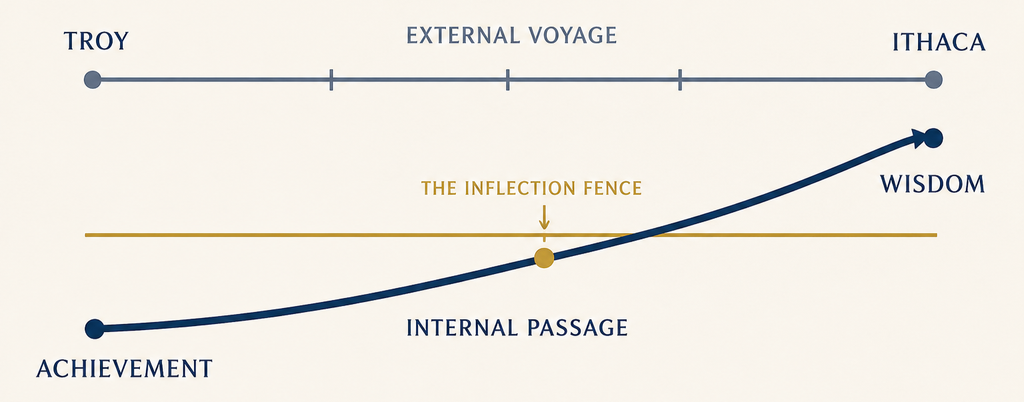
FIGURE 1 The journey Homer was really writing about. The enduring power of the Odyssey is psychological rather than geographical. The external voyage from Troy to Ithaca exists to make possible the internal passage from achievement to wisdom.
03 – The Energy of Willing
Every leader begins with the same conviction. If I work hard enough, I can overcome any obstacle. It is a beautiful belief, and an incomplete one. Organizations notice initiative and reward decisiveness, and promotions follow those who move rather than those who hesitate. The Arc calls it the Energy of Willing: the impulse that moves possibility into reality, the willingness to begin, to assume responsibility, and to act before certainty exists.
No one embodies it more completely than the Odysseus who leaves Troy. He is not merely courageous, he is unstoppable, and he has conceived the deception that accomplished what a decade of force could not. He has every reason to trust himself, and that confidence is not yet arrogance.
It is competence, which is among the most intoxicating experiences in leadership, because when leaders discover they can repeatedly produce results they begin to believe they can produce any result.
The Cicones
The first stop after Troy seems almost insignificant and is often skipped by readers. Odysseus and his men raid the city of the Cicones and win. The battle is over, the objective achieved, and at that moment wisdom whispers a single word: leave.
But victory creates the illusion that the conditions producing yesterday’s triumph will continue indefinitely. Instead of departing, the Greeks remain. They celebrate, gather spoils, and linger, until the Cicones regroup.
Notice what happened. Nothing external changed. The problem was timing. Action had become attachment, and the very capacity that produced success became the reason for unnecessary loss.
This pattern repeats in organizations daily. A successful product continues long after the market has moved, and an executive who built a company through relentless personal effort cannot understand why that same behavior now exhausts everyone around them. The issue is rarely effort. It is knowing when effort has completed its work, because every strength has an expiration date.
The Illusion of More
Early leadership is dominated by one equation: more effort, more hours, more determination, more success. Eventually the equation breaks. Culture will not be forced, trust will not be accelerated, innovation will not be commanded, and wisdom cannot be scheduled.
The executive who attacks these challenges with greater intensity discovers a painful irony. The harder they push, the less movement they create. The obstacle is no longer outside the leader. It has become the leader’s own operating system.
THE PRICE OF THE CROSSING The first crossing asks leaders to surrender a deeply comforting illusion, that effort alone is enough. Many executives spend years believing every difficult situation simply requires more discipline, more commitment, more sacrifice. Eventually reality refuses to cooperate. That refusal is not failure. It is the invitation to discover that discernment accomplishes what determination alone cannot.
DEVELOPMENTAL MOVEMENT Effort ▸ Discipline ▸ Judgment ▸ Discernment
ON THE PAGE The Cicones: A clean victory becomes a costly defeat, not because the enemy grew stronger but because the winners would not leave. Homer spends barely a page on it, and places it first, which is its own kind of argument.
Executive reflection. Where am I still trying to solve a developmental challenge with greater effort instead of greater awareness?
04 – The Energy of Thinking
If Troy taught Odysseus how to conquer, the sea teaches him how little conquest explains. For perhaps the first time, Odysseus enters a world where intelligence matters more than strength.
Homer then makes a deeper point: intelligence itself must evolve. The Arc calls this second current the Energy of Thinking, marking a shift from knowing to seeing. Knowing accumulates information. Seeing reorganizes perception and changes the perceiver.
The Cave
Few scenes in world literature are as memorable as the encounter with Polyphemus: a giant, a cave, a trapped crew, an impossible problem. Brute force fails before it begins, because the entrance is sealed by a stone no human can move. For the first time since Troy, courage becomes irrelevant.
Odysseus invents an entirely different game. He offers wine, he waits, he studies the giant rather than attacking him, and then, asked his name, he answers that he is Nobody.
The brilliance lies in changing the problem rather than in being clever. Every mediocre strategist asks how to solve the problem in front of them. The exceptional strategist asks whether it is the right problem.
The Fatal Need to Be Known
The escape is perfect until it is not. As the ships pull away, Odysseus cannot resist shouting back across the water, announcing his true name, wanting the Cyclops to know who defeated him.
His intelligence wins the battle and his identity loses the war. Poseidon hears the prayer of his son, and the voyage home lengthens by years, over one sentence, one moment of ego, one decision born not of wisdom but of the need to be recognized.
How familiar this feels inside organizations, where leaders cannot let others receive credit, experts know the answer before the conversation begins, and brilliant people slowly become prisoners of their own brilliance. The problem is no longer intelligence. It is attachment: the need to be right, to be admired, to be known. Homer quietly suggests these may be more dangerous than any monster.
THE PRICE OF THE CROSSING The second crossing asks leaders to surrender the belief that they already see clearly. The wisest executives are rarely those with the fastest answers. They are those who have learned to interrogate the assumptions hidden inside their own thinking, and who will pay the visible cost of saying I do not yet understand this in a room that expects otherwise. That is the moment intelligence becomes wisdom.
DEVELOPMENTAL MOVEMENT Knowing ▸ Analysis ▸ Perspective ▸ Seeing
ON THE PAGE Polyphemus: The trap is escaped by imagination and then re-sprung by vanity, in the space of a few lines. Homer gives the same man both moments deliberately, because they come from the same place.
Executive reflection. What belief about myself has become so successful that I no longer question it?
05 – The Energy of Feeling
There comes a moment in every meaningful journey when the obstacles outside give way to the obstacles within. For Odysseus that moment is almost imperceptible. Yet the sea has stopped asking whether he can solve this. It has begun asking who he is becoming.
Most leadership development begins by expanding capability. Can the leader communicate, execute, influence, think strategically? Eventually leadership asks something more personal. Can this person remain grounded while others panic, care deeply without becoming captive to the opinions of others, suffer loss without becoming cynical? Capability brought Odysseus this far. Character must carry him the rest of the way.
The Arc’s third movement is the Energy of Feeling, and the word has been badly worn by misuse. It describes the gradual movement from living through achievement toward living through authenticity, as the center of gravity moves inward.
The leader stops deriving identity primarily from accomplishment, identity begins arising from congruence, and the distance between the public self and the private self slowly disappears. For many executives this is the most difficult transition of all, because competence can be developed through practice while authenticity usually develops through suffering.
The Journey Begins Taking Things Away
The first half of the Odyssey is filled with victories and the second half with losses. One by one the companions disappear, some through poor decisions, others through temptation, others because they cannot survive the voyage. The world Odysseus believed he could control steadily slips beyond it. This is not punishment. It is formation.
Leadership frequently develops the same way. Early success creates confidence and repeated success creates identity, until life begins separating the two. The executive who has always been admired experiences failure, the founder loses a company. No leadership course prepares someone for these moments, because the lesson is existential rather than informational.
I have sat with more than one executive in the months after a loss like that, and the striking thing is never the grief. It is discovering they had no language for who they were without the result.
Calypso
Nowhere does Homer reveal this more precisely than on the island of Calypso. She offers Odysseus what nearly every human being claims to want: safety, comfort, freedom from responsibility, even immortality. Homer does not portray this as paradise. He portrays it as captivity.
Odysseus has everything except purpose, because human beings do not become themselves through comfort. They become themselves through calling. The Greek word nostos, usually rendered as homecoming, carries more than a return to a physical place. For Homer, home is not geography. It is identity.
Executives encounter Calypso more often than they realize. It appears as the prestigious position that no longer calls forth growth, the career built around reputation rather than contribution. The temptation is rarely dramatic. It is the quiet invitation to stop becoming. Many leaders accept it. Odysseus does not.
THE PRICE OF THE CROSSING The third crossing asks us to surrender the deepest illusion of all, that achievement can tell us who we are. This is the passage from accomplishment to authenticity, and it cannot be made theoretically. It is usually made in the aftermath of a loss the leader did not choose and cannot repair by working harder. A leader whose identity has never been separated from a result has not yet been tested for what remains underneath it.
DEVELOPMENTAL MOVEMENT Achievement ▸ Recognition ▸ Congruence ▸ Authenticity
ON THE PAGE Calypso: Homer gives Odysseus immortality and stages it as imprisonment. Seven years of paradise, described as captivity, because nothing is being asked of him. The invitation to stop growing rarely announces itself as a loss.
Executive reflection. If every title and accomplishment were suddenly taken away, what part of my leadership would remain untouched?
06 – The Energy of Being
Home Begins Calling Before It Appears
Something subtle happens in the second half of the poem. Odysseus speaks less about conquest and more about home. Yet Homer is describing something more profound than homesickness. The destination remains stable, and only one thing changes: Odysseus. We become different interpreters. Reality has not changed. The observer has.
By the time he nears Ithaca, Odysseus no longer longs merely to reclaim a throne. He longs to restore right relationship with Penelope, with his son, with his people, and with himself. Leadership follows the same progression. Early careers are organized around proving and advancing, until another question quietly replaces them. Can people trust me, not because of my title, but because of who I have become? Competence earns opportunities. Character sustains them.
The Return
The final lesson arrives quietly. There is simply a man who has learned to wait. The younger Odysseus would have marched into the palace, announced his return, and challenged every rival before sunset. Instead Homer gives us something unexpected. Odysseus disguises himself as a beggar, says almost nothing, observes, and allows reality to reveal itself before attempting to change it.
This appears anticlimactic and is the culmination of everything the journey has taught. The warrior who left Troy believed leadership meant imposing order on the world. The king who returns understands that leadership begins by perceiving reality as it actually is.
The Arc’s fourth movement is the Energy of Being. It is not another competency or leadership style. Being is the integration of willing, thinking, and feeling into a stable interior life that no longer depends on external circumstances for its identity.
The mature leader still acts, still thinks, still feels, and these capacities no longer compete. Action flows from wisdom rather than urgency, thinking serves reality rather than ego, and feeling deepens discernment rather than overwhelming it. The leader stops performing leadership and begins simply being it.
This is why the greatest leaders often appear surprisingly ordinary. They rarely dominate conversations. Their presence itself becomes stabilizing, and people leave conversations feeling clearer and more capable, not because they received brilliant advice but because they encountered someone whose inner life had become ordered.
The Bow
Near the end of the poem Homer presents one final image. Penelope announces she will marry the man capable of stringing Odysseus’s great bow and sending an arrow through twelve axe heads. One after another the suitors fail, pulling harder, straining, growing frustrated. Nothing happens. Then the disguised beggar quietly asks for the bow. The room laughs. He lifts it, strings it effortlessly, and releases an arrow that passes cleanly through every axe.
Most readers see a contest of strength. Homer is showing us something else. The bow has not changed, the man has, and force has now become effortless because the person using it has become integrated. Power no longer comes from intensity. It comes from alignment. Meetings become calmer, conflict more productive, decisions clearer, not because the problems are easier but because the leader is no longer creating unnecessary turbulence.
THE PRICE OF THE CROSSING The final crossing asks us to surrender the need to become someone. Most leadership development begins with becoming more: more capable, more knowledgeable, more influential. Eventually the journey reverses. Leadership stops being about adding and becomes about removing the fear that drives overachievement, the ego that needs recognition, the certainty that prevents learning, and the masks that separate the public leader from the private self. What remains is a human being who is fully present, not trying to appear wise or humble or inspiring, simply inhabiting reality so completely that wisdom becomes visible.
DEVELOPMENTAL MOVEMENT Doing ▸ Performing ▸ Integrating ▸ Being
ON THE PAGE The Bow: Twelve axe heads, one arrow, and a room that had been laughing a moment earlier. The suitors fail by straining. Odysseus succeeds without visible effort, which is Homer’s entire point about what has changed in him.
Executive reflection. What am I still trying to add, when the next stage may require removing something instead?
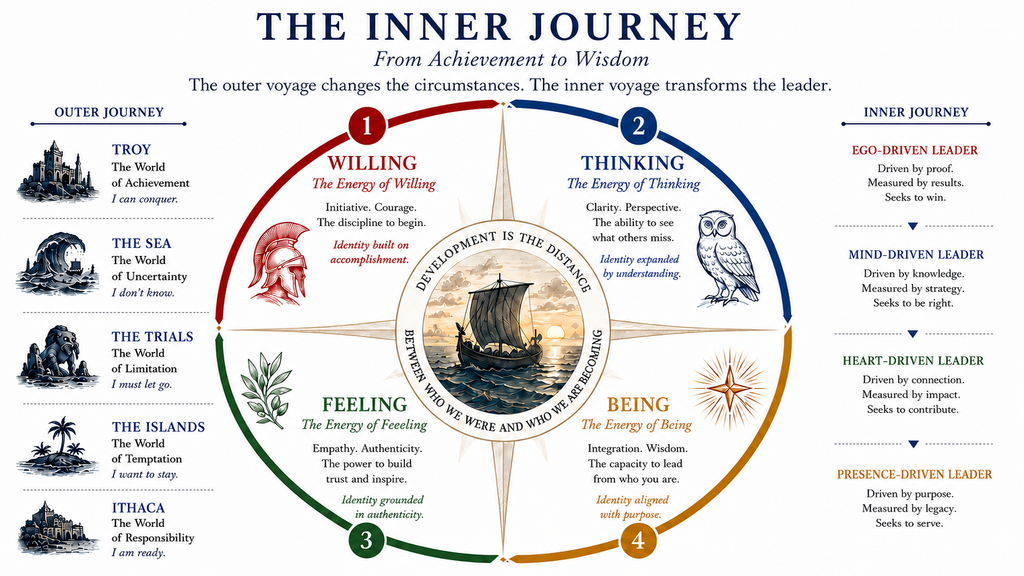
FIGURE 2 The outer voyage and the inner one, set side by side. The left column names the worlds Odysseus passes through. The right names the leader each world produces. Between them the Arc’s four capacities turn, and development is the distance from one column to the other.
07 – Why the Odyssey Still Matters
So why has this story survived three thousand years? It keeps speaking because Homer understood something that does not expire. Every human being eventually leaves a Troy, crosses an uncertain sea, and meets monsters that cannot be defeated by force alone. And every one of them eventually discovers that the greatest struggle is never against the world. It is against the self that no longer fits the life now asking to be lived.
That is why executives keep recognizing themselves in Odysseus: the first-time manager leaving technical expertise behind, the founder discovering the company can no longer revolve around one person’s energy, the chief executive realizing that strategy alone cannot create trust.
The Arc and the World’s Great Stories
Perhaps the more remarkable discovery runs the other way. The Arc illuminates a great many enduring stories, not just this one. Parsifal leaves home believing courage is enough and learns that only compassion heals the Fisher King. Dante begins lost in a dark wood and ends with transformed vision rather than additional information. Shakespeare works the same ground repeatedly, as Lear loses a kingdom and finds himself and Prospero relinquishes power in order to attain wisdom.
These are variations on a single human pattern rather than isolated stories. Cultures separated by centuries and religions arrive repeatedly at the same conclusion, that the outer journey exists to make possible an inner transformation. This is where the Arc becomes a developmental lens rather than a leadership model, a framework great literature reveals rather than one imposed on it. The maps are ancient. The language is new.
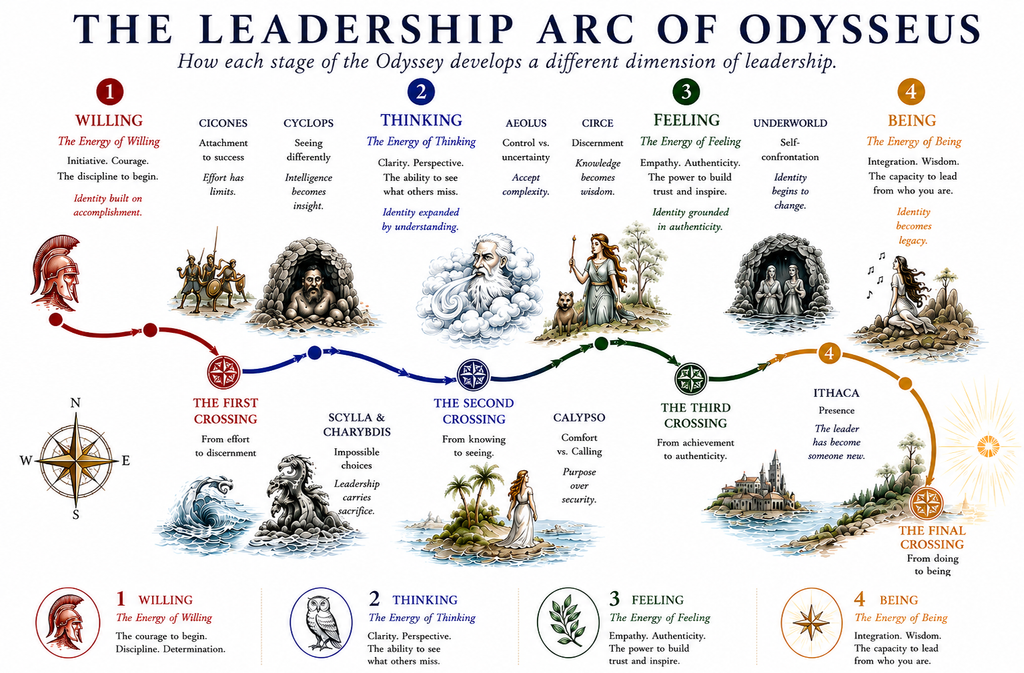
FIGURE 3 The voyage drawn as a curriculum. Each landfall takes something from the traveler and leaves a capacity in its place, so the route Homer gives us is also the order in which a leader is formed. This paper takes up four of these stops in detail.
08 – The Last Word
The Odyssey is often described as a story about finding one’s way home, and home was never merely Ithaca. It was the self Odysseus could not become without the journey. The sea was never the destination but the teacher, the monsters were never the enemy but the curriculum, and Ithaca was never the prize. It was the place where the transformed man could finally arrive.
Leadership is not measured by how many storms we survive, nor by how many victories we accumulate. It is measured by who we become while crossing the sea.
That may be Homer’s gift to the leaders who read him honestly. The Arc offers no summit, only the next crossing and the willingness to pay for it. Twenty years at sea was never the punishment. It was the length of time the work actually took.
Five Questions
Pause here, not to evaluate Odysseus but to evaluate yourself. Before turning the page, sit with the following for a few minutes.
— Where in my leadership am I still trying to force what requires understanding?
— What in my organization cannot be defeated by greater effort?
— What is quietly inviting me to stop growing?
— Where is life asking me to surrender an old identity rather than acquire a new skill?
— Five years from now, would colleagues speak of my accomplishments or my presence?
None of these has a quick answer. They are questions a person carries for a while and is changed by.
CONTINUE THE CONVERSATION
Where are you on the voyage?
Every executive is somewhere on this journey. Some are discovering the power of disciplined action, others are expanding their capacity to think systemically, others are learning that influence grows from authenticity rather than authority. A few have found that leadership reaches its highest expression not in what they accomplish but in the quality of presence they bring to every interaction. Odysseus needed the whole voyage to tell which of these he was standing in.
The challenge is that we are poor judges of our own development. We know what we have achieved. We are far less certain about who we are becoming, and the sea does not send word ahead about which crossing is next.
That is the purpose of the Leadership Arc Assessment. It identifies a leader’s developmental coordinates, surfaces the assumptions that may now be limiting further growth, and clarifies the next crossing on the journey.
The objective is not simply to become more capable. It is to become the person the journey was for.
Because every meaningful journey begins by knowing where you are.
The next paper in this series turns from what the four capacities make possible to what they become when they go wrong. Every strength described across these pages carries the seed of its own distortion. Initiative hardens into force, thinking into detachment, feeling into enmeshment, and presence into withdrawal, and the distortion is never a different thing from the capacity. It is the capacity without a steward. That paper asks what it takes to become worthy of what you have grown.
NOTE: Bibliography and references available upon request. The ideas, arguments, frameworks, and conceptual architecture presented in this paper are the original work of the author. Artificial intelligence was used as a collaborative writing and editorial tool to assist in drafting and refining the prose. All substantive judgments, interpretations, and conclusions are the author’s, who retains full responsibility for the final content.
© 2026 CaMiNa Consulting. All rights reserved.