
How the Leadership Arc extends Cialdini’s six principles, and why the same principle, in different hands, produces entirely different outcomes.

01 – Executive Summary
Influence is not simply a function of what leaders do. It is the visible expression of who they are becoming.
Two leaders read the same research, learn the same principles, and lead very differently.
For more than four decades, Robert Cialdini’s work has shaped how leaders think about influence. His six principles, Reciprocity, Commitment and Consistency, Social Proof, Authority, Liking, and Scarcity, remain among the most extensively researched findings in behavioral science. They explain why people say yes, how trust is established, and why certain behaviors consistently shape human decision making.
Yet one question has remained largely unexplored. Why do two executives, equally fluent in these principles, produce such different outcomes? One inspires lasting commitment while the other secures temporary compliance, one builds trust where the other builds dependence, and one leaves people more capable than before while the other leaves them merely persuaded. The principle has not changed. The leader has.
That claim is where this series has been heading. The first paper argued that leadership cannot be read from behavior alone, because behavior emerges from an underlying stage of development, and named the threshold every paper since has returned to. The second established what it costs a leader to meet that threshold without a map, and who receives the invoice. The third argued that a map is unusable until a leader knows where they are standing on it. The fourth took the resulting ceiling apart and found it built from a leader’s own successes, and the fifth mapped it capacity by capacity. The sixth set out the nine loops that keep capable people circling. The seventh separated authorship from the rebellion that imitates it, and the eighth located development in conversation rather than in insight.
The eighth paper ended on a question this one begins from. If development happens in the exchanges between a leader and the people around them, the principles governing those exchanges deserve a second look. Cialdini explains the psychology of influence. The Leadership Arc explains its evolution. The principles remain constant while the consciousness expressing them matures.
As leaders develop, authority evolves from position toward presence, reciprocity from transaction toward genuine generosity, and commitment from image toward identity. Across every principle, influence moves from technique to competence to character, and finally toward an integrated presence capable of holding willing, thinking, and feeling in balance.
The future of executive leadership will not belong to those who master more techniques of influence. It will belong to those who become more integrated human beings.
This paper is the ninth in a series introducing the Leadership Arc.
ON SCREEN Invictus (dir. Clint Eastwood, 2009; Malpaso Productions)
Mandela holds more formal authority than anyone in the country and declines to use almost any of it. Every conventional instrument is available to him, and he leads instead through a series of improbable relationships, one at a time, in a nation with every reason to refuse him. The power was granted by an election. The influence was not.
Executive reflection. When people follow me, are they responding to my title, my expertise, my character, or my presence?
02 – What Behavioral Science Leaves Out
Organizations have invested enormous resources in leadership development. Executives attend the world’s leading universities, hire coaches, and complete sophisticated programs, becoming more knowledgeable, more experienced, and often more technically competent. Yet a persistent question remains. Why do some leaders continue to grow throughout their careers while others plateau despite decades of experience?
The answer rarely lies in intelligence, ambition, education, or opportunity. Most senior executives possess these in abundance. The difference is developmental.
Traditional development expands what leaders know and what they can do. New competencies are introduced, communication skills are refined, decision-making models grow more sophisticated, and each intervention contributes something valuable. Together they still leave one dimension untouched, improving the leader’s repertoire without transforming the leader.
Behavioral science has the same blind spot, and by design. It has demonstrated that reciprocity creates obligation, that authority shapes credibility, that scarcity increases perceived value, and that social proof reduces uncertainty. But its subject is the psychology of the follower. It explains why influence works, and tells us very little about why influence matures.
Consider two executives making the same request of their organizations. Each articulates a compelling vision, communicates with clarity, carries impressive credentials, and understands the principles of influence perfectly well. One consistently creates energy, initiative, and commitment. The other creates compliance. The observable behaviors are strikingly similar. The experience of following them is not.
The same act of generosity can land as manipulation or as genuine care, the same expression of authority can create fear or confidence, and the same strategic decision can strengthen trust or quietly erode it. Outwardly, the behavior may be identical. Inwardly, the source has changed.
This is the central proposition of the Leadership Arc. Leadership is less the accumulation of competencies than the progressive development of the person expressing them, which is why influence cannot be understood by examining behavior alone. People respond not only to what leaders do but to the developmental maturity from which those behaviors emerge.
03 – The Leadership Arc
The Leadership Arc rests on a simple observation. Experience accumulates naturally over time. Development does not.
Most executives become more knowledgeable, many become more technically proficient, and some become exceptionally successful. Only a smaller number undergo the deeper transformation that changes how they perceive themselves, relate to others, and exercise leadership. Experience adds knowledge. Development changes the knower.
From what level of development is this leader exercising influence?
Philosophers, developmental psychologists, and leadership scholars have explored this terrain for decades. Though they employ different language, many describe leadership less as the acquisition of new competencies than as the progressive expansion of the consciousness through which those competencies are expressed. The Arc builds on that tradition and asks the question above of every executive. Early in a career, influence is driven by personal achievement, determination, and the ability to produce results. As development continues it becomes grounded first in judgment, then in authentic relationship, and ultimately in an integrated presence capable of balancing action, thought, and human connection without becoming captive to any one of them.
The Four Human Capacities
Influence draws on four capacities every leader already has: the capacity to act, to think, to feel, and to be present. What varies from one executive to the next is not whether they are available but how evenly they have been grown. Earlier papers named them Initiative, Innovation, Intrinsic, and Immersive, and named the energies beneath them Willing, Thinking, Feeling, and Being. It is those four energies this paper follows through each principle of influence.
These capacities are cumulative rather than sequential. The mature leader does not abandon action in favor of reflection, nor replace expertise with empathy. Action stays decisive, thinking stays rigorous, feeling stays deeply human, and presence brings all of it into balance. Development is not the replacement of earlier strengths but their integration.
This amounts to more than increasing effectiveness. It is a transformation in the nature of influence itself. At the earliest stages influence is something the leader consciously applies, as leaders persuade, motivate, negotiate, reward, and direct in order to accomplish objectives, and influence functions as a capability. As development continues, influence depends less on what leaders intentionally do and more on who they consistently are. This explains one of the enduring mysteries of executive leadership. Some individuals possess extraordinary communication skills and leave little lasting impact, while others speak quietly, rarely seek attention, and nevertheless transform organizations. The difference is not personality. It is developmental.
The Developmental Shift
Understanding the Arc requires one distinction. The principles of influence do not evolve, and human psychology does not change as leaders mature. What changes is the individual expressing those principles. Authority is still authority, reciprocity still reciprocity, scarcity still scarcity. Each is expressed differently depending on the developmental maturity of the leader, and the progression is consistent enough to be recognizable. Influence begins externally and moves inward, as technique gives way to competence, competence deepens into character, and character becomes integrated through presence.
Once this pattern becomes visible, it appears everywhere. It becomes possible to understand not only why certain leaders are influential, but why their influence deepens over time.
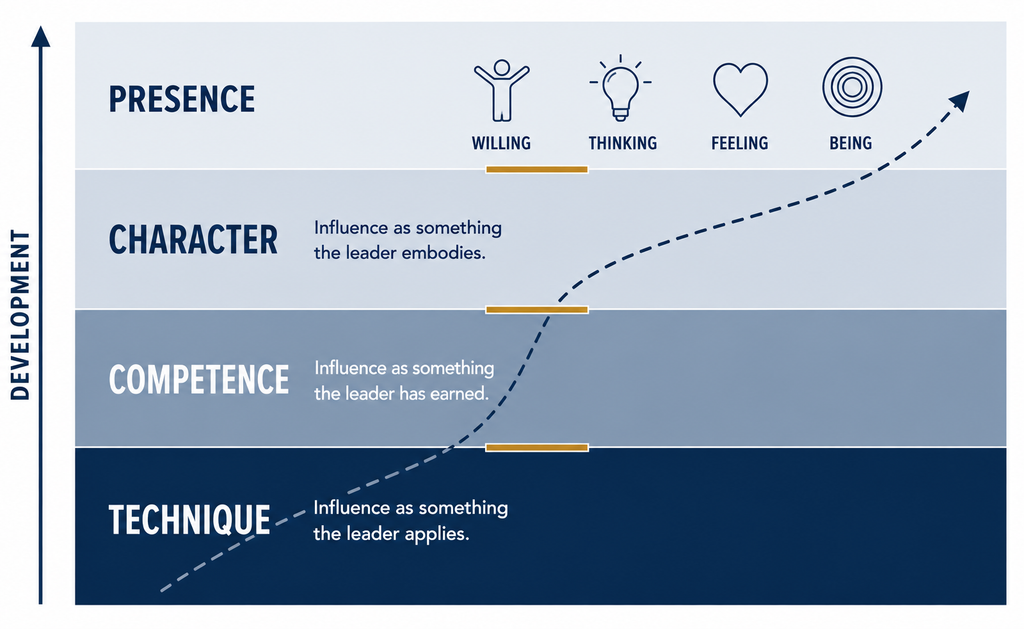
FIGURE 1 The Developmental Shift. The change is not in the principles, nor in human psychology. It is in the leader, and therefore in the expression of influence.
04 – The Six Principles Across the Arc
The Leadership Arc proposes no new principles of influence and does not challenge Cialdini’s findings. It observes that every principle evolves as leaders mature, so that what begins as technique gradually becomes an authentic expression of competence, character, and ultimately integrated presence.
Each crossing carries a price. This is the Inflection Fence the first and fifth papers describe, appearing here six times over, once inside each principle. Development stalls not because leaders fail to see the next stage but because they are unwilling to pay for it, and the sections that follow name both the progression and its cost.
Authority
Cialdini demonstrated that people are more likely to follow those they perceive as credible, knowledgeable, or legitimate. Position, expertise, credentials, and experience all contribute. The Arc suggests that authority itself evolves. Early on, authority is exercised through position: the title confers legitimacy, and influence is reinforced by hierarchy. As leaders mature, authority shifts toward competence, and people follow because the leader demonstrates sound judgment. With further development, authority becomes grounded in trust, and followers are influenced less by what the leader knows than by confidence in their integrity. At the highest levels, authority becomes presence. Leaders no longer need to assert it, because their clarity and steadiness create confidence on their own.
THE PRICE OF THE CROSSING Each stage requires surrendering the protection of the last. Moving beyond position means giving up the ability to end a disagreement by pulling rank. Moving beyond competence means being willing to leave a question open in a room that came for an answer. The executive who must invoke position has already revealed where the Arc stopped.
DEVELOPMENTAL MOVEMENT Position ▸ Competence ▸ Trust ▸ Presence
Reciprocity
When someone gives something of value, people naturally feel an obligation to respond in kind. What leaders choose to give changes significantly over time. At earlier stages, reciprocity operates as transaction: leaders exchange favors, opportunities, and recognition in ways that strengthen cooperation. As development continues, giving turns toward creating value rather than exchanging benefits. Later still, reciprocity becomes relational, as time, attention, and genuine interest become the gifts that deepen trust. Ultimately it becomes generative. Leaders contribute because contribution has become part of their identity rather than a strategy for return.
THE PRICE OF THE CROSSING Generativity requires giving without the security of the ledger, and accepting that some of what you give will never be returned, acknowledged, or even noticed. The irony is that the least transactional form of giving produces the deepest loyalty. People can feel the difference between a favor extended to obligate them and a gift extended to grow them.
DEVELOPMENTAL MOVEMENT Transaction ▸ Value ▸ Relationship ▸ Generativity
Commitment and Consistency
People naturally seek consistency between their commitments and their behavior, and public commitments become powerful drivers of future action because they reinforce identity. Development changes the nature of that identity. Early in leadership, consistency is organized around image: leaders demonstrate reliability because it reinforces reputation. As they mature, consistency centers on goals, and disciplined follow-through becomes the foundation of influence. With further development it shifts toward values, as decisions align with deeply held principles rather than immediate pressures. At the highest levels, consistency becomes identity. Followers experience a congruence between what the leader believes, says, and lives, and authenticity replaces impression management.
THE PRICE OF THE CROSSING Consistency anchored in values will eventually cost you a goal you wanted. That is the test, and there is no way to pass it cheaply. A leader whose values have never cost them anything has not yet demonstrated that they hold any.
DEVELOPMENTAL MOVEMENT Image ▸ Goals ▸ Values ▸ Identity
Social Proof
Human beings look to others when navigating uncertainty, and social proof reassures us that our decisions align with accepted norms. Development changes where leaders seek that confirmation. At earlier stages, leaders look outward for belonging, and acceptance by peers or respected institutions provides confidence. As competence develops, credibility replaces belonging. With further maturity, influence shifts toward shaping culture: rather than following norms, leaders create environments in which others flourish. At the highest levels, leaders themselves become trusted reference points, sought out not because they always have the right answer but because they bring judgment and balance to complexity.
THE PRICE OF THE CROSSING Becoming a reference point requires standing outside the consensus that once made you comfortable. There is a period, sometimes a long one, in which the leader has left belonging behind and has not yet been granted credibility. Most turn back there.
DEVELOPMENTAL MOVEMENT Belonging ▸ Credibility ▸ Culture ▸ Reference point
Liking
People are naturally influenced by those they know, like, and perceive as similar to themselves. The meaning of being liked changes profoundly across development. Early in leadership, being liked is associated with approval, and leaders seek acceptance because approval seems bound up with influence. As they mature, approval gives way to respect, and competence matters more than popularity. Later, relationships deepen through authenticity, and leaders grow comfortable bringing their genuine selves into difficult conversations. At the highest levels, authenticity matures into trustworthiness. The leader no longer seeks to be liked. Others simply experience a consistent alignment of character, intention, and action.
THE PRICE OF THE CROSSING This crossing costs the most and is refused the most often, because it requires tolerating being disliked by people whose approval once organized your entire sense of professional worth. This is not coldness. Leaders at the far end of this arc are often deeply warm. The difference is that the warmth flows from them rather than being extracted from the room.
DEVELOPMENTAL MOVEMENT Approval ▸ Respect ▸ Authenticity ▸ Trustworthiness
Scarcity
People value what appears limited. Time, resources, and opportunity all become more valuable when they are perceived as scarce, and development changes how scarcity is understood. Early in leadership, scarcity is experienced as urgency. Everything appears important, and leaders respond by working harder and attempting more. As maturity develops, urgency gives way to prioritization. With further development, scarcity becomes stewardship, and time, energy, and organizational resources are invested deliberately. Ultimately, scarcity becomes presence. The rarest resource in modern leadership is not information or opportunity. It is the capacity to give another person complete, undivided attention.
THE PRICE OF THE CROSSING Stewardship requires letting something visible fail in order to protect something important, and accepting that the organization may never learn what you protected. A senior executive’s undivided attention, freely given, is among the rarest commodities in organizational life, and everyone in the room knows it.
DEVELOPMENTAL MOVEMENT Urgency ▸ Prioritization ▸ Stewardship ▸ Presence
05 – The Evolution Matrix
Viewed individually, each principle appears to follow its own path. Authority evolves differently than reciprocity. Scarcity seems distinct from social proof. Commitment appears unrelated to liking.
Viewed together, a single pattern emerges. Every principle begins with an external expression of influence and moves inward. What functions first as technique becomes an expression of competence. Competence deepens into character. Character becomes integrated through presence. The deepest change is not occurring within the principles. It is occurring within the leader expressing them.
The implications extend well beyond influence. If development changes how leaders express authority, reciprocity, or commitment, it is reasonable to ask whether the same progression governs trust, executive presence, innovation, conflict resolution, coaching, and organizational culture. The Arc suggests that it does. Influence is simply the first place we chose to look.
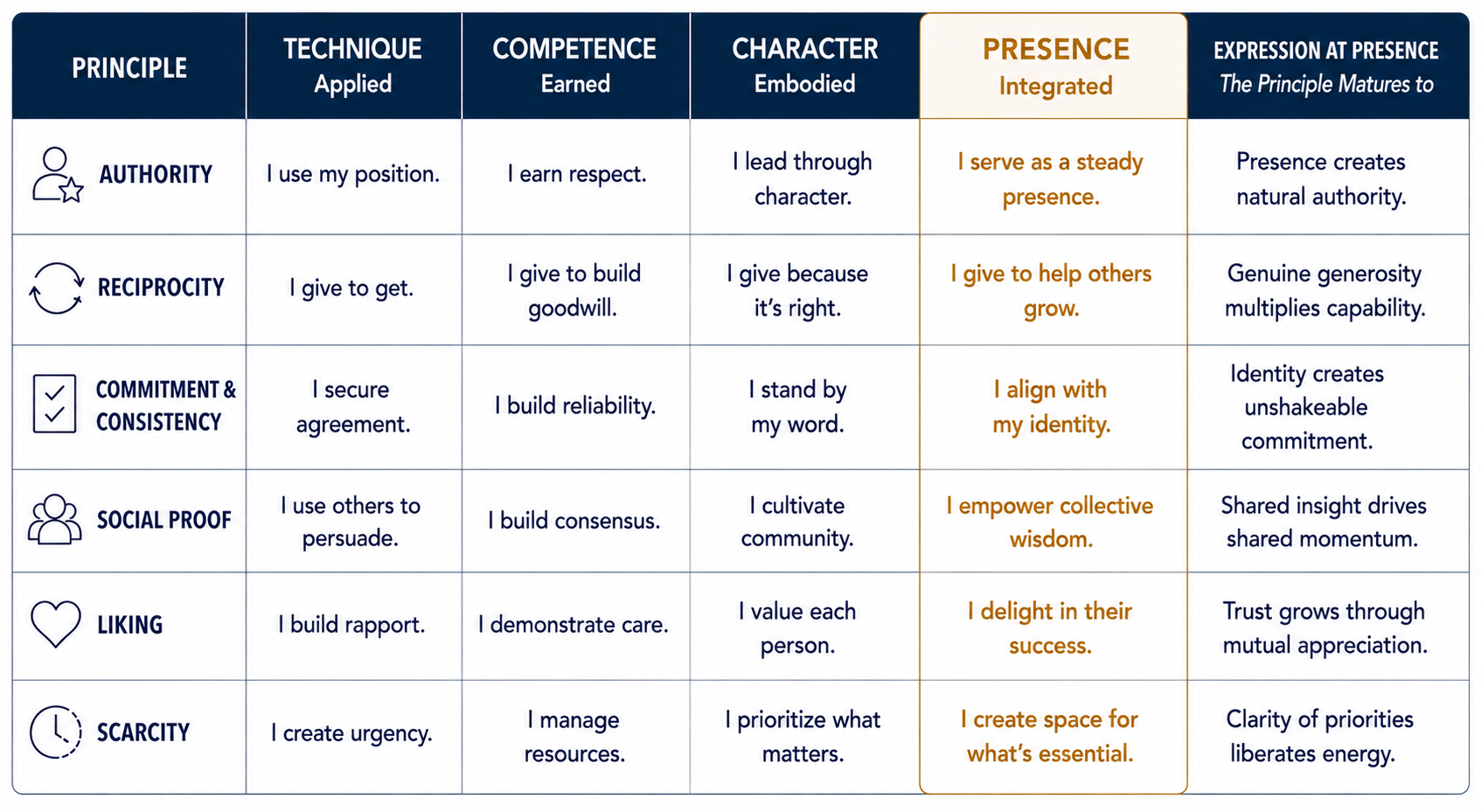
FIGURE 2 The Evolution Matrix. Read down any column and you see a coherent leader. Read across any row and you see that leader growing.
06 – Implications for Executive Leadership
One of the greatest challenges in executive development is that leaders receive advice before they receive orientation. Organizations recommend new competencies, communication strategies, and coaching models. These recommendations are frequently valuable. Yet they assume every leader begins from the same developmental place. They do not, and the advice each of them requires is therefore different.
Advice arrives late. Orientation has to come first.
In practice this means different work at different points on the Arc. Leaders centered in technique grow by building genuine expertise and replacing urgency with judgment. Leaders centered in competence grow by discovering that expertise persuades without bonding. Leaders centered in character grow through the interior disciplines of reflection and presence, learning to steady others by who they are in the room rather than by what they say. And leaders approaching integration grow by giving the whole thing away, developing successors, building culture, and becoming generative in the truest sense.
Three observations help in reading your own position honestly. Under pressure, leaders reliably regress one stage, so behavior in a crisis reveals the true center of gravity far more accurately than behavior at a strategy offsite. The stage you find most irritating in other leaders is often the one you have most recently left, and I have caught myself doing this often enough to trust it as a diagnostic. And the sequence cannot be shortcut, because presence reached for before competence has been built reads as performance, and organizations are unusually good at detecting it.
Leadership begins to feel less like performance, and more like presence.
07 – What Influence Becomes
Cialdini transformed the study of influence by explaining why people respond as they do, and his six principles remain among the most important contributions to modern behavioral science. The Arc begins where that work leaves off and asks a different question. How does the expression of those principles change as leaders mature?
The answer is simple and consequential. The principles remain constant; the leader evolves. Authority moves from position to presence and reciprocity from transaction to generosity. Commitment moves from image to identity, social proof from belonging to becoming a trusted reference point, liking from approval to trustworthiness, and scarcity from urgency to the stewardship of attention. Across every principle, influence follows the same path inward, and it is always the same four steps in the same order.
What This Asks of Us
This is not a modest claim, and it arrives at a consequential moment. The organizations we lead are being asked to absorb more change in a decade than most absorbed in a generation. A great deal of what we presently call expertise is being commoditized in front of us. Speed is being rewarded. And the executive whose single move has always been to press harder is finding that the move has stopped working.
In that environment, the half-life of technique keeps shortening. What holds its value is the set of things a model cannot supply and a program cannot install: steadiness that survives contact with a genuinely bad quarter, conviction that has already been tested against something it cost, and attention given fully to one person in a week that offered a hundred reasons to withhold it. These are not soft attributes. They are what remains once everything transferable has been transferred.
The executives who matter most in the coming decade will not be those who accumulate the most sophisticated tools. They will be the ones willing to undertake the harder and less visible work of becoming someone through whom trust, clarity, and generosity move naturally, leaders whose influence does not need to be exercised because it is simply, unmistakably there.
That work has no completion date. There is no summit on this Arc, no stage at which a leader may finally rest. There is only the next crossing, and the willingness to pay for it. But this is the invitation the moment extends: not to become more persuasive, but to become more complete, and to recognize that every executive who takes that path changes not only their own trajectory but the experience of every person who will ever work for them.
ON SCREEN Chariots of Fire (dir. Hugh Hudson, 1981; Enigma Productions)
Eric Liddell refuses to run his best Olympic event because the heat falls on a Sunday. The decision costs him the goal he trained for, and it is precisely the willingness to pay that makes his conviction credible. Commitment anchored in identity does not negotiate with convenience.
Executive reflection. What has my conviction cost me, and could anyone else name it?
The question is no longer how to become more influential. The question is who we must become.
Five Questions
Influence is the one leadership capability everyone believes they can read in themselves, and the one they read least accurately. Before turning the page, sit with the following for a few minutes.
— When people follow me, are they responding to my position, my competence, my character, or my presence?
— Do I create value primarily through action, expertise, relationship, or integration?
— Which principle of influence becomes hardest for me under pressure?
— Which stage of development described here irritates me most in other leaders?
— What would the next crossing cost me, and am I willing to pay it?
The answers reveal less about your leadership style than about where the Arc has stopped.
CONTINUE THE CONVERSATION
What is your influence made of?
Every executive occupies a particular position along the Arc. Some lead primarily through achievement and action, others through expertise and judgment, others through relationship and trust. A smaller number have begun integrating willing, thinking, feeling, and being into a coherent way of leading that inspires confidence almost on contact.
The challenge is that very few leaders accurately recognize their own developmental center of gravity, and influence is the last place they would think to look for it. It is far easier to audit a technique than to ask what the technique is made of.
My work focuses on helping executives answer that question. The Leadership Arc Assessment identifies a leader’s developmental coordinates, surfaces the assumptions that may be limiting further growth, and provides a practical roadmap for the next crossing.
The objective is not simply to become more influential. It is to become someone whose influence no longer needs to be exercised.
Because every meaningful journey begins by knowing where you are.
The next paper turns from how influence matures inside a leader to where the right to exercise it comes from in the first place. An organization can appoint an executive, and appointment is not the same thing as standing. The people around a leader grant legitimacy separately, in stages, on terms they rarely state aloud, and they can withdraw it without ever announcing that they have. That paper sets out those stages and what each one asks.
NOTE: Bibliography and references available upon request. The ideas, arguments, frameworks, and conceptual architecture presented in this paper are the original work of the author. Artificial intelligence was used as a collaborative writing and editorial tool to assist in drafting and refining the prose. All substantive judgments, interpretations, and conclusions are the author’s, who retains full responsibility for the final content.
© 2026 CaMiNa Consulting. All rights reserved.