
Why rebellion is so reliably mistaken for growth, and what separates authorship from opposition.

01 – Executive Summary
The first freedom is freedom from the expectations of others. The greater freedom is freedom from needing those expectations as the reference point for a life.
A man has achieved everything his culture taught him to pursue. A respected career. Financial security. An apartment furnished from a catalog, item by item, until it became a portrait of the kind of adult he was supposed to have become. By every external measure available to him he is succeeding, and he cannot sleep.
That is the opening condition of Fight Club, and the insomnia is a more precise diagnosis than it looks. His exhaustion is not physical. It is developmental. He has mastered the expectations of the world without locating an inner center from which to live, so his identity has been assembled entirely from outside: achievement, status, competence, approval. He performs a life that no longer feels like his own.
I encounter this condition constantly in executive work, and almost never in the form the executive expects. The presenting complaint is rarely a crisis of identity. It is fatigue that sleep does not touch, a promotion that produced no satisfaction, or the sense, hard to say out loud in a performance review, that the whole arrangement has become slightly unreal.
The person is not failing, which is exactly why it goes unaddressed for years. Organizations are built to detect underperformance. They have almost no instrument for detecting a leader who is succeeding on borrowed terms.
The first two papers in this series argued that executive development has reached the limits of the competency model, and that experience will teach every leader the same lessons regardless. The third established that none of it is usable until a leader knows where they are standing, and named the mechanism that keeps them from knowing.
The fourth took the resulting ceiling apart and found it built from a leader’s own successes, the fifth mapped it capacity by capacity, and the sixth described the nine patterns that raise it one reasonable defense at a time.
The sixth paper ended on a warning this one begins from. The Loop is not defeated by becoming its opposite. What follows the recognition of a pattern is very often not authorship but rebellion, and rebellion is the most convincing counterfeit development has.
The leader begins questioning authority, rejecting convention, speaking more directly, setting harder boundaries, and feeling anger that has been unavailable since childhood. To the leader, and to everyone watching, this feels like transformation. Sometimes it is exactly that. Sometimes it is only the first reaction against an identity that has become too small.
Rebellion creates distance from expectation. Development changes a leader’s relationship to expectation altogether.
Telling the two apart is the entire practical problem. This paper uses Fight Club as its running illustration, not because leaders resemble Tyler Durden, but because the film dramatizes the counterfeit more precisely than any case study I could construct.
This paper is the seventh in a series introducing the Leadership Arc.
ON SCREEN Fight Club — dir. David Fincher, 1999, from the novel by Chuck Palahniuk. Discussed here as commentary and criticism. The narrator moves through his condominium while the furniture assembles itself around him, each piece labeled with its name and price, an inventory of taste standing in for a person. When the apartment is later destroyed, what he grieves is not the loss of objects. It is the loss of the evidence that he existed.
Executive reflection. When I describe what I have built, how much of the description is inventory?
02 – What the Arc Asks Beyond Self-Authorship
Early development depends on external reference points, and properly so. We learn by imitating teachers, meeting expectations, and earning recognition, and nothing about this is pathological. The difficulty arrives when those structures become permanent, when leaders grow steadily more capable while remaining psychologically dependent on the world to tell them what they are worth. The person looks mature and remains internally organized by other people.
Robert Kegan named this transition more clearly than anyone. His movement from the Socialized Mind to the Self-Authoring Mind describes a person embedded in inherited systems of meaning, experiencing them as the structure of reality, who gradually becomes able to step outside them and author an internal system of values and judgment. What was subject becomes object.
The Arc calls that first position the Conditioned Mind. The structure is Kegan’s and the debt is his. The word is different because socialized suggests a process a family or a culture performed well or badly, while what leaders actually meet is narrower and more useful: a set of conditions they did not choose, cannot see, and are still being run by. I use Kegan’s term when the argument is his and the Arc’s term when it is mine. They name the same thing.
Where the Arc departs from Kegan is in what it asks of the crossing. Kegan’s question is largely epistemological: can a person construct and regulate their own system of meaning? Feeling, the third capacity and the energy of connection, asks something harder.
Can they remain emotionally present inside that system, stay in relationship without surrendering authorship, exercise authority without using authority to defend the self? A leader can build an internal philosophy and remain thoroughly defended, hold strong values and remain reactive, exercise independent judgment and remain incapable of intimacy.
Self-authorship without emotional integration does not stay self-authorship. It becomes ideology with a person attached.
The word Feeling should not be misread as sentiment or the abandonment of rigor. It names the emergence of an intrinsic center through which a leader can interpret and author a life from within. It is not the soft addition to self-authorship. It is what keeps self-authorship from hardening.
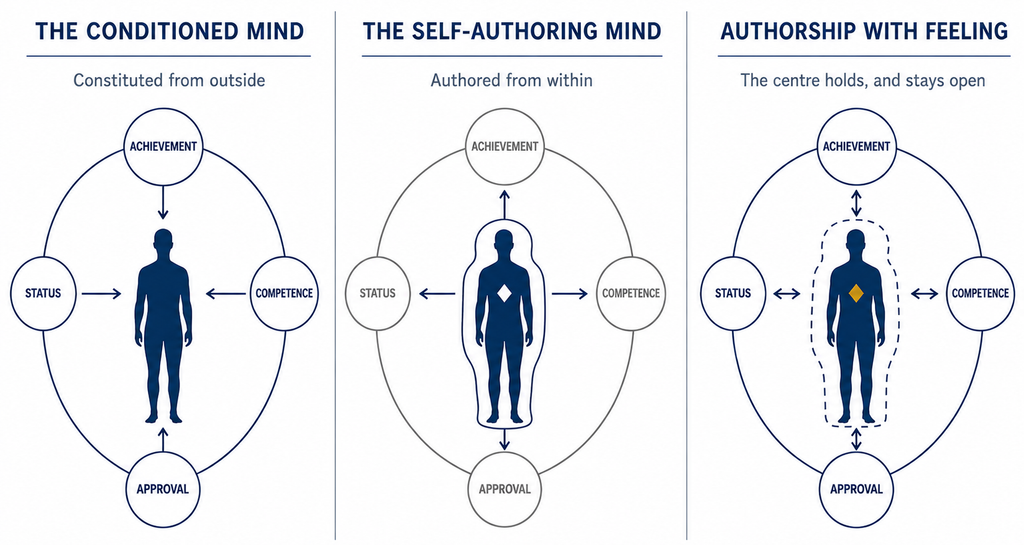
FIGURE 1 The Evolution of Identity. Identity begins shaped by external expectations, then relocates to an intrinsic center; Feeling is what keeps that center open rather than closed.
03 – The Conditioned Mind in Reverse
Kegan’s Socialized Mind is not simply obedient. It is externally constituted. The narrator at the opening of the film is nearly a textbook illustration. His work tells him who he is, his possessions tell him what kind of adult he has become, his competence tells him whether he has value, and his conformity tells him whether he belongs. He is not choosing these sources of identity. He is living inside them, unable to examine the system through which he makes meaning because he is contained by it.
Tyler Durden appears to change that. He sees the system, names it, and rejects it, and he can observe consumer identity rather than merely inhabit it, which is a genuine developmental movement. But seeing through a system is not the same as being free of it. Tyler remains dependent on it as the negative reference point through which his identity is maintained, and his worldview can be stated almost entirely through negation. He knows with great clarity what he rejects and is far less clear about what he positively serves.
The original identity says I am what the system values. The oppositional identity says I am what the system rejects. Both continue to derive meaning from the system. The polarity flips and the dependency remains.
In the Arc this is counterdependence, and it deserves more respect than it usually receives. The person who once needed approval starts refusing it. The employee who complied becomes reflexively resistant. The stage restores agency, returns disowned anger, and is often the first evidence that a previously excluded self is emerging.
But counterdependence is still relationally governed. The person still needs the other; they simply need the other cast as adversary. That is Tyler’s structure exactly: he requires institutions to attack, followers to awaken, and norms to violate. The enemy gives his identity its shape. A genuinely self-authoring person can oppose a system without requiring opposition as the source of selfhood. Tyler cannot. His rebellion is not one expression of identity. It is the identity, which is why it has to escalate.
DEVELOPMENTAL MOVEMENT Compliance ▸ Counterdependence ▸ Authorship ▸ Stewardship
Readers of the sixth paper will recognize the shape. What the film dramatizes is an expansion-direction Loop organized around Worth, the pattern that answers a threat to significance by enlarging force and reach. Tyler is not an exception to the Nine Loops. He is one of them, filmed beautifully.
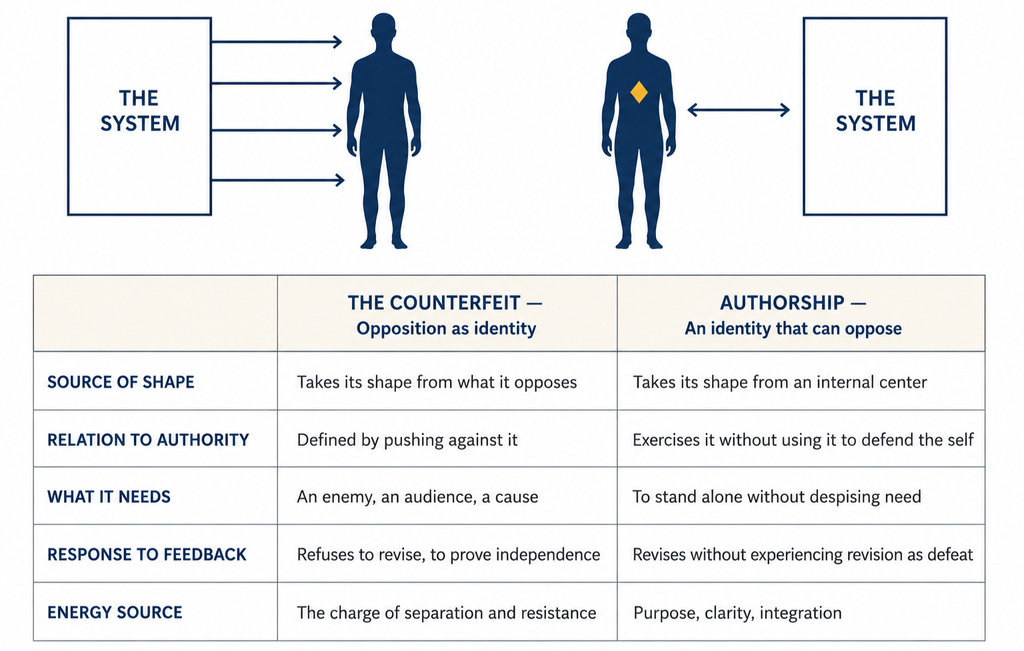
FIGURE 2 The counterfeit and the real thing. Rebellion and authorship can look alike from outside; only one has stopped taking its shape from what it opposes.
04 – The Leader Who Becomes the System
The Self-Authoring Mind does more than hold strong beliefs. It can create and regulate a system of beliefs, weighing competing values and revising the framework when experience demands it. Tyler has a philosophy. What it cannot do is examine itself. Authority is corrupt unless it is his; individuality is sacred until his followers are asked to surrender theirs. Coherence without reflexivity.
This matters far beyond the film, because self-authorship without self-examination hardens into ideology. The leader stops borrowing meaning from the institution and becomes the institution. A personal worldview turns into the unquestioned frame through which everyone else is required to interpret reality. That is not mature authorship. It is the replacement of an external authority with an internal one that has never learned to question itself.
The leader has ceased being subject to the original system. Everyone else has become subject to the leader.
The pattern is clearest in founders. A founder begins by seeing what the existing system cannot see, and the early organization needs that intensity. Then it grows and the demand changes. The founder has to move from being the source of all energy to being the steward of a system, and the company has to become something other than an extension of one person.
A founder who cannot make that shift goes on defining themselves as the rebel long after becoming the central authority. Challenge is welcomed when aimed at the industry and punished when aimed at the founder. The movement that promised authorship becomes another Conditioned Mind, organized this time around a person rather than an institution.
Fight Club begins as liberation from social identity and ends as a system of total identity, and the man who promised freedom builds a structure more conformist than the world he set out to oppose. Tyler changed who controls the system. He never transformed the emotional use of control.
THE PRICE OF THE CROSSING To move from opposition into authorship, a leader loses the enemy. Opposition supplies extraordinary clarity: what to do next, who is with you, what your anger is for. Authorship supplies none of that. Many leaders stall here, not because the crossing is beyond them, but because the first months on the other side feel like a loss of force.
Mature autonomy is often misread as radical independence. It requires differentiation, the capacity to remain oneself while remaining in relationship. Tyler can reject relationship and cannot sustain differentiation inside it. Need feels dangerous and mutuality like a threat to control, so he can create followers but not partners, loyalty but not intimacy. His relationship to fear is similarly less free than it appears. He accepts pain and pushes others past ordinary limits, but cannot tolerate fear as an internal experience, and a person who must continually prove fearlessness is still being governed by fear.
The belonging Fight Club creates answers a real hunger and is not developmentally mature, because it requires submission. Members enter by accepting Tyler’s frame, and the group’s meaning is inherited from the charismatic authority at the center rather than co-created. The apartment becomes the abandoned house, the suit becomes the uniform, the catalog becomes the rulebook. The narrator has not learned to live without a prescribed identity. He has traded one prescription for another.
05 – What the System Carries for You
The film’s most important developmental moment happens well before the buildings fall, when the narrator understands that Tyler is not another man but a part of himself he has been unable to own. Tyler carries everything he cannot consciously claim: strength, aggression, courage, defiance. Because Tyler carries them, the narrator gets to keep a different identity. The reasonable man. The innocent party. Nobody becomes whole while treating essential parts of themselves as though they belonged to someone else.
Leadership development requires a comparable loss of innocence, and most of it never gets there. The leader begins by locating the problem outside the self: the difficult culture, the resistant team, the political board, the broken process. Those diagnoses are frequently accurate and rarely complete.
At some point the question has to turn. How am I participating in the reality I am criticizing? What am I calling strategy that is also fear, anger, or control? What stays outside awareness can only be suffered; what becomes owned can be worked. Agency and innocence are not available at the same time.
Leaders rarely produce a literal Tyler Durden. They routinely produce an organizational equivalent. A leader who cannot acknowledge fear generates urgency in every direction. One who disowns aggression builds a culture in which somebody else always delivers the threat. An executive who experiences herself as thoroughly collaborative may rely on a loyal lieutenant to punish dissent on her behalf, and be surprised to hear it described that way.
What leaders cannot hold, the organization holds on their behalf, and it is usually the first thing a new hire notices and the last thing the leader hears about.
This is why development cannot be reduced to technique. A leader can learn to communicate more clearly and go on using communication to control, or adopt the vocabulary of vulnerability while still expecting the room to provide reassurance. The method changes and the structure survives it intact.
What remains subject to the leader keeps organizing experience from the inside and cannot be examined, because they are still inside it. The need to be right. The conviction that disagreement is disloyalty. None of these present themselves as interpretations; they present themselves as reality. Development is the moment they can be taken as object.
ON SCREEN Fight Club
The recognition arrives not as revelation but as accounting. The narrator retraces his own movements through cities he does not remember visiting and finds his signature on work he does not remember doing. He is implicated in the movement, the loyalty, the violence, and the destruction. There is no one else to hold responsible.
Executive reflection. Of the problem I most often describe as external, what share of it is actually mine?
06 – The Capacities Return Without Proportion
The narrator first tries to stop Tyler as though Tyler were an external enemy, which cannot work, because Tyler is generated by opposition in the first place. This is a common misunderstanding of development. Leaders try to eliminate whatever part of the self feels unacceptable: fear must go, anger must be controlled, ambition renounced. But what gets rejected does not stop existing. It becomes less conscious and usually more powerful.
The task is not elimination but integration, the capacity to hold competing material inside a larger order: courage and fear, ambition and humility. The mature self is not the triumph of one side but the ability to contain both. Which is why the narrator does not need to destroy what Tyler represents. He needs to reclaim it. Tyler carries capacities he genuinely lacks: the ability to refuse, the tolerance for conflict, the courage to act without permission. He is not pathological but compensatory.
The difficulty is that the capacities return without proportion. Anger returns as violence, courage as recklessness, boundary as contempt, independence as emotional cutoff. This is one of the most reliable patterns in executive work and one of the easiest to misread as regression.
The accommodating executive discovers assertiveness and is briefly harsh with everyone. The leader who spent a career seeking approval begins dismissing feedback on principle. Colleagues conclude that something has gone wrong. Often something has finally gone right, in a form nobody can yet use. The task is to keep the new energy without letting it become the entire identity, which is precisely the work Tyler never completes.
DEVELOPMENTAL MOVEMENT Suppressed ▸ Split off ▸ Returned without proportion▸ Integrated
One honest caveat about the illustration. Fight Club is a film about masculinity, and the counterfeit it portrays is a specifically male one: force, contempt, and physical ordeal standing in for interiority. The developmental structure generalizes. The presentation does not. In my assessment work the women crossing this same threshold rarely present as Tyler. They present as suddenly, unnervingly quiet, and when they do express the recovered anger directly it is read as instability rather than awakening, which means the unintegrated phase costs them considerably more than it costs their male peers. The pattern is the same. The permission is not.
Marla Singer is easy to read as a subplot and is closer to the developmental center of the film than Tyler is. She represents everything Tyler cannot integrate: need, mutuality, contradiction, emotional exposure. She cannot be absorbed into his ideology because she remains irreducibly human, neither follower nor enemy. At the end the narrator reaches for her hand, a gesture easily lost against the spectacle outside the window and developmentally the most significant act in the film.
So the real developmental tests are relational, and worth more than any self-report instrument. Can the leader stay connected to someone who disagrees? Revise a judgment without losing coherence? Receive a colleague’s success without feeling diminished? Tyler’s philosophy cannot survive any of them, because it requires hierarchy to stay coherent.
07 – What Authorship Actually Requires
If Tyler represents the counterfeit, the real thing begins where opposition loses its organizing power. The leader no longer needs the external world either to confirm identity or to supply something against which identity can be formed. It starts with the relocation of authority. The difficulty at earlier stages is that the external structure becomes inseparable from identity: leaders no longer simply want recognition, they need it to feel substantial. Praise expands the self and criticism contracts it, and a leader can appear formidable while governed by the reactions of the room.
Inner authority is not indifference. It is the ability to stay in relationship with feedback without being governed by it. A compliant leader changes position to preserve approval. A rebellious leader refuses to, in order to prove independence. An authoring leader can listen, reconsider, and revise without experiencing revision as defeat.
That requires reflexivity, which Tyler conspicuously lacks. He can critique the world but not his own critique. An authoring leader can observe a reaction rather than enact it, and ask which assumption is being treated as fact and what they may be unwilling to see. The need for approval and the anger triggered by disagreement do not disappear. They become visible, and once visible they become workable.
And it requires emotional integration, which is where the Arc asks more than cognitive self-authorship alone. In practice this means fear no longer has to become urgency, shame no longer has to become perfectionism, and threat no longer has to become a reorganization announced on a Friday. Emotion becomes no less consequential, only more conscious. Tyler turns every emotion into movement. The authoring leader creates a pause, and inside that pause emotion becomes information rather than command.
The same shift changes what authenticity and power mean. Tyler represents authenticity as uninhibited expression, which is compelling beside the narrator’s numbness, but authenticity is coherence between experience, awareness, values, and action, not the public broadcast of every internal state. Bluntness that avoids vulnerability is not honesty; it is a defense with good public relations.
Authority is the same question in another form, because it so often protects the leader from dependence and shame. The authoring leader begins separating authority from self-worth, and it shows in ordinary decisions: delegating without feeling diminished, sharing credit without disappearing, making an unpopular call without converting opposition into betrayal. The question changes from what will protect me to what the system requires beyond my preference.
THE PRICE OF THE CROSSING The last price is the audience. Counterfeit development is watchable. It produces energy, loyalty, and a story other people want to tell about you. The genuine article produces better decisions and worse anecdotes. Leaders crossing this threshold routinely report that the work became more effective and they became less interesting. That disappointment is a leading indicator, not a warning.
08 – The Leader Who No Longer Needs Tyler
The film sees clearly that competence can coexist with emptiness and that the excluded parts of a person return with force. What it sees is the necessity of rupture. What it does not see is what has to follow.
Tyler believes freedom requires the destruction of dependence, structure, and social identity. But a self without relationship does not become free, it becomes isolated. A self without accountability does not become authentic, it becomes dangerous. His deepest failure is one of discernment: he cannot distinguish oppressive structure from necessary form, so he destroys both. Some limits are prisons and others are boundaries. Telling these apart is most of the job.
The mature leader is not weaker than Tyler or less willing to challenge the world, only less divided, able to use force without worshipping force, challenge convention without requiring the identity of the rebel, and stand alone without despising need. Everything Tyler represents has been reclaimed, and now sits inside a larger structure that also contains humility and proportion.
This is a substantial achievement and still not the end of the Arc. Crossing the Inflection Fence is what makes authorship available in the first place; it places the self at the center, which is necessary, because leaders have to build a center before they can loosen their attachment to being the center. What follows is a further movement, well above the Fence, in which the leader becomes less occupied with constructing an identity and more capable of becoming available to what the work, the relationship, or the larger purpose actually requires. Leadership shifts from authorship toward presence.
Tyler cannot come near that crossing. He has constructed a self he cannot step outside. Which returns us to the ending: the escape does not occur when the buildings collapse, but earlier, when the narrator can no longer place Tyler outside himself.
Tyler was right about the prison. He was wrong about the escape. The prison was every identity inherited without examining. The escape was authorship, and authorship, to become mature, had to become integration.
Five Questions
Stop asking what you have rejected and ask what you are now organized by. Before turning the page, sit with the following for a few minutes.
— If what I am fighting disappeared tomorrow, how much of me would go with it?
— Can I state what I am for as clearly as what I am against?
— What is my organization carrying that I cannot hold myself?
— When did I last revise a judgment without feeling defeated by it?
— Who makes claims on me that I cannot control?
The answers reveal less about how far you have come than about what still supplies the reference point.
CONTINUE THE CONVERSATION
What are you organized by?
Most leaders arrive at this threshold without a name for it. They know only that the identity that carried them for twenty years has stopped fitting, and that the first thing to return is usually anger. Whether that energy becomes authorship or hardens into opposition is not a matter of character. It is a matter of whether anyone helps them read the moment correctly.
That is the difficulty. We are poor judges of our own development, and the counterfeit is far more convincing from the inside than from anywhere else.
CaMiNa Consulting works with executives and leadership teams at exactly this crossing, through individual coaching, developmental assessment, and team engagements built on the Leadership Arc.
The objective is not simply to become free of what held you. It is to become the author of what comes next.
Because every meaningful journey begins by knowing where you are.
The next paper in this series turns from what a leader must become to what a leader is finally for. Early on, the value is in having the answer. Beyond a certain complexity no one holds enough of the picture to produce it, and the leader’s contribution becomes the question the organization could not have reached alone. That paper examines why better questions emerge in conversation, and why the last thing a leader needs to add is another answer.
NOTE: Bibliography and references available upon request. The ideas, arguments, frameworks, and conceptual architecture presented in this paper are the original work of the author. Artificial intelligence was used as a collaborative writing and editorial tool to assist in drafting and refining the prose. All substantive judgments, interpretations, and conclusions are the author’s, who retains full responsibility for the final content.
© 2026 CaMiNa Consulting. All rights reserved.